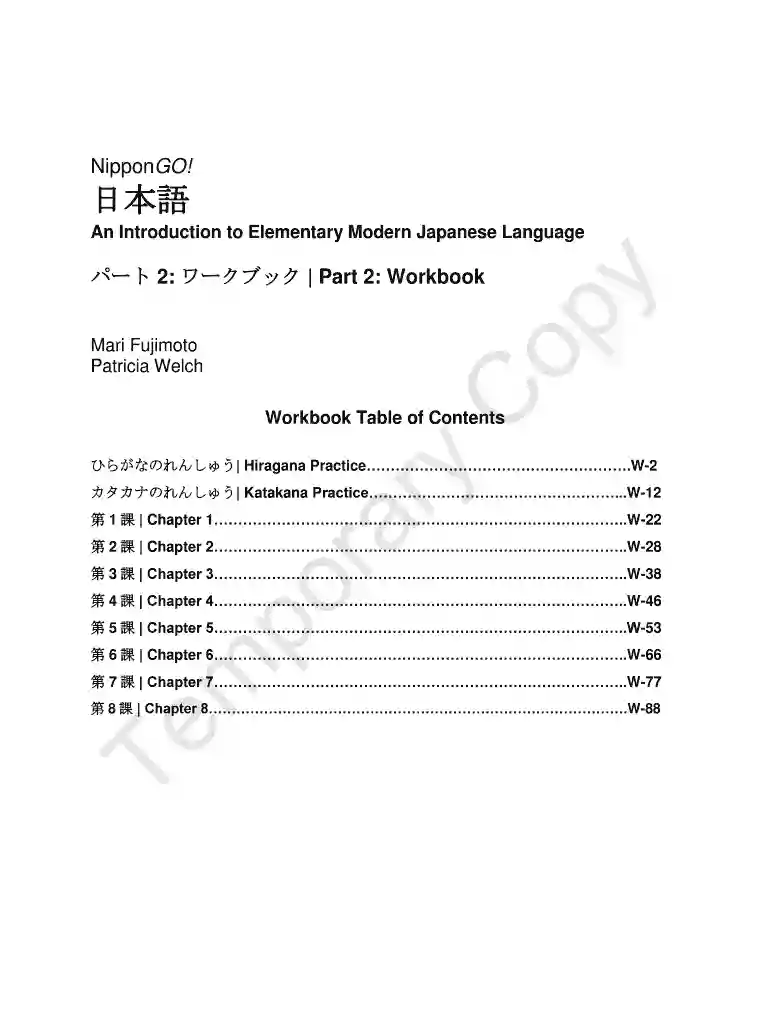
An Introduction to Elementary Modern Japanese Language 2026

Get Form
An Introduction to Elementary Modern Japanese Language Preview on Page 1

Here's how it works

01. Edit your form online
Type text, add images, blackout confidential details, add comments, highlights and more.

02. Sign it in a few clicks
Draw your signature, type it, upload its image, or use your mobile device as a signature pad.

03. Share your form with others
Send it via email, link, or fax. You can also download it, export it or print it out.

Definition & Meaning

The term "An Introduction to Elementary Modern Japanese Language" typically refers to a foundational course designed to teach beginners the basic linguistic elements of the Japanese language. This encompasses an understanding of its writing systems—Hiragana, Katakana, and an introduction to Kanji—along with basic vocabulary, sentence structures, and essential grammar. The emphasis is often placed on achieving a functional level of communication in everyday scenarios by introducing conversational phrases and common expressions.

Purpose of Elementary Japanese Language Courses

  • Educational Foundation: Provides essential knowledge to build upon with more advanced language skills.
  • Cultural Insight: Educates learners about cultural nuances and etiquette associated with language use.
  • Skill Development: Focuses on developing writing, listening, and speaking skills.

How to Use the An Introduction to Elementary Modern Japanese Language

Utilizing a course or workbook like "An Introduction to Elementary Modern Japanese Language" involves a structured approach to ensure comprehensive learning.

Effective Learning Strategies

  1. Consistent Practice: Engage with the material regularly to reinforce learning and develop muscle memory, particularly with character writing.
  2. Integrated Practice: Combine writing and reading exercises with listening and speaking activities to enhance overall language proficiency.
  3. Utilization of Supplements: Use additional resources such as flashcards, language apps, and audio-visual materials to reinforce learning.

Practical Application

  • Daily Life Contexts: Apply newly learned words and phrases in everyday settings, such as ordering food or asking for directions.
  • Interactive Exercises: Engage with language games or join conversation groups to practice speaking.

Steps to Complete the An Introduction to Elementary Modern Japanese Language

Completing a beginner course in modern Japanese usually involves a sequence of progressive steps that build upon each other for thorough understanding.

Sequential Learning Path

  1. Begin with Hiragana and Katakana: Start with mastering the basic scripts before introducing Kanji characters.
  2. Understand Basic Grammar: Focus on sentence structures, verb conjugations, and common particles.
  3. Expand Vocabulary: Incorporate commonly used nouns, verbs, and adjectives into practice.
  4. Engage in Dialogues: Practice simple conversations to enhance speaking and listening skills.

Additional Learning Tips

  • Deliberate Practice: Allocate time to review and refine pronunciation and writing.
  • Peer Learning: Collaborate with fellow learners to exchange knowledge and practice conversational skills.

Why You Should Study Elementary Modern Japanese Language

Understanding elementary Japanese offers a multitude of benefits beyond mere linguistic ability. It enriches cultural understanding and opens up diverse opportunities for personal and professional growth.

Key Benefits

  • Cross-Cultural Engagement: Gain deeper insights into Japanese culture, which can enhance travel experiences and foster better international relations.
  • Professional Opportunities: Knowing Japanese can be an asset in various industries such as business, tourism, and technology.
  • Cognitive Benefits: Learning a new language improves memory, problem-solving skills, and cognitive flexibility.

Practical Outcomes

  • Personal Satisfaction: Achieve the rewarding feeling of being able to communicate in a new language.
  • Networking: Enhance social interactions within communities or at events related to Japanese culture.

Key Elements of the An Introduction to Elementary Modern Japanese Language

A comprehensive introduction to elementary modern Japanese typically includes several critical components essential for foundational language acquisition.

Core Components

  • Character Learning: Focus on Hiragana and Katakana, progressing to introductory Kanji.
  • Basic Vocabulary: Compile a list of fundamental words and phrases necessary for simple conversations.
  • Grammar Basics: Introduce sentence structures and grammatical rules essential for coherent communication.

Learning Extensions

  • Cultural Lessons: Incorporate lessons on cultural norms, traditions, and socio-linguistic aspects.
  • Assessment Tools: Use quizzes and exercises for self-evaluation to track progress.

Examples of Using the An Introduction to Elementary Modern Japanese Language

Applying elementary Japanese language skills in real-world scenarios demonstrates the course's practical application and value.

Real-World Applications

  • Travel: Navigate through Japan by conversing in hotels, restaurants, and tourist destinations.
  • Social Media: Engage with Japanese content online to enhance learning through context.
  • Educational Pursuits: Use Japanese to access educational materials and resources that are unavailable in other languages.

Case Studies

  • Travelers: Achieved ease of travel by utilizing basic conversational Japanese.
  • Students: Applied beginner-level Japanese to understand Manga or Anime without subtitles.

Digital vs. Paper Version

When choosing between digital and paper versions of language learning materials, it's important to consider various factors influencing learning effectiveness.

Comparative Analysis

  • Digital Version: Provides interactive features, instant feedback, and accessibility through multiple devices.

    • Benefits: Easily updated, includes interactive exercises.
    • Considerations: Requires internet connection; screen fatigue is possible.
  • Paper Version: Offers a tactile learning experience, which some learners find beneficial for memory retention.

    • Benefits: Reduces screen time, flexible for annotations.
    • Considerations: Static content; not easily updated.

Personal Preferences

  • Learners should assess individual preferences and study habits when selecting between digital and paper formats.

Software Compatibility

It's essential to know the software compatibility when engaging with digital course materials for learning Japanese.

Compatible Software and Tools

  • Language Learning Apps: Utilize apps designed specifically for learning Japanese characters and vocabulary.
  • Online Platforms: Engage with software platforms that offer structured course experiences and track progress.

Compatibility Considerations

  • Ensure that digital materials are compatible with devices you frequently use, ensuring a smooth and interactive learning experience.

Language learners often benefit from employing tools that reinforce comprehension, such as integrating DocHub for annotating readings and completing digital exercises in conjunction with language apps.

be ready to get more

Complete this form in 5 minutes or less

Get form

Got questions?

We have answers to the most popular questions from our customers. If you can't find an answer to your question, please contact us.
Contact us
Im a student. よろしくお願いします。 Yoroshiku onegai-shimasu.
0:00 0:59 Name then we have the topic particle. Then you give your name followed by the final. Or thisMoreName then we have the topic particle. Then you give your name followed by the final. Or this literally its me of name.
Old and Middle Japanese are the pre-modern periods of the attested history of the Japanese language. Old Japanese (OJ) is largely the language of the 8th century, with a modest, but still docHub number of written sources, most of which is poetry.
Heres how to introduce yourself in Japanese by saying the following phrases in both settings: Stating Your Name (Using Watashi wa or 私 は) Where Youre From. Occupation. School. Hobbies. Formal. Informal (Yoroshiku onegaishimasu or よろしく お願い し ます) Dont Talk About Yourself Too Much.
Heres a simple structure you can follow: Greeting: - 皆さん、こんにちは. (Minasan, konnichiwa.) -- ``Hello everyone. Self-Introduction: - 私の名前は(Your Name)です. (Watashi no namae wa (Your Name) desu.) -- ``My name is (Your Name). - (Your Position/Role)として働いています. ( (Your Position/Role) to hataraiteimasu.)

Security and compliance

At DocHub, your data security is our priority. We follow HIPAA, SOC2, GDPR, and other standards, so you can work on your documents with confidence.
Learn more
ccpa2
pci-dss
gdpr-compliance
hipaa
soc-compliance
be ready to get more

Complete this form in 5 minutes or less

Get form

People also ask

FAQs こんにちは (Konnichiwa) - Hello. ありがとう (Arigatou) - Thank you. すみません (Sumimasen) - Excuse me / I am sorry. はい (Hai) - Yes. いいえ (Iie) - No. おはようございます (Ohayou gozaimasu) - Good morning. こんばんは (Konbanwa) - Good evening. さようなら (Sayonara) - Goodbye.
Here are the top 3 languages most widely spoken by different communities across Japan: Standard Japanese (Nihongo) As the official language of the country, Japanese is used in daily communication, education, and business. Ryukyuan languages (Ryūkyū-goha) Ainu lanaguage.
Basic Self-Introduction in Japanese [hazimemashite] This phrase is used to greet someone you meet for the first time. [watashino namaewa tanaka mikikodes] [mikito yonde kudasai] [amerikakara kimashita] [watashiwa gakuseides] [watashiwa dezaina:des] [yoroshiku onegai shimas] [onamaewa nandeska]

Related links