01. Edit your form online
Type text, add images, blackout confidential details, add comments, highlights and more.

Type text, add images, blackout confidential details, add comments, highlights and more.

Draw your signature, type it, upload its image, or use your mobile device as a signature pad.

Send it via email, link, or fax. You can also download it, export it or print it out.
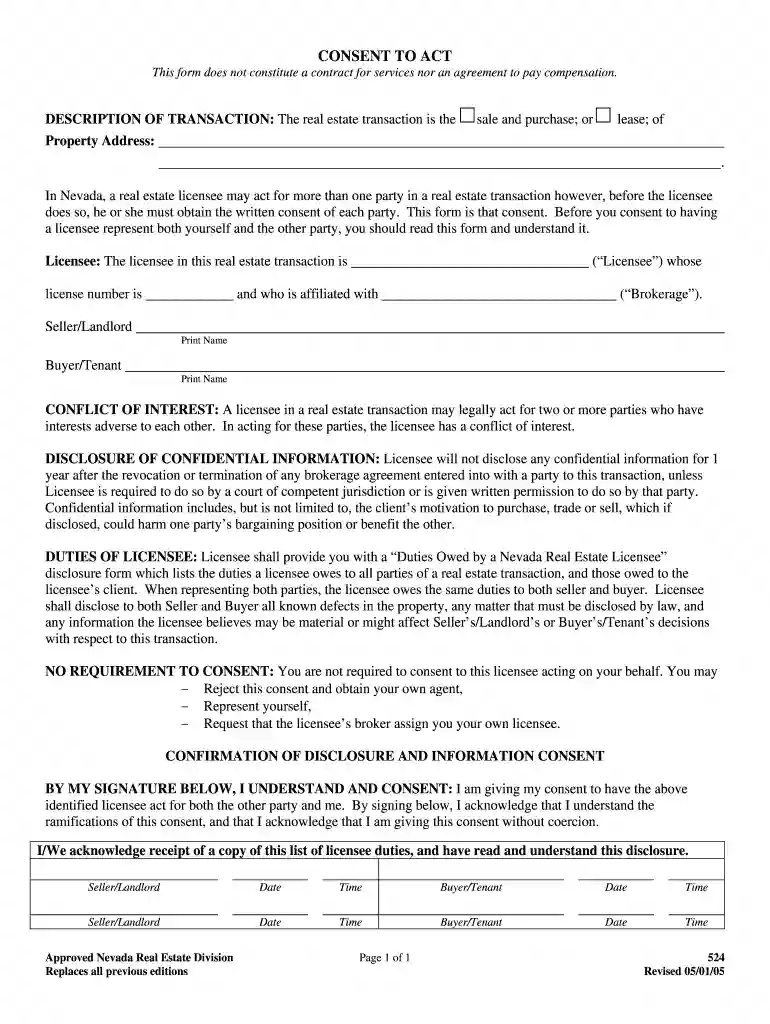
The "524-COMP Consent to Act" is a legal form used in real estate transactions, specifically in Nevada, allowing a real estate licensee to represent both the seller and buyer or landlord and tenant in the same transaction. This type of consent form outlines the transactional nature and highlights any potential conflicts of interest, ensuring all parties are aware of their rights and responsibilities.
The form is crucial in maintaining transparency between parties, ensuring that the dual representation does not infringe upon confidentiality obligations or compromise the duties owed by the licensee to both parties. Consent is optional, providing stakeholders with the choice to opt-out if they are uncomfortable with dual representation.
Understanding the primary components of this form is essential for effective usage. The "524-COMP Consent to Act" includes several critical elements:
Transaction Details: Outlines the specifics of the real estate transaction, including the identities of the parties involved and the nature of the property.
Dual Representation Agreement: Details the licensee's intention to represent both parties, highlighting the potential benefits and drawbacks of such an arrangement.
Conflict of Interest: Explains the potential for conflicts and provides measures on how such conflicts will be managed to protect all parties involved.
Confidentiality Provisions: Ensures that the confidentiality of each party's information is maintained, even when the same licensee represents both sides.
Recognition of Consent: Explicitly states that signing the form is not mandatory, allowing parties to choose representation options that best suit their interests.
Successfully filling out the "524-COMP Consent to Act" involves several steps:
Review Transaction Details: Begin by verifying the details outlined in the form are accurate and complete.
Understand the Implications of Dual Representation: Consider the potential conflicts and weigh the advantages and disadvantages of having a single licensee represent both parties.
Fill in Required Sections: Complete all necessary fields, ensuring the information provided is truthful and up-to-date.
Consent or Opt-Out: Decide whether to consent to the dual representation or not. If proceeding, sign in the allocated section.
Ensure All Parties Sign: Both the buyer and the seller, or the landlord and tenant, should review and sign the form to validate mutual understanding and agreement.
File the Document Appropriately: Store a copy of the signed form in your records and provide a copy to all involved parties for transparency.
Using this consent form has several benefits:
Clarity and Transparency: Ensures all parties understand the relationship dynamics between them and the licensee.
Legal Protection: Provides a solid legal foundation for dual representation, offering protection against potential allegations of misconduct.
Informed Decision-Making: Enables parties to make informed decisions about their representation options, knowing their rights and the risks involved.
Streamlined Transactions: By allowing a single licensee to handle communications, it can expedite negotiations and streamline the transaction process.
Legally, the form serves as a protective measure for all parties involved by:
Compliance with the "524-COMP Consent to Act" safeguards licensees from ethical violations while preserving the legal rights of each party.
This form is primarily used by:


Key terms to understand include:
In Nevada, specific rules govern the use of this form:
Adhering to state-specific guidelines is critical to ensure the form's validity and effectiveness.
We've got more versions of the 524-COMP Consent to Act form. Select the right 524-COMP Consent to Act version from the list and start editing it straight away!
| Versions | Form popularity | Fillable & printable |
|---|---|---|
| 2005 | 4.8 Satisfied (169 Votes) |
At DocHub, your data security is our priority. We follow HIPAA, SOC2, GDPR, and other standards, so you can work on your documents with confidence.