






Definition and Meaning
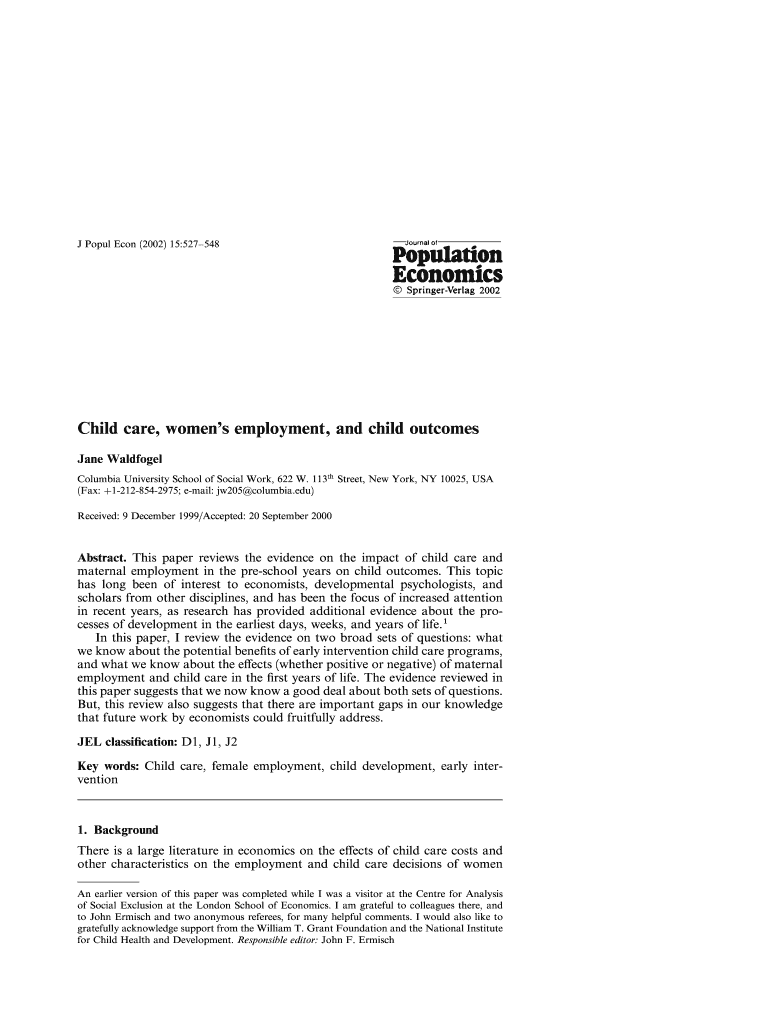
The form related to "Child care, womens employment, and child outcomes" concerns itself with the complex interplay between child care solutions, the employment patterns of women, and the developmental outcomes for children. It is fundamentally aimed at assessing how these elements impact one another, providing insights into policy formation and educational strategies. The document emphasizes the importance of understanding how child care and women's employment influence the cognitive and socioemotional development of children.
Key Elements of Child Care, Women's Employment, and Child Outcomes
This form encompasses several critical components that must be highlighted to grasp its full intent:
- Child Care Programs: The quality, availability, and type of child care programs available to families.
- Maternal Employment: Patterns of employment among mothers, including part-time, full-time, and flexible work arrangements.
- Child Outcomes: Assessment of cognitive, emotional, and social development in children, influenced by the availability of child care and maternal employment.
- Research Gaps: Areas that still require comprehensive studies to provide a better understanding of the dynamics involved.
Steps to Complete the Form
Completing this document involves several key steps to ensure thoroughness and accuracy:
- Gather Data on Child Care: Collect detailed information regarding the type, location, and availability of child care services.
- Detail Maternal Employment: Provide data on employment status and conditions for mothers involved in the study.
- Assess Child Development: Use standardized metrics to measure child outcomes in cognitive and socioemotional areas.
- Identify Research Gaps: Note any areas that lack data or require further exploration.
- Compile Findings: Organize the collected data into an understandable and coherent format.
Who Typically Uses the Form
This form is primarily utilized by:
- Policy Makers and Analysts: To create informed policies that support child care services and employment solutions for women.
- Educational Institutions: For developing curriculums and support systems that aid child development.
- Researchers and Academics: As a basis for studies and papers focusing on the intersection of childcare, employment, and developmental outcomes.


Important Terms Related to Child Care, Women's Employment, and Child Outcomes
Understanding specific terminology is crucial for the proper context of this form:
- Cognitive Development: Refers to how a child learns, thinks, and problem-solves.
- Socioemotional Development: Pertains to a child's ability to interact socially and manage emotions.
- Flexible Work Arrangements: Includes job sharing, telecommuting, and adjustable working hours.
Legal Use of the Form
The document fulfills a legal role in guiding the development and implementation of child care and employment policies. It must comply with relevant child protection and labor laws to ensure ethical use of the information collected. Researchers must adhere to data protection regulations to safeguard personal data.
State-Specific Rules
Regulations regarding child care and employment can vary significantly by state. Therefore, it's essential to:
- Consult State Guidelines: Examine individual state requirements for child care centers and labor laws.
- Adapt Materials and Processes: Align the form's content with specific state laws to ensure compliance.
Examples of Using the Form
Real-world scenarios illustrate the form's utility:
- Policy Development: A state government utilized data from the form to establish grants for working mothers to access high-quality child care.
- Academic Research: Researchers employed data from this form to publish a study on the correlation between maternal employment and child literacy rates.
State-by-State Differences
States may have differing standards and support structures for child care and women's employment:
- Subsidies and Financial Aid: Varies in scope and application process between states.
- Regulatory Environment: Licensing requirements for child care providers differ state by state.
- Employment Policies: State policies on parental leave and flexible work conditions can affect how the form is applied and interpreted.
Required Documents
To effectively complete and submit the form, the following documents may be necessary:
- Child Care Provider Contracts: Agreements that outline the terms and conditions of child care services.
- Employment Records: Documentation of hours worked, roles, and employment status for mothers involved in the form.
- Developmental Assessments: Reports measuring various aspects of child outcomes.
Providing maximum content coverage for this form ensures that all significant aspects, nuances, and regulatory requirements are met, helping facilitate informed decision-making and policy development in the area of child care, women's employment, and child outcomes.