






Definition & Meaning
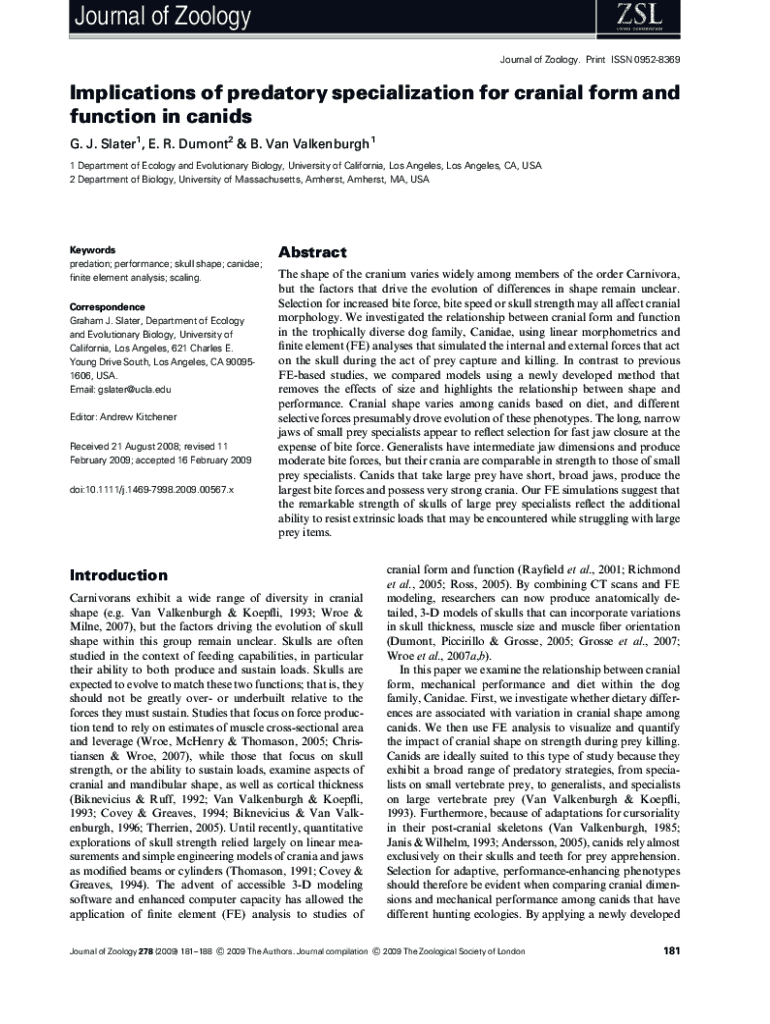
The study of the "Implications of predatory specialization for cranial form and function" delves into how specialized dietary habits among predators influence the evolution of skull morphology. In canids, for example, different jaw shapes correlate with predatory strategies adapted to pursuing specific prey sizes. This research examines how variations in cranial design enhance survival and efficiency by affecting mechanical performance during hunting and feeding processes.
Key Elements of the Implications
Understanding the "Implications of predatory specialization for cranial form and function" involves recognizing several critical factors:
- Cranial Morphology: Examines different skull shapes, such as long, narrow jaws versus short, broad jaws.
- Dietary Specialization: Considers how specific dietary needs impact skull evolution.
- Mechanical Function: Analyzes how cranial form supports specific mechanical actions like jaw closure speed or bite force.
- Evolutionary Adaptation: Highlights the evolution of skull features that arose in response to predation demands.
How to Use the Study
This academic exploration offers valuable insights into evolutionary biology, especially for researchers studying morphological adaptations:
- Framework for Analysis: Use it as a model for examining other species' morphological traits.
- Comparative Studies: Compare findings with other predators to understand cross-species evolutionary strategies.
- Educational Material: Incorporate into curriculum content for biology or anthropology classes.
Examples of Using the Implications
Consider real-world scenarios that exemplify the implications:
- Conservation Efforts: Adapt conservation strategies based on understanding of species-specific adaptations to prey.
- Education: Use as case studies in lectures on evolutionary biology.
- Research Expansion: Serve as a reference point for expanded research in ecological niches.
Important Terms Related
Several technical terms are crucial to grasp fully the content:
- Finite Element Analysis (FEA): A computational method for predicting how object reacts to forces, used in studying skull mechanics.
- Morphology: The study of the form and structure of organisms and their specific structural features.
- Phylogenetics: Understanding of evolutionary relationships among biological species based on genetic and morphological data.
Who Typically Uses This Research
Different groups find the study relevant:
- Evolutionary Biologists: For further research and academic discussions.
- Conservationists: In developing strategies to protect wildlife.
- Educators: As teaching material in higher education.
Legal Use of the Study
While academic in nature, the research might intersect with legal or policy frameworks:
- Protection Policies: Influencing wildlife management and legal protections based on ecological understanding.
- Educational Licensing: Legal uses in producing educational content and materials.
Digital vs. Paper Version
In academia, accessibility extends to available formats:
- Digital Formats: E-readers and online academic databases offer versions for broader access.
- Print Formats: Physical copies held in university libraries for reference and study.
Eligibility Criteria
For conducting similar research using the specialized analysis techniques:
- Academic Qualification: Typically requires advanced degrees in biology or related fields.
- Institutional Affiliation: Formal association with research bodies or educational institutions may be necessary.


Steps to Complete the Research Analysis
Conducting such an analysis involves systematic methodology:
- Literature Review: Begin with comprehensive reviews of existing research.
- Sample Collection: Gather specimens for morphological examination.
- Finite Element Analysis: Apply computational models to assess mechanical performance.
- Data Interpretation: Analyze results to correlate cranial form with predatory specialization.
Software Compatibility
The study's findings may benefit computational software tools:
- Research Tools: Compatibility with statistical software like R for data analysis.
- Modeling Applications: Use in CAD (Computer-Aided Design) software for form and function visualization.
Penalties for Non-Compliance
In research contexts, failing to adhere to ethical standards can have consequences:
- Academic Misconduct: Plagiarism or data fabrication leading to sanctions.
- Funding Impact: Non-compliance with grant terms may result in loss of funding.
Who Issues the Study
Primarily conducted and published by:
- Academic Institutions: Universities worldwide as part of their research initiatives.
- Research Journals: Journals focused on evolutionary biology and ecology.
Business Types that Benefit
The findings can impact certain business domains:
- Biotechnology Firms: In developing tools for ecological applications.
- Education Services: Companies providing academic resources and materials.
By understanding each section in detail, you gain comprehensive insights into the intricacies and broad applications of the implications of predatory specialization for cranial form and function, furthering both academic pursuits and practical applications in related fields.