







Definition and Meaning
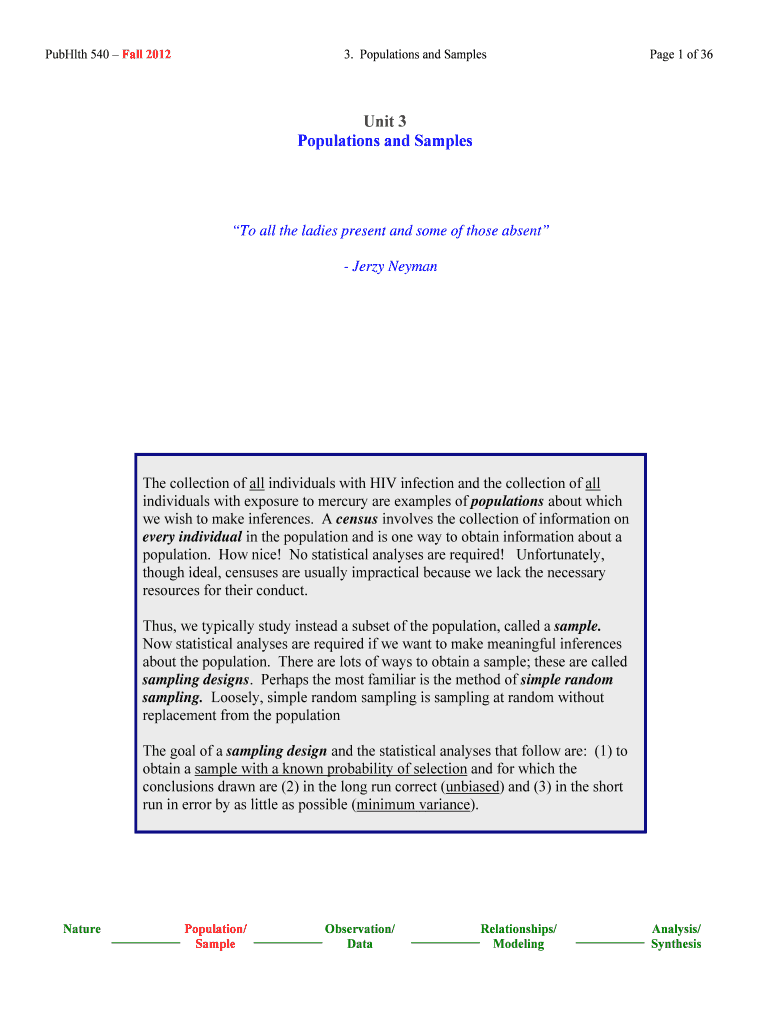
The "Unit 3 Populations and Samples - people umass" refers to an educational resource used mainly in academic settings to teach students about the statistical concepts of populations and samples. In statistical analysis, a population encompasses all elements from a set of data or a specific group you're interested in studying. A sample is a subset of that population and is used to make inferences about the population as a whole. This unit serves as a fundamental part of courses that involve understanding data collection, analysis, and interpretation, essential for making informed decisions based on statistical evidence.
Key Elements of the Unit 3 Populations and Samples
The unit focuses on several critical components essential for conducting statistical analyses.
- Target vs. Sampled Populations: Understanding the difference between the entire group you wish to study (target population) versus the group you can reasonably study (sampled population).
- Sampling Methods: Techniques including simple random sampling, systematic sampling, stratified sampling, and multi-stage sampling are explored. Each method has its unique applications and benefits depending on research goals.
- Bias and Unbiased Sampling: Emphasis on unbiased sampling ensures the results are representative of the population. The unit covers techniques to minimize sampling errors.
- Non-Probability Sampling: Although not as reliable as probability sampling methods, non-probability sampling is also discussed to understand its limitations and practical uses.
Important Terms Related to Unit 3 Populations and Samples
Several terms are integral to the understanding of this unit:
- Population: The complete set of elements or observations that are of interest in a given study.
- Sample: A subset of the population used to represent the whole, from which data is gathered and analyzed.
- Sampling Error: The deviation of the sample from the population, which sampling techniques aim to minimize.
- Stratification: A technique used to divide the population into subgroups before sampling to ensure representation.
Steps to Complete Unit 3 Populations and Samples
- Understand the Concepts: Begin with a thorough review of the theoretical foundations covered in the unit.
- Select Sampling Methodology: Assess different sampling methods, choosing the most appropriate one for your study.
- Data Collection: Gather data according to the chosen sampling method, ensuring compliance with any outlined procedures.
- Analyze Data: Use statistical tools to analyze the sample data, draw conclusions, and make predictions about the population.
- Review Findings: Interpret the analysis results, taking into account sampling errors or potential biases.
- Document Process: Keep detailed records of your methodology, findings, and any challenges encountered for future reference.
Examples of Using Unit 3 Populations and Samples
Educational institutions implement this unit to facilitate practical learning scenarios where students analyze datasets to draw conclusions.
- Academic Research: Students use course materials to conduct research projects requiring data collection and analysis.
- Market Research: Businesses utilize sampling techniques taught in the unit to understand consumer behavior and preferences.
- Public Health Studies: Health researchers apply these concepts to study disease prevalence within populations.
Legal Use of the Unit 3 Populations and Samples
The concepts within this unit can be applied legally across various domains where statistical analysis is permissible. They are crucial in fields like:
- Government Statistics: Conducting census surveys or other governmental data collection methods.
- Medical Research: Garnering insights from clinical trials for new treatments or drugs.
- Corporate Data Analysis: Informing strategic decision-making processes within organizations based on statistical evaluations.
Required Documents for Engaging With the Unit
The materials required for this unit may include, but are not limited to:
- Course Textbooks: Covering statistical methodologies, in-depth explanations, and examples.
- Data Sets: Provided or sourced datasets for practical exercises.
- Statistical Software: Tools like SPSS, R, or Excel might be necessary for data analysis and modeling.
Software Compatibility
The unit's practical applications often require software that can handle statistical computations.
- SPSS: Widely used in academic settings for complex data analysis.
- R and Python: Open-source programming languages that allow for extensive data manipulation capabilities.
- Excel: Suitable for basic statistical operations and teaching foundational concepts.
These tools ensure students and professionals alike can effectively implement the lessons learned in Unit 3 Populations and Samples, utilizing empirical data for informed decision-making processes.




