






Definition & Meaning
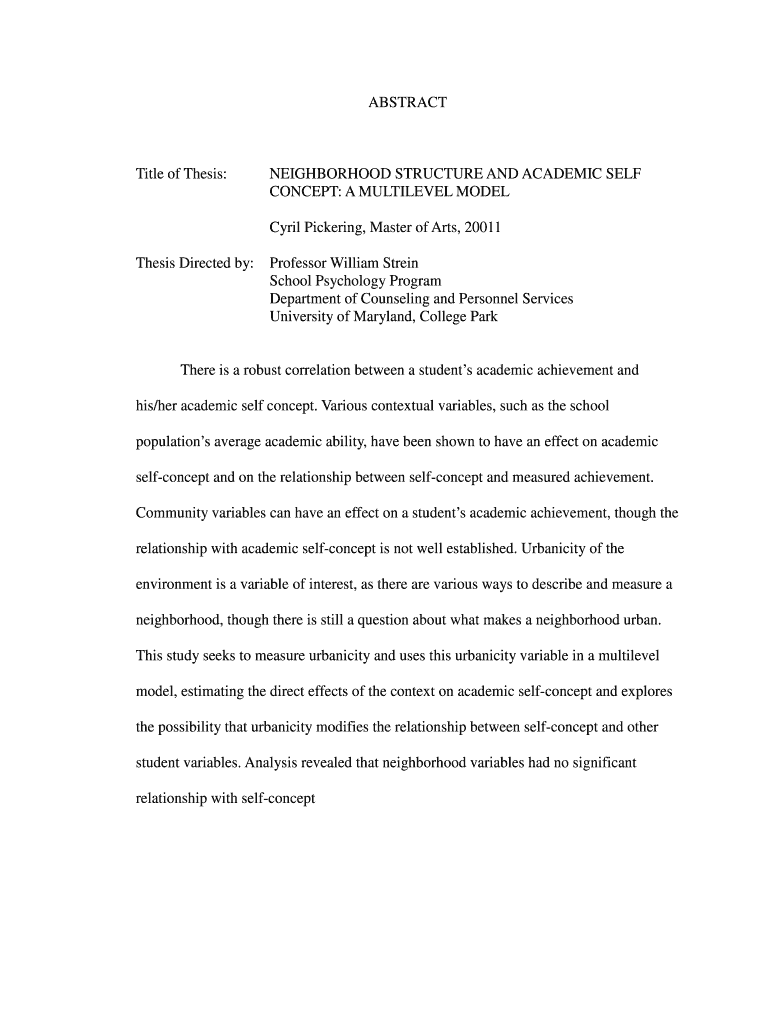
The term "Neighborhood Structure and Academic Self Concept" refers to the interconnectedness between the environmental context where students live and their perceptions of their academic abilities. This concept examines how neighborhood factors like socio-economic status, urbanicity, and school-wide achievement can influence an individual's academic self-concept. Academic self-concept is a student's perception of their own academic abilities, which can significantly impact their motivation, engagement, and performance in an educational setting.
Key Elements of the Neighborhood Structure and Academic Self Concept
Understanding the key elements of this concept involves examining various neighborhood and individual factors:
- Urbanicity: The degree of urbanization in a student's neighborhood may or may not significantly impact their academic self-concept, as the research suggests.
- Academic Achievement: There is a noted correlation between self-concept and academic achievement, although neighborhood structure may not strongly influence this.
- School-wide Achievement: The Big Fish Little Pond Effect indicates that higher school-wide achievement might negatively impact a student's self-concept, suggesting an inverse relationship where students feel academically smaller despite performing well.
How to Use the Neighborhood Structure and Academic Self Concept
Application of this concept involves assessing how different environmental variables, such as neighborhood structure, influence academic self-perceptions among students. Educators and policy-makers can use these insights to:
- Tailor Educational Interventions: Develop programs that reinforce positive academic self-concept irrespective of neighborhood conditions.
- Policy Development: Inform policies aiming to minimize negative impacts of high achieving environments on individual self-concept.
- Research and Analysis: Utilize multilevel modeling to evaluate data and tailor educational strategies that benefit students from diverse backgrounds.
Steps to Complete a Study on Neighborhood Structure and Academic Self Concept
Conducting a study involves several systematic steps:
- Define Objectives: Clearly outline what you aim to investigate regarding neighborhood impacts and self-concept.
- Collect Data: Utilize datasets like the Educational Longitudinal Study to gather relevant information.
- Choose Methodology: Apply multilevel modeling to analyze how neighborhood variables correlate with self-concept.
- Analyze Results: Interpret the findings to understand the role of neighborhood constructs on academic self-perception.
- Report Findings: Compile the research into a comprehensive report detailing your conclusions.
Important Terms Related to Neighborhood Structure and Academic Self Concept
Key terms central to understanding this concept include:
- Academic Self-Concept: A student's self-evaluation of their academic abilities.
- Big Fish Little Pond Effect: The phenomenon where students perceive themselves as less capable in a high-achieving environment.
- Urbanicity: The characteristic of the area where a student resides, regarding its urban or rural attributes.
Examples of Using the Neighborhood Structure and Academic Self Concept
Illustrative examples can demonstrate practical application:
- Case Study: Analyze a city where socio-economic diversity within neighborhoods allows for varied academic self-concepts among students.
- Simulation: Conduct predictive modeling to forecast impacts of changing neighborhood structures on academic perceptions.
Applications & Approval Time for Related Studies
For studies related to this concept:
- Applications: Research proposals for educational studies should be submitted to relevant educational departments or institutions.
- Approval Time: Typically depends on the complexity of the study and demands certification from ethics review boards, with a timeline ranging from weeks to months.
State-Specific Rules for Research on Academic Self Concept
While the fundamental principles are broadly applicable, local legislation or educational policies may influence research approaches:
- Variations: Different states might implement unique educational policies affecting neighborhood and self-concept studies.
- Compliance: Researchers must ensure they comply with state-specific educational research guidelines.
By considering these perspectives, educators, researchers, and policymakers can strategically approach the implications of neighborhood structures on academic self-concept, facilitating improved educational outcomes and interventions.