
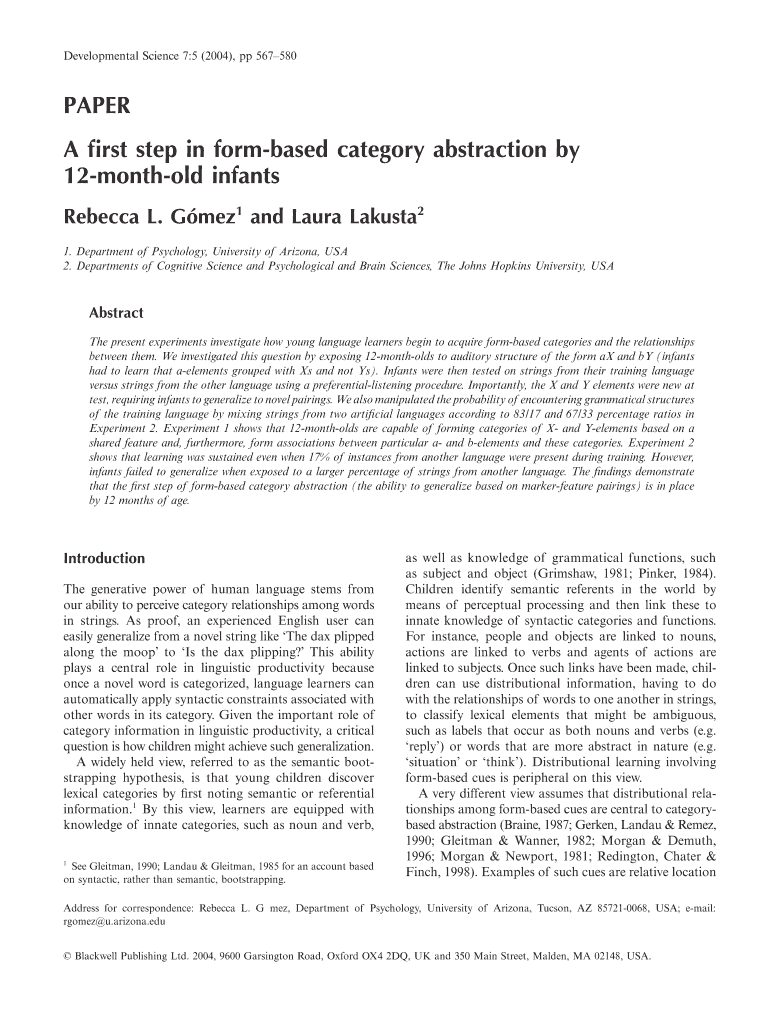







Definition and Meaning
Form-based category abstraction involves the cognitive process whereby individuals, especially infants, categorize different linguistic elements based on shared features. This form represents initial steps in understanding how language acquisition occurs in infancy. Originating from research conducted by Montclair State, it explores the formation of these categories in 12-month-old infants, focusing on their ability to generalize learned associations.
Key Elements of Form-Based Category Abstraction
Understanding this process involves several crucial components:
- Feature Associations: Infants discern common features across different items, grouping them into categories.
- Cognitive Development: Highlighting how early associations contribute to language learning.
- Generalization Abilities: Discusses how infants apply learned categories to novel situations.
- Montclair State Research: Provides foundational insights into early language acquisition, noting the impact of consistent and inconsistent linguistic input.
Steps to Complete the Form
While the form is not a conventional document, implementing the findings requires systematic observation and categorization:
- Observe the Subject: Begin by closely watching infant reactions to linguistic stimuli.
- Identify Patterns: Note recurring features in language that infants respond to.
- Assess Generalization: Introduce novel items to see if infants apply learned categories.
- Evaluate Outcomes: Determine the effectiveness of category formation and abstraction in language development.
How to Use Form-Based Category Abstraction in Research
Researchers utilize this framework to gain insights into early language development. Practical applications include:
- Designing Experiments: Setting up structured experiments to test categorization abilities.
- Data Analysis: Quantifying the degree of generalization among infants.
- Applying Findings: Using insights to inform educational strategies in early childhood.
Important Terms Related to the Form
- Abstraction: The cognitive process of identifying commonalities among different items.
- Category Formation: Grouping linguistic inputs based on shared characteristics.
- Generalization: Applying previously learned categories to new stimuli.
- Linguistic Input: The variety of language and sounds infants are exposed to.
Who Typically Uses Form-Based Category Abstraction Studies
Primarily utilized by:
- Child Development Researchers: For studying cognitive and linguistic progression in infants.
- Linguists: Interested in the foundational elements of language acquisition.
- Educators: Designing curricula that facilitate early language development through category abstraction.
Examples of Using Form-Based Category Abstraction
Research may involve scenarios such as:
- Controlled Experiments: Testing infant reactions to different phonetic inputs.
- Real-World Observations: Monitoring how infants interact with language in natural settings.
- Comparative Studies: Cross-analyzing data from diverse linguistic backgrounds to assess variability in category abstraction.
Legally Backed Implications in Research
Ensuring ethical compliance in research involving infants is crucial:
- Informed Consent: Essential from guardians before study participation.
- Adherence to Research Protocols: Maintaining strict guidelines to safeguard infants' well-being throughout the study.
- Data Privacy: Upholding high standards of confidentiality and data protection for all participants.
Software and Tools for Analysing Form-Based Category Abstractions
Researchers may employ various digital tools for data collection and analysis:
- Statistical Software: For quantitative data evaluation, offering insights into category formation rates.
- Video Analysis Tools: To observe and record infant behavior and responses during experiments.
- Data Management Systems: Ensuring systematic storage and retrieval of research data and findings.




