






Definition & Meaning of Blurred Target Tracking by Blur-driven Tracker
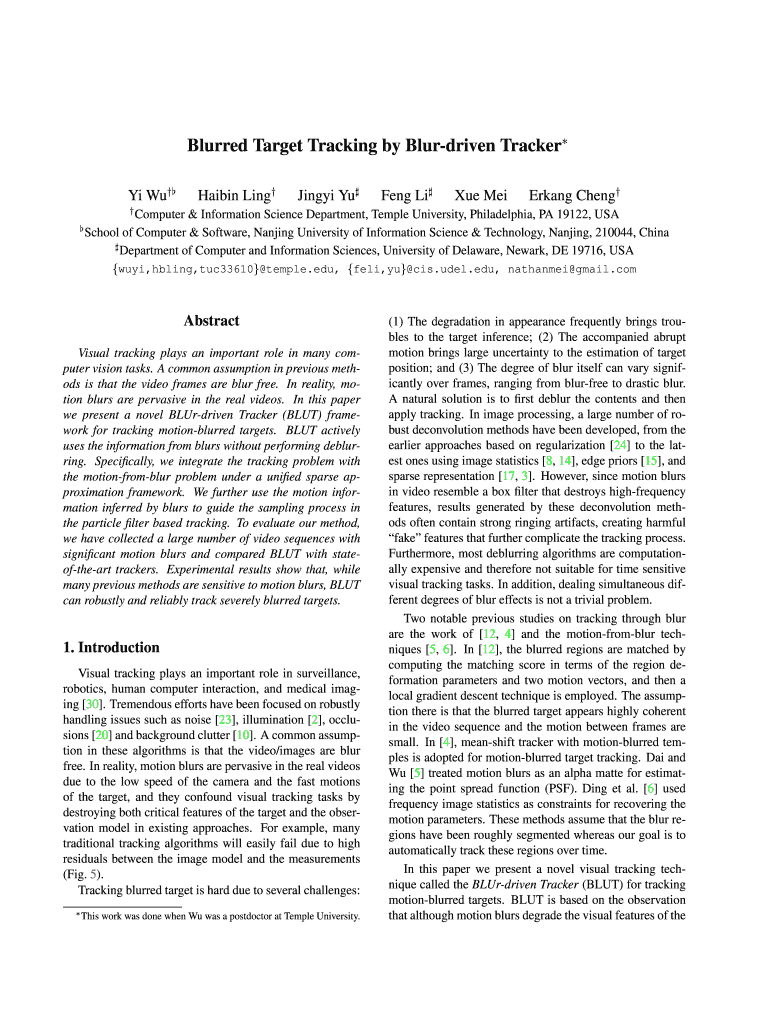
The term "Blurred Target Tracking by Blur-driven Tracker" refers to a visual tracking framework known as the BLUr-driven Tracker (BLUT). This advanced methodology is designed to manage and track motion-blurred targets within video sequences. Unlike traditional tracking techniques that rely on deblurred images, BLUT capitalizes on the information available from motion blurs, merging tracking and motion-from-blur challenges into a cohesive framework. This approach utilizes a sparse approximation framework, improving the inference about the target and aiding particle filter-based tracking.
How to Use the Blurred Target Tracking by Blur-driven Tracker
Using the BLUr-driven Tracker involves understanding its components and methods:
-
Integration of Motion Blur: Begin by leveraging motion blur data to inform target tracking, circumventing the need for preliminary deblurring.
-
Sparse Approximation Framework: Utilize this framework to enhance target tracking capacity, ensuring that the tracker recognizes and follows blurred targets effectively.
-
Guidance and Implementation: Implement in conjunction with particle filter-based tracking to refine tracking precision.
-
Experimental Setup: Conduct trials to fine-tune the parameters, ensuring optimal performance in various scenarios involving motion blur.
Why Use Blurred Target Tracking by Blur-driven Tracker
The BLUr-driven Tracker offers substantial advantages over conventional tracking methods:
-
Enhanced Accuracy: BLUT outperforms existing trackers, particularly under conditions with significant motion blur.
-
Innovative Approach: By using blur information, it offers a novel perspective in visual tracking, eliminating the deblurring step.
-
Versatility: This tracker is suitable for a range of applications, especially where traditional methods fall short due to low visibility conditions caused by motion blur.
Key Elements of the Blurred Target Tracking by Blur-driven Tracker
Several core elements characterize the BLUr-driven Tracker:
-
Motion Blur Utilization: Central to its function, utilizing blur directly enhances tracking capabilities.
-
Sparse Representation: This method allows for efficient target modeling, aiding in precise tracking performance.
-
Particle Filter Integration: This component provides robust tracking, especially in dynamic and unpredictable environments.
Examples of Using the Blurred Target Tracking by Blur-driven Tracker
Real-world applications of the BLUr-driven Tracker include:
-
Surveillance Systems: For environments with rapid camera movements or low light conditions that result in blur.
-
Sports Analytics: To track fast-moving athletes where traditional tracking would struggle with blur.
-
Autonomous Vehicles: Beneficial in scenarios with high-speed object tracking where blur is prevalent.
Important Terms Related to Blurred Target Tracking by Blur-driven Tracker
Understanding these terms will enhance your comprehension of the tracker:
-
Motion Blur: A distortion caused by rapid movement, integral to BLUT's tracking approach.
-
Sparse Approximation: A technique that simplifies complex data, crucial for effective blur-driven tracking.
-
Particle Filter: A method for estimating dynamic systems, leveraged by BLUT for accurate tracking.
Legal Use of the Blurred Target Tracking by Blur-driven Tracker
When employing the BLUr-driven Tracker, note:
-
Compliance: Ensure usage aligns with applicable local, state, and federal regulations, especially for surveillance.
-
Data Protection: Secure any collected video data in compliance with privacy laws to prevent unauthorized access.
Digital vs. Paper Version of the Blurred Target Tracking by Blur-driven Tracker
In the digital landscape:
- Software Implementation: BLUT is inherently digital, often implemented within software solutions on computing platforms for real-time processing and tracking.