




Definition and Meaning
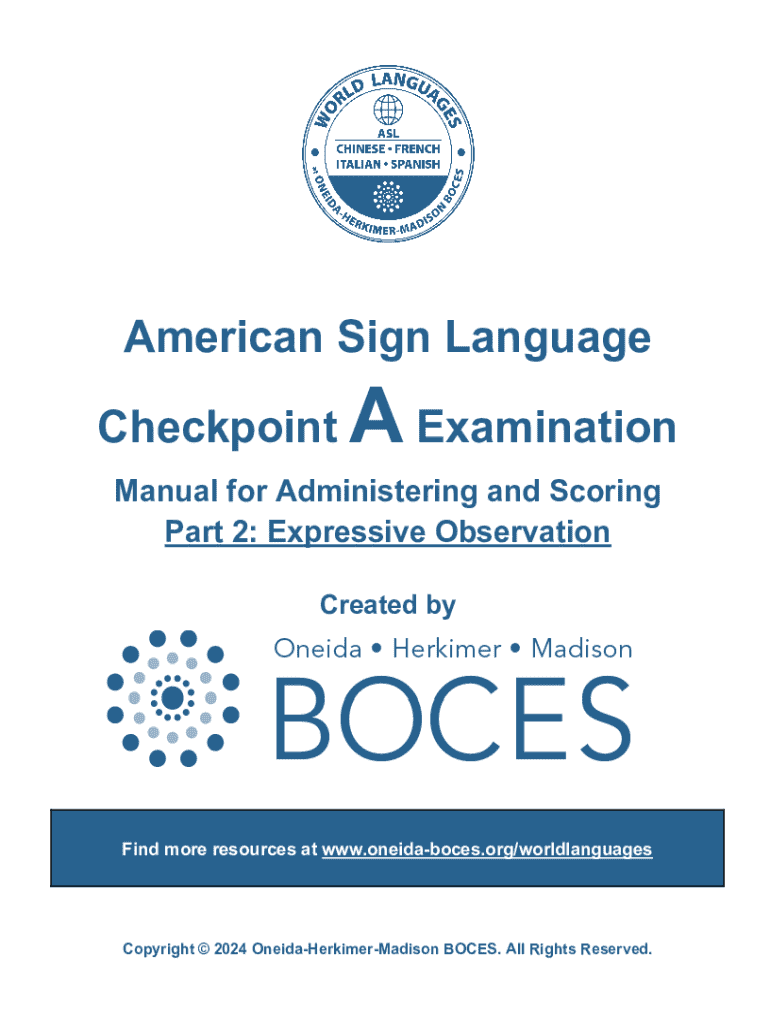
The ASL Manual for Administration and Scoring Checkpoint A - Part 2 serves as a comprehensive guideline for educators and examiners involved in the American Sign Language (ASL) Checkpoint A examination. This manual specifically addresses the Expressive Observation component, highlighting the method of evaluating students' signing skills. It delineates the structure, objectives, and criteria that must be adhered to during the exam process. The manual ensures that the assessment is standardized across different testing environments, thereby providing a fair and consistent evaluation of ASL proficiency among students.
How to Use the ASL Manual for Administration and Scoring Checkpoint A - Part 2
Educators and examiners utilize this manual for precise guidance on administering the Checkpoint A - Part 2 examination. The manual outlines essential steps to facilitate the smooth execution of the exam:
-
Setup: Prepare the examination space and materials, ensuring all equipment required for displaying picture scenarios is operational.
-
Administration: Conduct the exam following the procedural guidelines specified, starting with introducing the examination rules to students.
-
Scoring: Use the scoring criteria outlined in the manual to assess student responses based on comprehensibility, accuracy, and complexity.
-
Reporting: Document the student scores and feedback as per the manual's recommendations, maintaining a standardized format.
Important Terms Related to ASL Manual for Administration and Scoring Checkpoint A - Part 2
Several key terms are fundamental to understanding and using this manual effectively:
-
Expressive Observation: The section of the examination where students express their observations of visual stimuli using ASL.
-
Picture Scenarios: Pre-selected images that serve as prompts for students to create ASL responses.
-
Comprehensibility: A criterion measuring how clearly the student's ASL communication can be understood by the evaluator.
-
Complexity: The richness and sophisticated use of ASL in expressing ideas and emotions.
Key Elements of the ASL Manual for Administration and Scoring Checkpoint A - Part 2
The manual comprises several key components indispensable for successful examination delivery:
-
Administration Procedures: Detailed steps on how to organize and execute the examination.
-
Scoring Criteria: Specific guidelines on evaluating student performance, focusing on ASL fluency.
-
Security Protocols: Measures to protect examination materials and ensure the integrity of the scoring process.
-
Post-Scoring Requirements: Instructions on reporting scores and handling examination materials after the test.
Who Typically Uses the ASL Manual for Administration and Scoring Checkpoint A - Part 2
This manual is primarily targeted at:
-
ASL Educators: Instructors responsible for teaching and assessing students’ proficiency in ASL.
-
Examiners: Individuals conducting and grading the ASL examination.
-
Education Administrators: Those overseeing ASL program implementation and assessment strategies within educational institutions.

Legal Use of the ASL Manual for Administration and Scoring Checkpoint A - Part 2
The manual is used under strict adherence to educational and institutional regulations. It ensures compliance with standardized testing protocols, maintaining fair assessment practices.
-
Security Measures: Protects against unauthorized access to examination materials.
-
Data Privacy: Complies with regulations to protect student information collected during the exam.
State-Specific Rules for the ASL Manual for Administration and Scoring Checkpoint A - Part 2
While the fundamental structure of the manual remains consistent across states, some variations may exist due to local educational policies:
-
Localized Scenarios: Some states might adopt specific picture scenarios based on regional cultural context.
-
Assessment Adaptations: Modifications in scoring criteria to align with state-specific educational standards.
Examples of Using the ASL Manual for Administration and Scoring Checkpoint A - Part 2
Practical case studies demonstrating the manual’s application can be insightful:
-
Case Study in a New York School: A detailed account of administering the exam and strategies employed to enhance student performance.
-
Adaptations for Diverse Learning Environments: Examples of how different schools have tailored the administration process to accommodate unique student needs.
These sections provide an in-depth understanding of the ASL Manual for Administration and Scoring Checkpoint A - Part 2, ensuring educators and examiners are equipped with the necessary tools to administer and evaluate ASL proficiency effectively.