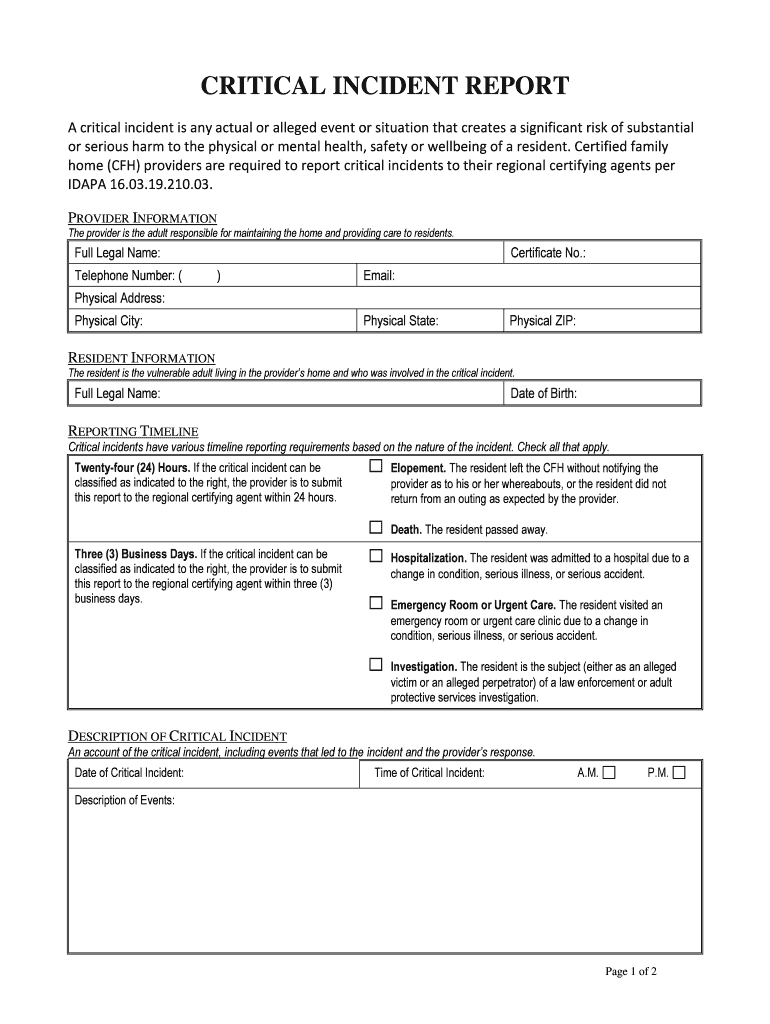







Definition & Meaning of the Critical Incident Report
A Critical Incident Report for the Idaho Department of Health and Welfare is a formal document designed for certified family home (CFH) providers to report significant incidents that impact the health, safety, or wellbeing of residents. This report is an integral component of maintaining high standards of care and ensuring that all involved parties are swiftly informed of critical occurrences. The incidents covered by this report can include events such as resident elopement, unexpected death, hospitalization, and any investigations that may concern the welfare of residents. The report serves as a written record that helps in assessing ongoing risks and implementing preventative measures to avert future incidents.
How to Use the Critical Incident Report
Understanding how to appropriately use the Critical Incident Report is crucial for compliance and effective reporting. Users begin by gathering comprehensive details about the incident, including the date, time, location, and nature of the event. It is important to document all affected parties, the actions taken in response, and any witnesses or additional information that may be pertinent. This data should be accurately reflected within the designated sections of the report. Users should be aware of specific reporting timelines: certain incidents need to be reported within 24 hours, while others may have a deadline of up to three business days.
- Step-by-step usage:
- Identify and categorize the type of incident.
- Collect complete and accurate data related to the incident.
- Follow structured sections within the form for uniformity.
- Ensure timely submission based on incident urgency.
Steps to Complete the Critical Incident Report
Completing the Critical Incident Report demands attention to detail and adherence to the specified format. Follow these steps to ensure thorough documentation:
-
Record Incident Details: Start by filling out the date, time, and location of the incident. Specify the type of incident and parties involved.
-
Narrative Description: Provide a detailed, chronological description of what transpired, including any preliminary actions taken.
-
Notification Section: Include a record of whom within the Idaho Department of Health and Welfare was notified, alongside the date and time of notification.
-
Resolution Plan: Document any immediate actions taken to mitigate risks and any follow-up measures planned to prevent recurrence.
-
Submit Form: Ensure all sections are complete before submitting via the approved methods, whether online or by mail.
Key Elements of the Critical Incident Report
When preparing a Critical Incident Report, it is important to understand and include its essential elements. These elements ensure the report is comprehensive and actionable.
- Incident Details: Captures the who, what, when, and where of the incident.
- Description: Provides context and insight into the incident’s nature and potential outcomes.
- Compliance with Timelines: Ensures urgent matters are reported within the demanded timeframe.
- Follow-up Actions: Identifies immediate responses and future steps to assess effectiveness.
- Notification Log: Acknowledges all notified entities concerning the incident.
Who Typically Uses the Critical Incident Report
The Critical Incident Report is primarily utilized by certified family home providers within Idaho, responsible for providing care to residents under their supervision. These professionals include caregivers, healthcare workers, and administrative staff responsible for residential care environments. Their role necessitates vigilance in reporting significant occurrences that could influence the wellbeing of individuals under their care. Ensuring these reports are correctly completed and submitted aligns with the overarching goals of safety, compliance, and improved care practices.


Legal Use of the Critical Incident Report
Ensuring the legal use of the Critical Incident Report is crucial for compliance with state regulations and maintaining accreditation. Guidelines stipulate that reports should be completed accurately and with honesty to avoid legal repercussions. The report serves as an official document on record with the Idaho Department of Health and Welfare and is protected under privacy laws. Unauthorized disclosure of sensitive information contained within the reports can lead to legal consequences for the providers. As such, stakeholders should ensure that all legal prerequisites are met when compiling and submitting the report to protect both the provider and the individuals involved.
State-Specific Rules for the Critical Incident Report
The Critical Incident Report adheres to certain state-specific rules that practitioners in Idaho must follow to comply with local laws. These guidelines address the types of incidents that must be reported, the manner in which information needs to be documented, and the enforcement of submission timelines. For example, Idaho mandates distinct reporting periods based on the severity of the incident, ranging from immediate notification to within three business days for less critical events. Familiarity with these state-specific procedures is imperative for providers to fulfill their duty to report without infraction.
Examples of Using the Critical Incident Report
Practical examples illuminate the effective use of the Critical Incident Report:
- A resident experiencing elopement is observed leaving the facility unsupervised. The provider documents this under the “elopement” category and records immediate steps taken to locate and return the resident safely.
- In cases of unexpected hospitalization, such as a sudden fall resulting in injury, the report will detail the circumstances, witnesses, and medical actions administered onsite before hospital transfer.
- During an investigation prompted by observed signs of potential abuse, the report will include documented evidence, involved staff interviews, and protective measures enforced pending completion of the inquiry.
Through these examples, it becomes clear how the report serves as a tool for safeguarding both the residents’ wellbeing and the provider’s compliance obligations.