01. Edit your form online
Type text, add images, blackout confidential details, add comments, highlights and more.

Type text, add images, blackout confidential details, add comments, highlights and more.

Draw your signature, type it, upload its image, or use your mobile device as a signature pad.

Send it via email, link, or fax. You can also download it, export it or print it out.
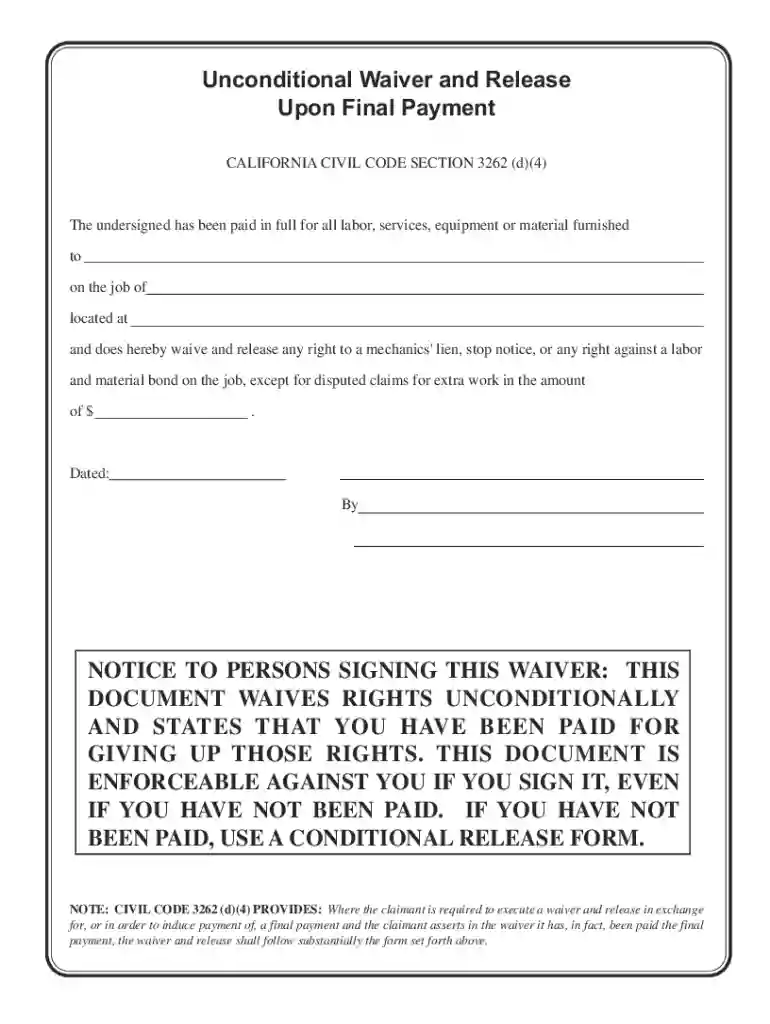
The "unconditional release upon final payment form" is a legal document primarily used in the construction industry to waive the rights to any mechanics' liens or claims upon receiving full payment for labor, materials, or services. This form signifies that the claimant acknowledges receipt of final payment and, as a result, releases any legal claims against the property or the party responsible for the payment. The release is termed "unconditional" because it is effective immediately upon signing, regardless of whether the claimant has actually received the payment.
To effectively use this form, the claimant must ensure that all the specified details are accurately filled out, including the payment amount, payer details, and payment date. The form should be presented after the final payment has been acknowledged to ensure that it is a valid unconditional release. Once completed and signed, the form acts as a binding legal agreement that confirms all claims are waived, facilitating smoother final transactions in construction or service projects.
Completing this form involves several key steps that must be followed precisely to ensure legal validity and enforceability. Begin by accurately documenting the claimant’s information, including name, contact details, and role within the project. Next, record the payment details such as the amount, date, and check number. It is crucial that these details match the agreed payment terms to avoid potential disputes. Finally, sign the document in the designated area, solidifying the waiver of any future claims related to the project’s payment.
This form is predominantly utilized by contractors, subcontractors, suppliers, and service providers in the construction sector. When a party has provided labor or materials to a project, this form serves to release them from any future claims against the property or payer once full payment is verified. Property owners and general contractors also use this form to ensure that all liens are released upon settling final payments, thus securing clear ownership and compliance with state regulations.


Critical components of this form include:
From a legal perspective, this form provides protection for both parties involved. For the claimant, it serves as a formal acknowledgment of payment receipt, relinquishing their ability to file a lien. For the payer, it offers peace of mind, knowing that they are free from future claims or disputes associated with the payment. It is vital to comprehend that once executed, the form is binding and enforceable in court, even if payment complications arise later.
Regulations regarding this form vary by state, especially concerning how the release is executed and recorded. In California, for example, specific language as prescribed in Civil Code Section 3262(d)(4) must be included to ensure it meets legal standards. Other states may have their own forms or additional requirements, such as notarization or filing with a county office. It is essential to consult state-specific guidelines to guarantee compliance when preparing and submitting this form.
Failure to properly execute an unconditional release upon final payment form can lead to various penalties, including the refusal of liens or legal claims for any outstanding amounts. Inaccurate or incomplete forms can also result in disputes and potential court cases, highlighting the importance of accuracy and adherence to stipulated regulations. In some jurisdictions, not using the form correctly could result in fines or legal costs associated with resolving disputes.
We've got more versions of the unconditional release upon final payment form form. Select the right unconditional release upon final payment form version from the list and start editing it straight away!
At DocHub, your data security is our priority. We follow HIPAA, SOC2, GDPR, and other standards, so you can work on your documents with confidence.