01. Edit your form online
Type text, add images, blackout confidential details, add comments, highlights and more.

Type text, add images, blackout confidential details, add comments, highlights and more.

Draw your signature, type it, upload its image, or use your mobile device as a signature pad.

Send it via email, link, or fax. You can also download it, export it or print it out.
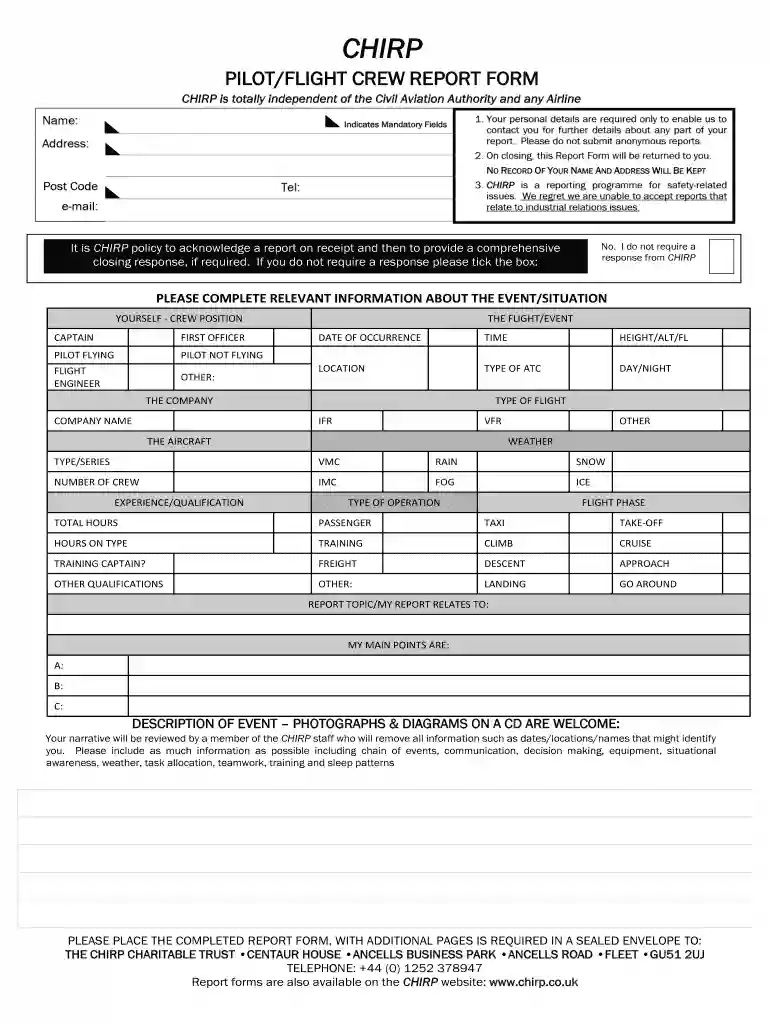
The PILOT FLIGHT CREW REPORT FORM is an essential tool used by pilots and flight crew members to document incidents and events related to aviation safety. It serves as a structured method for capturing details about occurrences such as near-misses, equipment malfunctions, or any deviations from standard procedures. This form is crucial in identifying potential hazards and facilitating corrective actions to enhance overall aviation safety. This document is independent of the Civil Aviation Authority and airlines, ensuring unbiased reporting and analysis.
Using the PILOT FLIGHT CREW REPORT FORM involves several key steps. First, gather all pertinent information about the incident, including date, time, and location. Next, complete the form by entering details about crew positions, flight specifics, and weather conditions. Additionally, include a comprehensive narrative description of the event, emphasizing factors that contributed to the situation. Follow established guidelines to ensure the information is detailed and factual.
This form includes several critical sections to ensure comprehensive incident reporting. Each element is tailored to capture specific aspects of an event:
The form plays a vital role in enhancing aviation safety by providing a systematic approach to incident reporting. By documenting events, trends can be identified, leading to data-driven improvements in safety protocols. It encourages a culture of transparency and accountability among aviation professionals, ultimately reducing the likelihood of similar incidents in the future.
This form is primarily used by pilots and flight crew members from various aviation sectors, including commercial airlines, private charters, and cargo services. Safety managers and operational staff may also utilize the form to review incident reports and implement safety improvements. Its use is widespread in the U.S., aligning with national aviation safety protocols to ensure consistency in data collection and analysis.


The PILOT FLIGHT CREW REPORT FORM is protected by confidentiality agreements to encourage honest reporting without fear of retribution. Information provided is stripped of any identifying details before analysis, ensuring compliance with legal standards. This legal framework fosters an environment conducive to thorough reporting, which is essential for maintaining high safety standards within the aviation industry.
Completing the form requires attention to detail and accuracy. Begin with inputting the flight details, followed by crew roles and responsibilities. Move on to recording relevant flight specifics, such as aircraft type and phase. Describe the atmospheric conditions, noting factors like visibility and turbulence. Finally, compose a narrative summarizing the incident, ensuring all contributing factors are highlighted and any potential safety recommendations are clearly articulated.
Upon completion, the form can be submitted through various avenues. Most organizations prefer electronic submission for efficiency and ease of storage. However, should digital submission be unavailable, the form can be mailed to the designated safety department. It's crucial to adhere to submission guidelines established by the operator to ensure timely processing and review of the report.
Consider a scenario where a flight experiences unexpected turbulence, leading to passenger injuries. The crew would use the form to report the incident, providing details on environmental conditions and flight dynamics. Alternatively, an equipment malfunction, such as an altimeter failure, would be meticulously documented to aid in analyzing the root cause and prevent recurrence.
While the form itself is comprehensive, additional documentation may be required based on the incident. Relevant documents could include maintenance records, flight logs, or cockpit voice recordings. Having these documents readily available can expedite the review process and provide further context necessary for thorough investigation.
While the form is standardized across the United States, certain regions may have additional reporting requirements or guidelines. It is essential to familiarize oneself with any state-specific mandates which could affect how incidents are reported or evaluated. Staying informed ensures compliance and supports uniform safety practices nationwide.
We've got more versions of the PILOT FLIGHT CREW REPORT FORM form. Select the right PILOT FLIGHT CREW REPORT FORM version from the list and start editing it straight away!
At DocHub, your data security is our priority. We follow HIPAA, SOC2, GDPR, and other standards, so you can work on your documents with confidence.