






Definition and Meaning
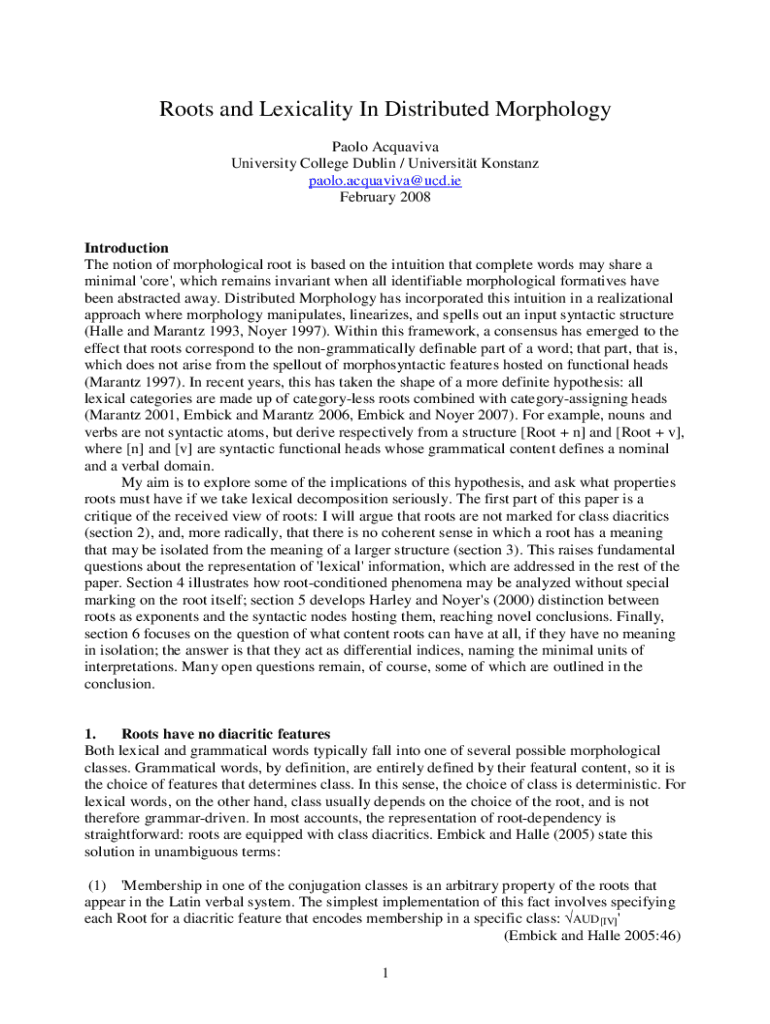
In the context of Distributed Morphology, "1 Roots into functional nodes: exploring locality and semi-" refers to the theoretical framework where morphological roots are analyzed. Roots in this framework are category-neutral and inherently lack specific meaning. They function as differential markers in syntactic structures, activating their roles once combined with category-defining elements. Here, meaning emerges not from the roots themselves but through their amalgamation with other syntactic components.
Core Concepts
- Category-Neutral Roots: Roots do not belong to any grammatical category until they combine with functional elements.
- External Lexical Information: The theory suggests that lexical information is applied externally and not intrinsic to the roots.
How to Use the Concept
The application of "1 Roots into functional nodes: exploring locality and semi-" involves a deep dive into how roots interact within syntactic structures to derive meaning. This involves:
- Analyzing Syntactic Structures: Explore how roots integrate with functional heads.
- Understanding Morphological Theory: Examine how roots maintain neutrality across categories until contextually defined.
Practical Application
- Linguistic Research: This framework supports researchers examining how meaning is constructed.
- Syntax and Morphology Courses: Useful for academic courses focusing on advanced grammar theories.
Steps to Explore the Theory
- Review Literature: Begin with foundational texts and recent research articles on Distributed Morphology.
- Analyze Examples: Study syntactic structures that illustrate category-neutral roots combining with category-defining elements.
- Conduct Experiments: Experiment with creating syntactic combinations using various roots and categories.
Detailed Breakdown
- Literature Review: Focus on works by key theorists in Distributed Morphology.
- Example Analysis: Breakdown complex sentences to identify root and functional combinations.
Why Study Roots into Functional Nodes
Understanding this concept provides insight into linguistic theory and syntax:
- It's crucial for examining how languages form meaning.
- Enhances comprehension of morphological processes in syntax.
- Useful for developing linguistic models or AI language processing.
Benefits
- Linguistic Diversity: Appreciate language variation and morphological subtleties.
- Cognitive Insights: Offers perspectives on cognitive processes underpinning language acquisition.
Important Terms Related to the Concept
- Distributed Morphology: A linguistic theory prioritizing the separation of morphology from syntax.
- Functional Nodes: Syntactic elements that assign category to roots, giving rise to specific meanings.
- Category Neutrality: Roots begin without grammatical classification until syntactic integration occurs.
Key Definitions
- Differential Indices: Role roots play as identifiers within syntactic structures.
Key Elements of the Theory
The major components involved in "1 Roots into functional nodes: exploring locality and semi-" include:
- Roots: Category-neutral elements.
- Functional Nodes: Elements that imbue roots with syntactic roles and meaning.
- Locality: Refers to constraints in syntactic derivations.
- Semantic Interpretation: Process where syntactic structures result in meaning.
Components Breakdown
- Roots: Serve as base elements devoid of inherent meaning.
- Semantic Interpretation: Final step wherein combined structures are comprehended.
Examples of Using This Theory
Applications of the theory can be seen in:
- Linguistic Textbooks: Utilized to explain syntactic structure processes.
- Research Studies: Employed in studies dissecting syntax and morphology interactions.
Case Studies
- Example scenarios where roots transition from category-neutral to specific functions when combined with functional nodes.
Versions or Alternatives to the Concept
While "1 Roots into functional nodes: exploring locality and semi-" remains a key aspect of Distributed Morphology, there are alternate approaches:
- Lexicalism: Opposes the theory by positing meaning and grammatical category are inherent to roots.
- Generative Grammar: Offers a broader perspective on syntax and morphological connections.
Alternative Frameworks
- Lexicalism vs. Distributed Morphology: Contrasts inherent versus externally assigned meanings to roots.
This comprehensive exploration of the theory "1 Roots into functional nodes: exploring locality and semi-" provides a thorough understanding of its application in linguistic morphology while illustrating its relevance and practical uses in academic and research settings.