







Definition & Meaning
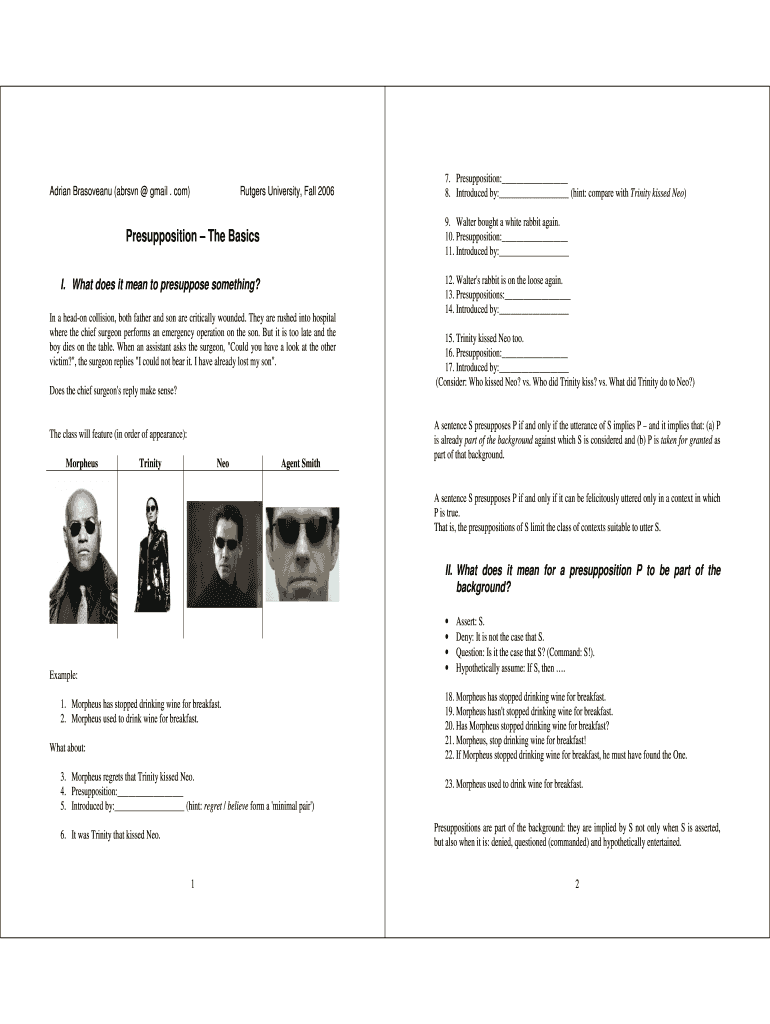
"Walter bought a white rabbit again" illustrates a linguistic presupposition, suggesting Walter has purchased a white rabbit at least once before. In the context of semantics, such presuppositions imply recurring actions or background scenarios that are assumed to be true without being explicitly stated.
How to Use the Form "Walter bought a white rabbit again"
This form explores linguistic structure, especially in teaching and psychological evaluations. Educational exercises can incorporate this sentence to help students identify presuppositions and assumptions in language, improving their comprehension and analytical skills.
Contextual Applications
- Educational Exercises: Teachers can use this form as a starting point for discussing presuppositions, encouraging students to think critically about implied meanings in daily communication.
- Semantics Research: Researchers in linguistics may analyze this form to study presupposition triggers and accommodation in language processing.
Key Elements of "Walter bought a white rabbit again"
Understanding the key components of this statement helps in examining linguistic nuances:
- Presupposition Trigger: The phrase "again" triggers the presupposition that Walter has purchased a white rabbit previously.
- Subject and Action: "Walter" as the subject and "bought" as the action verb form the core of the statement, establishing the needed context for semantic analysis.
Steps to Understand the Presupposition
Analyzing this form involves specific analytical steps:
- Identify the Trigger: Recognize words or phrases that imply a presupposition, in this case, "again."
- Examine Contextual Implications: Explore the background scenarios or previous events that the presupposition demands.
- Semantic Breakdown: Decompose the sentence into its core components (subject, action, object) for detailed examination.
- Compare with Variations: Consider variations or similar sentences to understand differing presuppositional triggers.
Examples of Using Presupposition in Language
Real-world examples illustrate how presuppositions function in various contexts:
- "He solved the puzzle again." Presupposes he has solved the puzzle before.
- "She returned to the office." Presupposes she has been in the office before.
- "The team won the championship again." Presupposes the team has won a previous championship.
Legal Use of Presupposition Analysis
In legal fields, understanding presuppositions is crucial during testimony and contract review:
- Testimonial Analysis: Lawyers must identify and challenge presuppositions to derive truth and mitigate misleading implications.
- Contractual Agreements: Reviewing language in agreements for presuppositions can prevent misunderstandings and ensure clarity.
Who Typically Uses Presupposition Analysis
Various professionals benefit from understanding and utilizing presupposition analysis:
- Linguists and Educators: Often explore sentence structures for educational and research purposes.
- Legal Professionals: Use analysis to determine implied statements and intentions in legal documents and testimony.
- Psychologists and Therapists: Examine client statements for underlying assumptions or recurring themes.
Software Compatibility for Linguistic Analysis
Analyzing "Walter bought a white rabbit again" may involve software solutions:
- Linguistic Analysis Tools: Applications like ELAN or Wordsmith can be used to dissect and analyze sentence structures.
- Educational Software: Language learning platforms may incorporate sentence deconstruction exercises focused on presuppositions.
Variations or Alternatives to the Statement
Exploring variations helps in understanding different aspects of presupposition:
- "Walter bought another white rabbit." Implies he has previously bought a similar pet.
- "Walter bought the white rabbit again." Suggests continuity in purchasing choices or preferences regarding a particular rabbit.
In engaging deeply with this content, educational institutions, linguistic researchers, legal professionals, and psychologists can grasp the complexities of presupposition and its practical applications in understanding language semantics and communication dynamics.




