







Definition and Purpose of the UCSC AAUS Diving Injury Incident Report Form
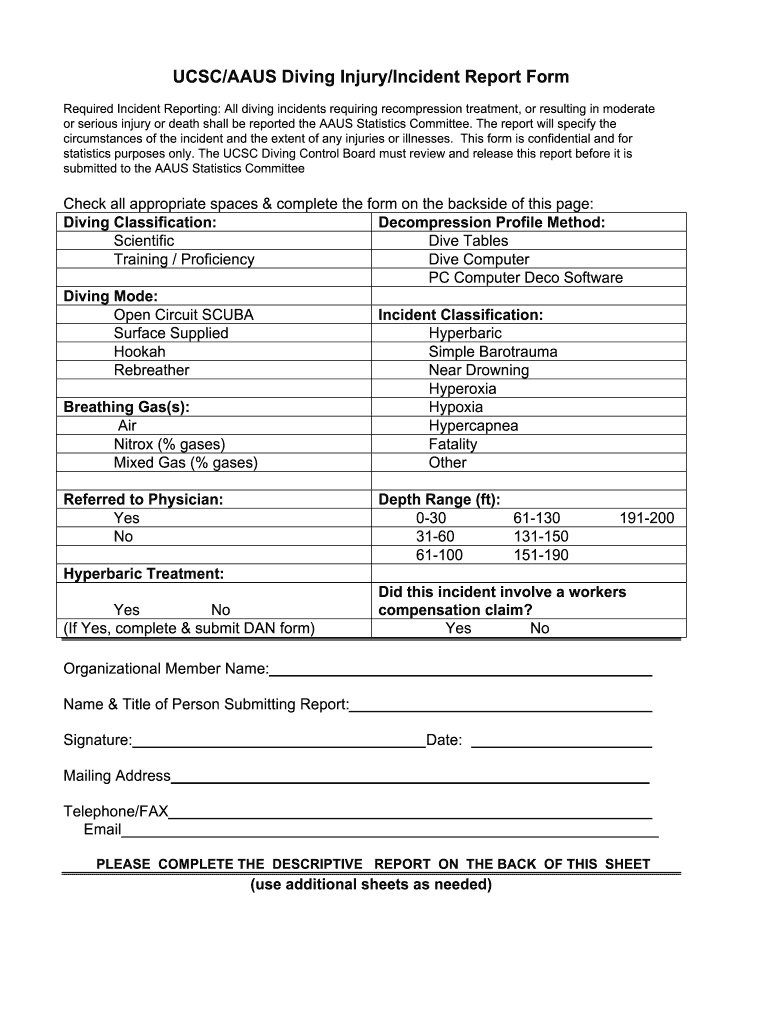
The UCSC AAUS Diving Injury Incident Report Form is a crucial document used within the diving community, particularly by the University of California, Santa Cruz (UCSC) and the American Academy of Underwater Sciences (AAUS). Its primary purpose is to report diving incidents that necessitate recompression treatment or result in significant injuries or fatalities. This form is essential for documenting the circumstances of an incident, detailing injuries sustained, and outlining treatments provided. The comprehensive nature of this form ensures that all relevant details are captured, aiding in the analysis and prevention of future incidents.
How to Use the UCSC AAUS Diving Injury Incident Report Form
Using the UCSC AAUS Diving Injury Incident Report Form involves several critical steps to accurately document a diving incident.
- Initial Details: Begin by filling in the basic information such as the date, location, and time of the incident. This sets the context for further details.
- Diver Information: Record personal details of the diver(s) involved, including their diving qualifications and any relevant medical history.
- Incident Description: Provide a detailed account of the incident, including environmental conditions, equipment used, and the sequence of events.
- Injury Details: Elaborate on the nature of injuries, specifying their severity and immediate symptoms observed.
- Treatment Administered: Detail the first aid and any medical treatment provided on-site, including recompression therapy if applicable.
- Witness Accounts: Gather statements from others present during the incident to offer additional perspectives on the events.
- Recommendations: Finally, propose preventive measures to avert similar incidents in the future.
Each section of the form is designed to ensure comprehensive data collection for effective incident analysis.
Steps to Complete the UCSC AAUS Diving Injury Incident Report Form
Completing the form requires diligence and attention to detail.
- Gather Required Information: Before filling out the form, ensure you have all necessary information at hand, including diver details and any witness accounts.
- Complete Each Section: Methodically fill out each section of the form, ensuring accuracy and completeness.
- Review Before Submission: Carefully review the completed form for any omissions or errors.
- Submit for Review: Send the form to the UCSC Diving Control Board for initial scrutiny prior to submission to the AAUS Statistics Committee.
These steps help in ensuring the form's integrity and utility for investigative purposes.
Important Terms Related to the UCSC AAUS Diving Injury Incident Report Form
Understanding specific terminology is vital when dealing with this form.
- Recompression Treatment: A therapeutic procedure used to treat divers suffering from decompression sickness.
- Diving Classifications: Categories used to identify the type of diving operation or training involved.
- Incident Classifications: This refers to how the incident is categorized, such as equipment failure or human error.
Each term plays a part in accurately describing and categorizing the incident.
Key Elements of the UCSC AAUS Diving Injury Incident Report Form
The form is composed of several critical elements:
- Diver Information: Detailed personal and professional details of the divers involved.
- Incident Narrative: A chronological and precise recount of the incident.
- Injury and Treatment Details: Comprehensive rundown of injuries and medical interventions.
These elements together form the basis for incident analysis and safety recommendations.
Who Typically Uses the UCSC AAUS Diving Injury Incident Report Form
The form is primarily used by:
- Diving Supervisors: Responsible for overseeing diving safety and incident reporting.
- Research and Technical Divers: Personnel engaged in scientific or technical diving operations.
- Diving Control Boards: Entities overseeing diving protocols and safety compliance.
These users ensure that incidents are systematically documented and reviewed.

Legal Use of the UCSC AAUS Diving Injury Incident Report Form
Legal aspects of the form involve compliance with federal and state safety regulations.
- Confidentiality: The form is treated as a confidential document, subject to privacy regulations.
- Regulatory Compliance: Compliance with diving safety standards set by UCSC and AAUS.
- Review and Approval: The form must be reviewed by the UCSC Diving Control Board to validate its contents.
Recognizing these legal considerations ensures proper handling and submission of the form.
Examples of Using the UCSC AAUS Diving Injury Incident Report Form
Real-world scenarios where the form proves vital include:
- Serious Dive-Related Injuries: For incidents requiring immediate medical intervention, such as decompression sickness.
- Fatal Dive Accidents: In unfortunate events involving diver fatalities, meticulous documentation is crucial.
- Near-Miss Reports: Even incidents that did not result in injury but had potential risks are documented for preventive insights.
These examples illustrate the critical role the form plays in maintaining diving safety and standards.




