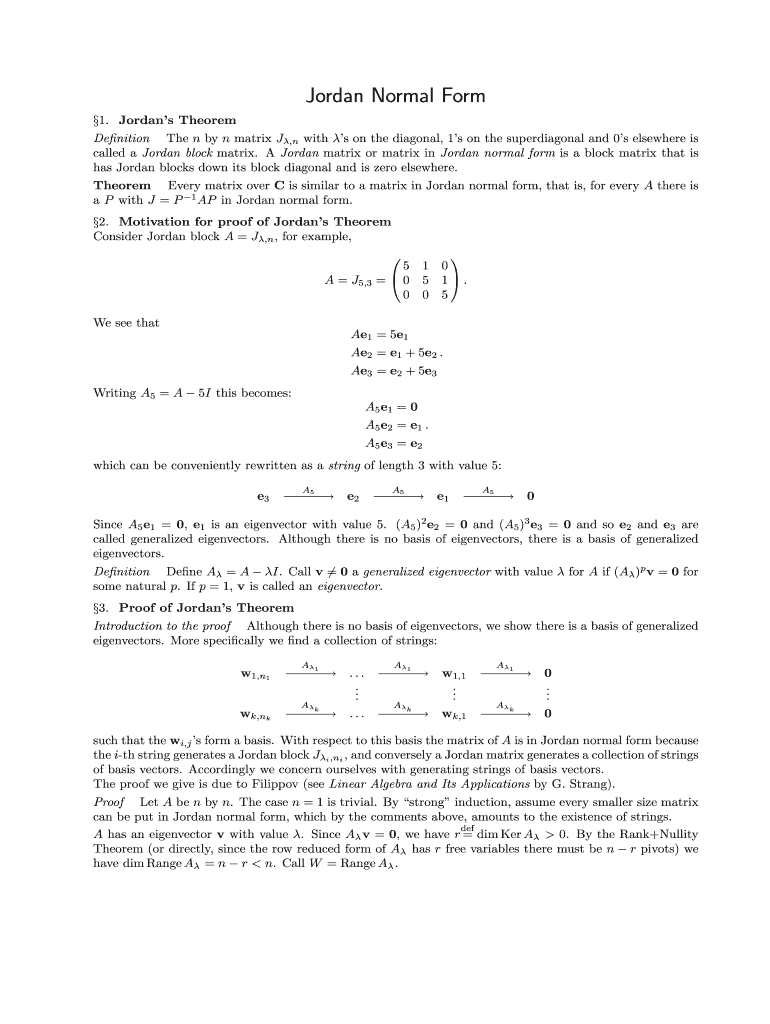







Definition and Meaning of Jordan Normal Form
Jordan Normal Form (JNF) is a canonical form of a matrix that simplifies its structure, making certain types of matrix calculations easier, particularly those involving complex numbers. It is named after the mathematician Camille Jordan. This form allows matrices to be represented in a nearly diagonal format, which is particularly useful in understanding their algebraic properties. In JNF, each matrix is broken down into Jordan blocks, which are special matrices that exhibit repeated eigenvalues in a structured fashion. This breakdown is fundamental in linear algebra, especially in fields such as differential equations, where simplifying matrices can offer insights into the system's behavior.
Jordan Blocks and Their Importance
Jordan blocks are the building blocks of the Jordan Normal Form. They are square matrices with a constant eigenvalue along the diagonal and ones on the superdiagonal, with zeros everywhere else. These blocks simplify the structural representation of matrices that have repeating eigenvalues, helping mathematicians and scientists understand the matrix's geometric multiplicity. For instance, in control systems, Jordan blocks play a crucial role in analyzing system stability and response to inputs.
How to Use the Jordan Normal Form in Math at UCSB
UCSB mathematics courses often utilize the Jordan Normal Form to teach advanced concepts in linear algebra. Students learn to use JNF to analyze matrices' structural properties, solve systems of linear equations, and explore eigenvalues and eigenvectors. Professors typically integrate this into their curriculum to facilitate a deeper understanding of theoretical and practical applications. This is critical for solving complex systems and provides a foundational tool for further study in both pure and applied mathematics.
Steps in Applying JNF at UCSB
- Identify Eigenvalues: Start by computing the eigenvalues of the matrix.
- Determine Eigenvectors: Find the eigenvectors corresponding to each eigenvalue.
- Construct Jordan Blocks: Use the eigenvalues and eigenvectors to construct Jordan blocks.
- Assemble the JNF: Organize these blocks into the Jordan Normal Form.
How to Obtain the Jordan Normal Form
Obtaining the Jordan Normal Form involves a systematic approach to transforming any given matrix into its JNF. This process begins with calculating the eigenvalues of the matrix and determining their algebraic and geometric multiplicities. Following this, you delve into finding the chains of generalized eigenvectors, which form the basis leading to the assembly of Jordan blocks.
Steps to Complete the Process
- Calculate Eigenvalues: Solve the characteristic polynomial of the matrix.
- Identify Chains of Generalized Eigenvectors: For each eigenvalue, build chains that form the basis for Jordan blocks.
- Formulate Jordan Chains: Each chain helps construct a Jordan block.
- Combine Jordan Blocks: These blocks make up the full Jordan Normal Form.
Why You Should Learn Jordan Normal Form
Understanding the Jordan Normal Form is essential for those diving deeply into linear algebra. It is particularly useful for:
- Simplifying Matrix Calculations: JNF provides a way to simplify complex calculations, making certain problems more tractable.
- Understanding Mathematical Structures: It helps in grasping the deeper properties of linear transformations.
- Applications in Various Fields: Numerous applications in engineering, physics, and computer science necessitate a comprehension of JNF.
Key Elements of the Jordan Normal Form
The critical components of JNF involve eigenvalues, generalized eigenvectors, and Jordan blocks. Each element plays a distinctive role in forming this canonical structure:
- Eigenvalues: Determine the diagonal structure of the Jordan blocks.
- Generalized Eigenvectors: Facilitate the formation of chains that lead to Jordan blocks.
- Jordan Blocks: Serve as the fundamental units of JNF, encapsulating repeated eigenvalues into manageable structures.
Importance of Each Element
- Eigenvalues dictate the structure and dimensions of each Jordan block.
- Generalized Eigenvectors ensure the correct formation of these blocks.
- Jordan Blocks simplify the representation and analysis of matrices.
Examples of Using the Jordan Normal Form
In academic settings like UCSB, students gain hands-on experience by converting matrices to JNF as part of solving complex algebraic problems. For example:
- Physics Applications: Calculating vibrations and dynamics in mechanical systems.
- Engineering Problems: Solving control system equations that require simplifying transfer functions.
- Computer Science Algorithms: From machine learning to data mining, optimization algorithms often employ JNF for reduced computational complexity.
Practical Applications
- Control Systems Analysis: JNF simplifies stability assessments.
- Quantum Mechanics: Utilized for solving eigenvalue problems in quantum state functions.
Important Terms Related to Jordan Normal Form
A few key terms are frequently linked to JNF:
- Eigenvalue and Eigenvector: Fundamental concepts needed to reach JNF.
- Generalized Eigenvector: Extends the concept of eigenvectors for repeated eigenvalues.
- Nilpotent Matrix: Part of the Jordan block structure when eigenvalue repetition occurs.
Detailed Explanation of Terms
- Eigenvalues/Eigenvectors define the matrix's fundamental traits.
- Generalized Eigenvectors broaden applications to more complex matrices.
- Nilpotent Matrices capture the essence of matrix power in the Jordan blocks structure.
Versions or Alternatives to the Jordan Normal Form
Alternative methods or variations like the Schur form might also be utilized depending on specific context requirements. While the Schur decomposition is another way to understand matrix structure, it ensures that the matrix is transformed into an upper triangular form using unitary transformations. However, it lacks the detailed insight into the eigenvalue multiplicity provided by JNF, making it an alternative but not a substitute for JNF's precise detail.
Comparison of Methods
- Schur Form: Offers a less detailed, but useful triangular form.
- Jordan Normal Form: Provided deeper insights into matrix structure concerning eigenvector multiplicity and relationships.