






Definition & Meaning
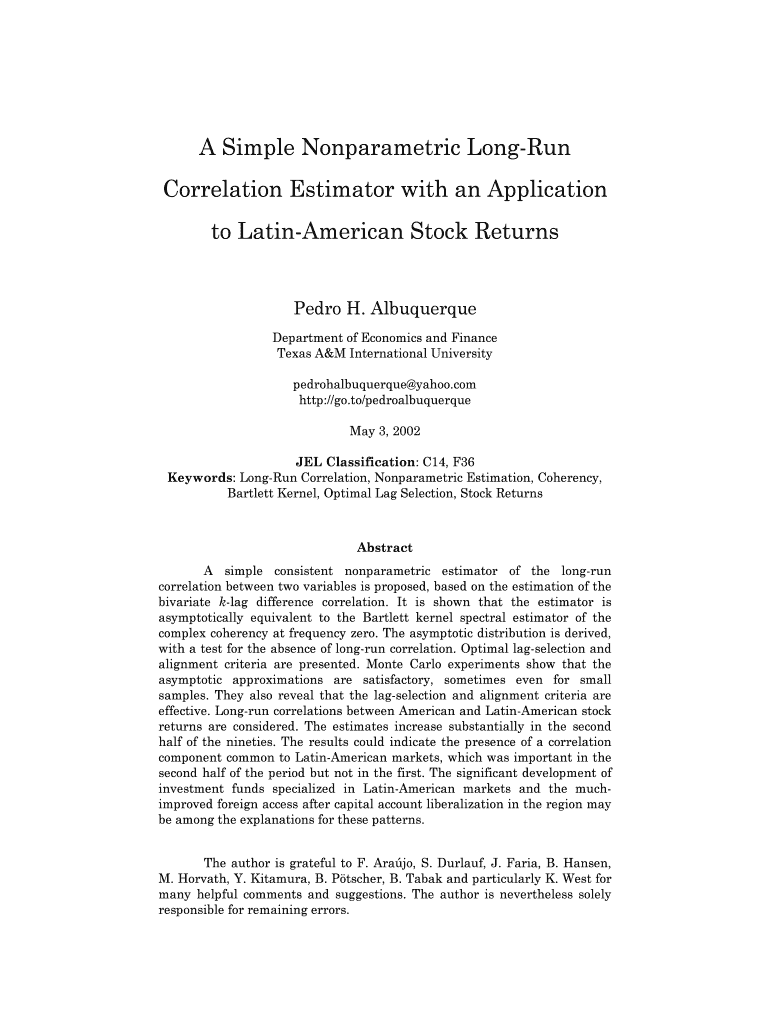
The "A Simple Nonparametric Long-Run Correlation Estimator - UCSD - math ucsd" refers to a statistical tool developed to estimate the long-term correlation between two variables without assuming a particular parametric form. This estimator is crucial for analyzing data where the standard parametric assumptions, such as normality or linearity, do not hold. The concept originated from the University of California, San Diego's mathematics department, reflecting an academic focus on advanced econometric and statistical techniques. It leverages nonparametric methods, thereby offering flexible approaches to data modeling.
Key Elements of the Estimator
- Nonparametric basis: Unlike traditional methods, it does not require the specification of a functional form, making it versatile for various datasets.
- K-lag difference correlation: This component of the estimator helps capture dependencies over multiple periods, enhancing the accuracy of long-term relationships.
- Bartlett kernel spectral estimator equivalence: Demonstrates theoretical robustness by proving asymptotic equivalence to known estimators.
- Applicability: Particularly useful in financial markets, where it can highlight trends and correlations that other models might overlook.
Important Terms Related to the Estimator
- Asymptotic equivalence: A property indicating that as sample size increases, the estimator behaves similarly to another well-established estimator.
- Monte Carlo experiments: Simulations used to validate the estimator's effectiveness across various scenarios and model assumptions.
- Optimal lag-selection: A process of choosing the appropriate number of past periods to consider, crucial for improving estimator accuracy.
How to Use the Estimator
- Identify variables: Choose the variables for which long-run correlation is to be estimated.
- Data preparation: Ensure data is clean and organized, suitable for input into the estimator.
- Selecting lags: Determine the number of lags using optimal lag-selection criteria.
- Implementation: Apply the k-lag difference correlation method to assess the connection between variables.
- Analysis: Interpret the results in the context of financial or econometric goals.
Steps to Complete the Estimator Application
- Gather required data: Collect historical data of the variables under study.
- Choose appropriate software: Use statistical software capable of handling nonparametric methods.
- Input data and specify lags: Enter data and configure lag specifications.
- Run the estimator: Execute the estimator algorithm.
- Validate results: Use Monte Carlo experiments or other methods to ensure the reliability of outcomes.
- Report findings: Interpret the long-run correlations and present the implications for decision-making.
Examples of Using the Estimator
- Stock market analysis: Applied to detect correlations in stock returns across different markets, such as Latin America and the United States, especially during periods of economic integration.
- Economic research: Used to assess the economic relationship between various macroeconomic indicators over long timeframes.
Who Typically Uses the Estimator
- Economists: for studying long-term economic relationships.
- Financial analysts: to uncover hidden patterns in financial data.
- Research institutions: conducting advanced statistical analyses.


Software Compatibility & Integration
The estimator can be easily integrated into existing statistical software platforms such as R, MATLAB, or Python, which support nonparametric methods. This compatibility ensures users can seamlessly incorporate the estimator into their usual analytical workflows.
Legal Use of the Estimator
While using the estimator, it is important to adhere to data privacy laws and regulations, especially when dealing with sensitive financial or personal data. Users should ensure compliance with regulatory standards such as GDPR or specific U.S. data protection laws, depending on the nature of the dataset used in the analysis.