






Definition & Meaning
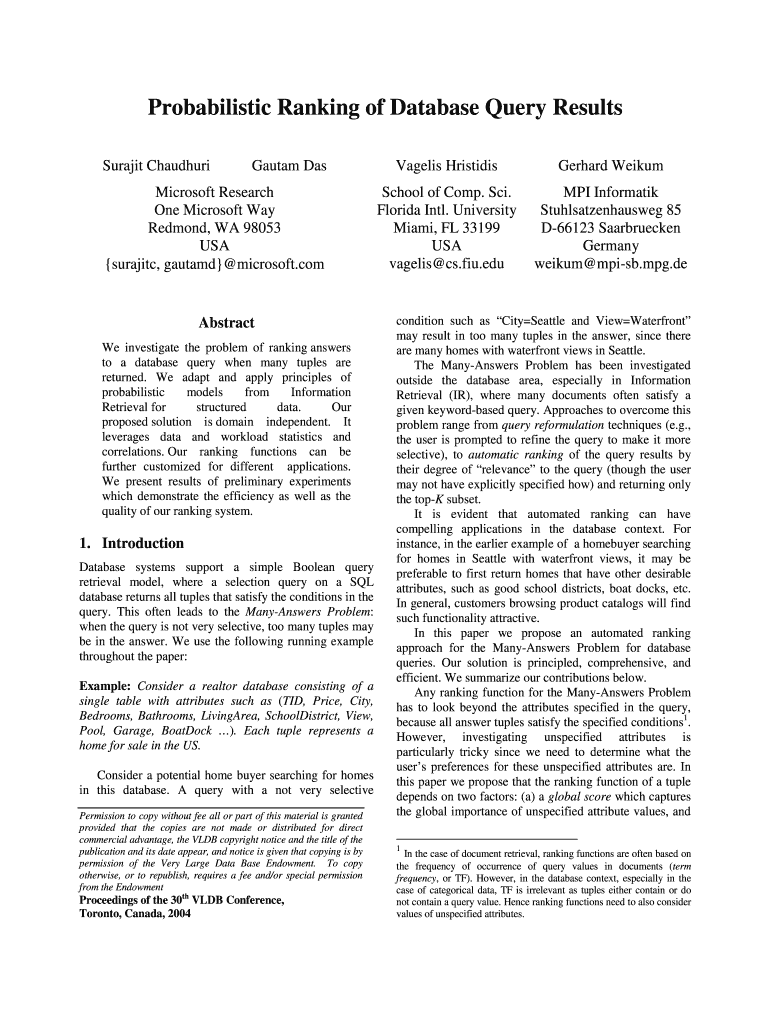
The "Semantics of Ranking Queries for Probabilistic Data and" refers to a framework used for analyzing and interpreting the ranking of query results in databases containing probabilistic data. This framework addresses the challenge of handling uncertainty in data by providing a structured approach to ranking the probable outcomes based on specific statistical models. The aim is to refine the process of retrieving database query results by implementing a ranking mechanism that accounts for both known and unknown data attributes.
The semantics involve the interpretation of data records and their relevance within a probabilistic framework, which is crucial for generating accurate query results. By applying this methodology, databases can efficiently manage queries that return numerous potential results, reducing redundancy and improving the precision of information retrieval.
How to use the Semantics of Ranking Queries for Probabilistic Data and
Using this framework requires a clear understanding of your database's characteristics and the nature of queries you intend to run. Here’s how you can apply it:
-
Understand Probabilistic Models: Familiarize yourself with the information retrieval models adapted for probabilistic data. These models help in setting up the groundwork for ranking, taking into account the uncertainty inherent in data.
-
Define Ranking Functions: Develop ranking functions that evaluate data entries based on global and conditional scores, which consider all possible attributes of the data. This involves deciding on which data attributes carry more weight in specific contexts.
-
Integrate with Existing Systems: Adapt the semantics to complement your existing database architecture. Ensure that your system supports the essential statistical operations required to compute rankings effectively.
-
Run Queries: Implement the ranking algorithms to process your data queries. By prioritizing results based on probabilistic evaluations, the framework ensures that returned data is both relevant and contextually accurate.
-
Evaluate Outcomes: Regularly assess the efficiency and precision of your ranking outcomes using experimental results. Adjust your models and algorithms as needed to improve the application of the semantics.
Steps to Complete the Semantics of Ranking Queries for Probabilistic Data and
-
Identify Query Requirements: Determine the goals and desired outcomes of your queries. Understand what aspects of the data need ranking and leverage this framework to manage these outcome expectations.
-
Collect Data: Gather all relevant data that will be processed under probabilistic scrutiny. This encompasses obtaining and cataloging known data points while preparing for the absence or uncertainty of others.
-
Set Up Ranking Criteria: Craft criteria that contribute to the ranking process. This involves assigning weights to data attributes and devising a scoring mechanism that influences the final results.
-
Design Algorithms: Develop algorithms capable of implementing your ranking criteria within the probabilistic context. This requires proficient use of data structures and computational methods.
-
Run Data Processing: Execute your queries using the established probabilistic ranking mechanisms. Ensure the system robustly processes and ranks results in line with your pre-set functions.
-
Review and Iterate: Continuously assess the effectiveness of your query results. Use iterative testing to refine algorithms and criteria for improved accuracy and relevance.
Key Elements of the Semantics of Ranking Queries for Probabilistic Data and
-
Probabilistic Models: Core components of the semantics, these models help convert uncertainty into manageable data points that can be ranked.
-
Ranking Functions: Essential algorithms that score data based on relevance and probability, considering both specified and unspecified data attributes.
-
Statistical Evaluation: Use of statistical measures and procedures to validate the precision and applicability of the ranking results.
-
Data Attributes: Key attributes of data that are prioritized by the ranking functions, aiding in the categorization and sorting of query outcomes.
-
Global and Conditional Scores: Differentiation of scores based on overall data context as well as specific conditions or attributes affecting individual data entries.
Examples of Using the Semantics of Ranking Queries for Probabilistic Data and
An example could involve a retail company seeking to rank customer purchase probabilities based on past buying behaviors and current trends. By applying probabilistic models, the company can better predict customer habits, refine marketing strategies, and enhance product recommendations accordingly.
Another example is within healthcare databases, where probabilistic rankings can prioritize patient records with higher probabilities of requiring intervention, based on past medical history and demographic data. This actively supports proactive healthcare management and resource allocation.
Important Terms Related to Semantics of Ranking Queries for Probabilistic Data and
-
Tuple: A single entry or record in a database; in probabilistic data contexts, a tuple may represent multiple potential entries based on data uncertainty.
-
Information Retrieval: The process of obtaining information systemically from a large repository, enhanced by probabilistic models in this context.
-
Many-Answers Problem: A common challenge in databases where a single query yields excessively large result sets that require efficient ranking mechanisms to manage.
-
Conditional Probability: Probability of an event occurring in the context of another, significant in assessing specific data outcomes against known attributes.
-
Scoring Mechanisms: Tools and processes used to assign relevance or importance to various data points or attributes.
Who Typically Uses the Semantics of Ranking Queries for Probabilistic Data and
Organizations and professionals dealing with large datasets containing inherent uncertainties tend to utilize these semantics. This includes:
-
Data Scientists: To enhance the accuracy of predictive models and data analyses through refined ranking processes.
-
Database Administrators: To improve the query performance and result relevance, especially in systems processing massive and varied data types.
-
Business Analysts: In leveraging probabilistic data for market, trend analysis, and strategic decision-making.
-
Software Engineers: In developing and refining the systems that facilitate these semantic frameworks, ensuring compatibility and efficiency in query processing.