






Definition & Meaning
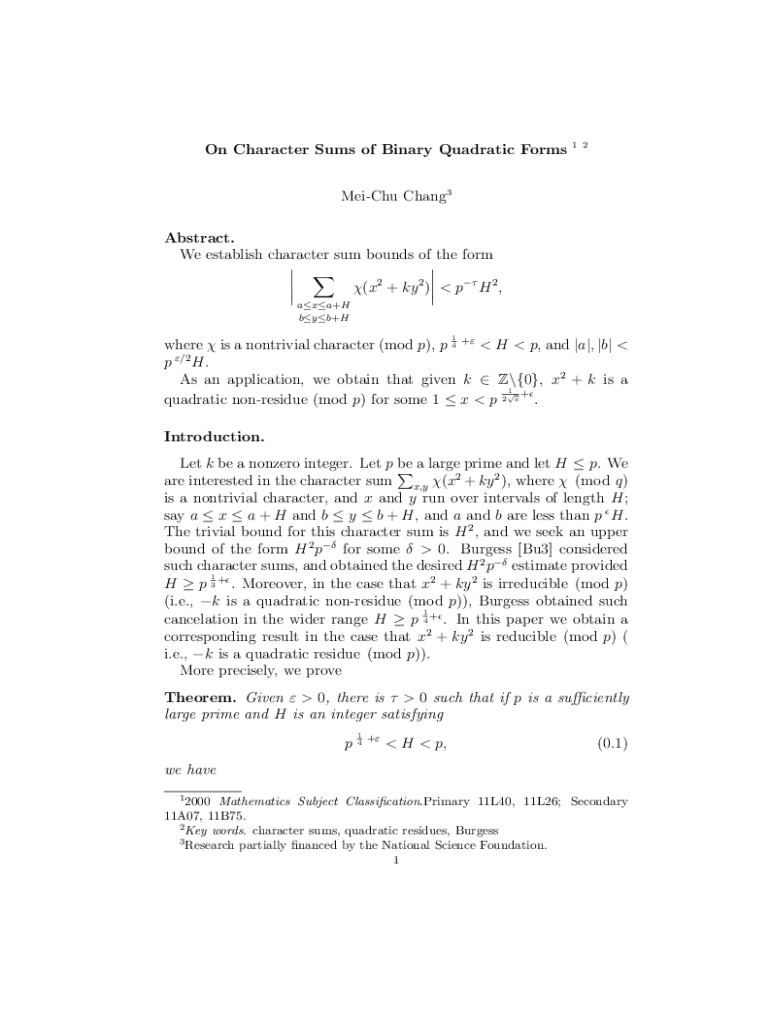
The "On Character Sums of Binary Quadratic Forms 1 2 Mei-Chu Chang3" relates to mathematical analysis in number theory, specifically focusing on character sums associated with binary quadratic forms. In mathematics, a binary quadratic form is a polynomial of the form ax² + bxy + cy², where x and y are variables, and a, b, c are coefficients. The character sum evaluates this form using a nontrivial character, a type of complex-valued function defined modulo a prime number. This analysis is crucial for understanding properties like non-residues and their distribution patterns within number theory.
How to Use the Document
To effectively use the "On Character Sums of Binary Quadratic Forms...", begin by familiarizing yourself with the context of binary quadratic forms and character sums. The document likely outlines methodologies for establishing bounds and performing calculations on specific character sums. Key steps include:
- Understand Character Sums: Grasp the basic principles of character sums and their role in analyzing quadratic forms.
- Study Methodologies: Follow the documented techniques for bounding character sums, possibly leveraging historical methods from mathematicians like Burgess.
- Apply Results: Use provided applications to identify quadratic non-residues within specified numerical ranges under large prime moduli.
Steps to Complete the Analysis
Completing the analysis within this document requires a structured approach:
- Identify Parameters: Determine the binary quadratic form parameters (a, b, c) and choose suitable values for x and y.
- Select Modulo and Character: Choose a large prime number as your modulo and define the nontrivial character to apply in calculations.
- Perform Calculations: Use the methodologies outlined in the document to calculate upper bounds for specified character sums.
- Verify Results: Check calculations against known results or applications to validate the derived bounds.
Key Elements of the Document
- Definition of Binary Quadratic Forms: Provides a clear understanding of the basic construction of quadratic polynomials in two variables.
- Character Sums: Details on how character sums are evaluated and their significance in mathematical proofs.
- Proof Techniques: Descriptions of mathematical proofs and bounding methodologies.
- Applications to Number Theory: Explorations of character sums in identifying quadratic residues and non-residues.
Important Terms Related to the Document
- Character Sum: A sum involving a nontrivial character, used to evaluate properties of numbers under modular arithmetic.
- Quadratic Non-Residue: A number that is not a square modulo a prime.
- Bounding Techniques: Mathematical approaches to deciding upper limits for character sums.
Examples of Using the Document
The document provides several practical examples:
- Bounding Exercises: Step-by-step execution of bounding exercises for character sums.
- Applications in Number Theory: Examples illustrating the document’s results in proving quadratic non-residues.
Legal Use of the Document
While the document is primarily mathematical, its results may be used in academic and research contexts, contributing to further studies in number theory and related fields. Its findings are often safeguarded under academic integrity guidelines, ensuring proper citation and use.
Who Typically Uses the Document
The content of this document is generally utilized by:
- Mathematicians: Engaged in research related to number theory and quadratic forms.
- Academic Researchers: Exploring computational theories and algorithmic applications.
- Graduate Students: Studying advanced topics in mathematics, especially those specialized in theoretical number analysis.


State-Specific Rules for Mathematical Applications
While state-specific legal guidelines do not directly apply to mathematical analyses, academic institutions across different states in the U.S. may have varied standards for the application or publication of these findings in educational settings.