






Definition and Meaning of Directional Resolution
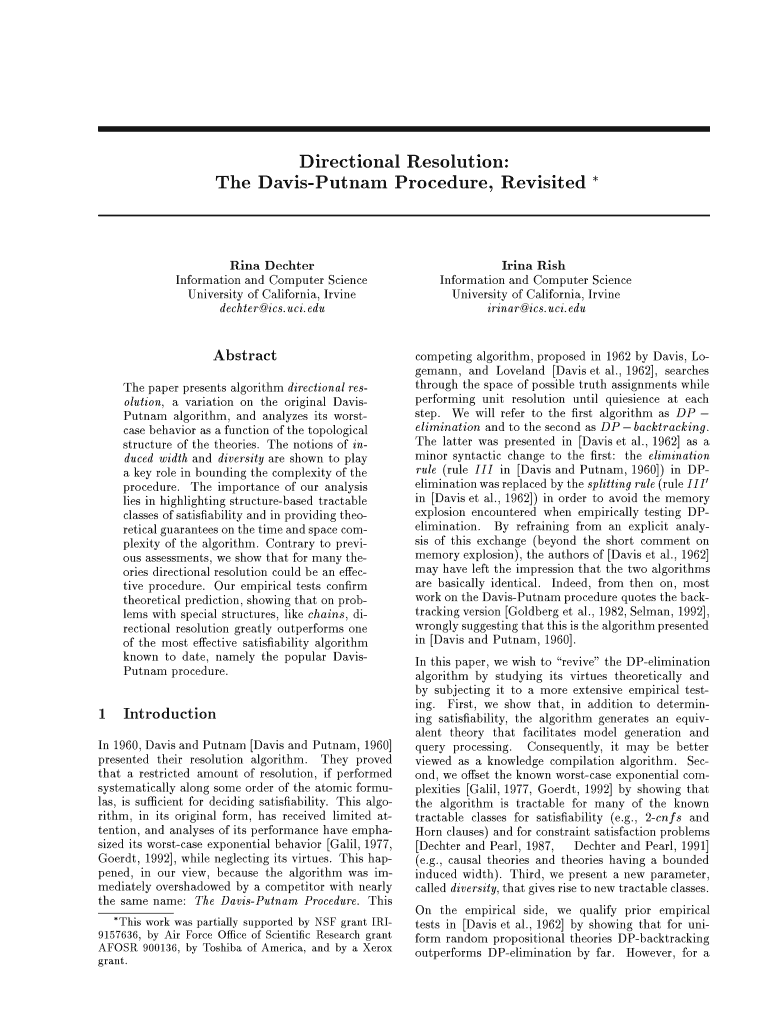
Directional Resolution is a concept that originated in computational theory, specifically related to the Davis-Putnam algorithm. This approach involves a variation that leverages the topological structure of logical theories to determine complexity. It is particularly valuable in handling complex structures like chains, where traditional methods such as DP-backtracking may fall short. Understanding its definition provides a foundation for exploring its applications in knowledge compilation and problem-solving within structured domains. Directional Resolution is not universally applicable to all satisfiability problems, but it excels in specific scenarios where traditional methods might struggle.
How to Use Directional Resolution
Directional Resolution can be applied to a variety of logical theories to simplify solving complex problems. This method involves examining the induced width and diversity of a theory to determine the best direction for resolution. By strategically selecting the path based on these factors, users can focus on more manageable subproblems, effectively breaking down the original complex theory. In practice, this is often used in fields such as artificial intelligence and software development, where simplifying and solving logical expressions quickly is crucial for efficiency.
Steps to Complete the Directional Resolution Process
-
Analyze the Theory's Structure: Start by examining the structure of the logical theory in question. Identify chains and other specific structures that might benefit from directional resolution.
-
Determine Induced Width and Diversity: Calculate these parameters to assess how the theory can be decomposed effectively. These calculations will guide the resolution process.
-
Select Resolution Path: Based on the analysis, choose the most promising direction for resolution. This step is critical for simplifying the problem as efficiently as possible.
-
Apply Resolution: Implement the directional resolution strategy, breaking down the problem into smaller, more manageable subproblems.
-
Verify and Compile: Once resolved, ensure the solution is verified and knowledge is compiled for future reference. This step ensures that the solution is robust and repeatable in similar scenarios.
Key Elements of Directional Resolution
Directional Resolution consists of several key elements that form the backbone of the process. These include:
- Topological Structure: The spatial arrangement of the logical theory, which plays a critical role in determining the resolution path.
- Induced Width: A measurement that reflects the complexity of the problem by gauging potential overlaps or dependencies between substructures.
- Diversity: The variety and uniqueness of elements within the theory, affecting how resolution paths are selected.
Understanding these elements is crucial for anyone looking to employ directional resolution effectively.
Important Terms Related to Directional Resolution
To grasp the intricacies of Directional Resolution, familiarize yourself with several important terms:
- DP-Backtracking: A traditional method that is sometimes outperformed by directional resolution in certain scenarios.
- Chains: Specific structures within logical theories well-suited for directional resolution.
- Knowledge Compilation: The process of summarizing resolved information for future use in problem-solving.
These terms represent the core aspects that anyone working with directional resolution should understand.
Examples of Using Directional Resolution
Directional Resolution proves especially useful in specific cases:
- Artificial Intelligence: In AI, simplifying logical expressions quickly can improve system response time and accuracy.
- Large Data Sets: When dealing with large volumes of logical expressions, directional resolution can streamline problem-solving by focusing on efficient resolution paths.
- Software Development: Directional resolution helps in developing more robust applications by enabling faster problem-solving with logical theories.
Real-world scenarios demonstrate that directional resolution can greatly enhance the efficiency and effectiveness of problem-solving in complex domains.
Who Typically Uses Directional Resolution
Directional Resolution is primarily used by professionals in fields that require complex problem-solving with logical theories. These include:
- Data Scientists: In AI and machine learning contexts, data scientists use directional resolution to handle complex logic.
- Software Developers: Developers working on logical frameworks often employ directional resolution for efficient problem-solving.
- Academic Researchers: In theoretical computer science, researchers use directional resolution to explore new algorithms and problem-solving techniques.
Understanding the typical users of directional resolution highlights its applications and relevance in various professional settings.
Business Types That Benefit Most from Directional Resolution
Several business types stand to gain significantly from implementing directional resolution in their operations:
- Tech Companies: Companies developing software solutions and applications can leverage directional resolution for efficient problem resolution within their products.
- Research Institutions: Universities and research institutions focusing on computational theory and artificial intelligence benefit from the streamlined logic processing capabilities of directional resolution.
- Consultancies: Firms that provide strategic advisory on technology implementation can use directional resolution to optimize problem-solving frameworks for their clients.
Recognizing the industries where directional resolution offers the most value underscores its strategic importance in today's digital landscape.