






Definition and Meaning
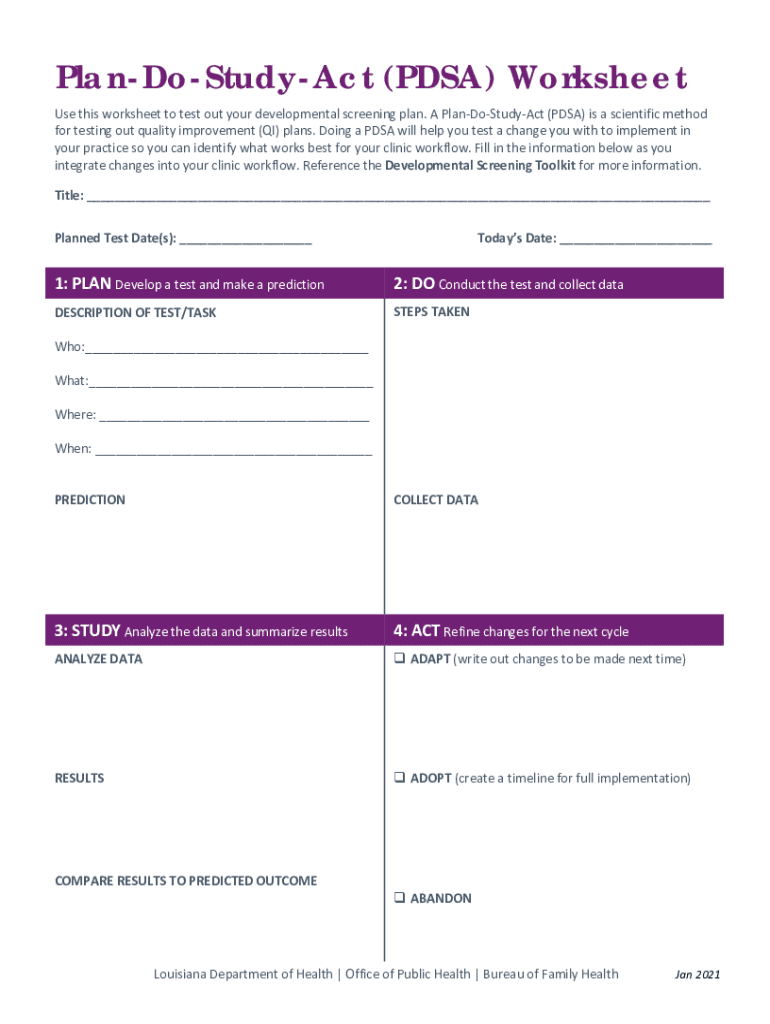
The Plan-Do-Study-Act (PDSA) cycle is a systematic series of steps for gaining valuable learning and knowledge for the continual improvement of a product or process. The "Fillable Plan Do Study Act (PDSA) Tool for Health Care PDSA Cycle Template" is specifically designed for health care professionals to facilitate the application of this methodology. It helps in planning tests, executing them, studying the outcomes, and acting upon the insights gained for refining processes. This tool is particularly useful in the context of developmental screenings and testing strategies in health care settings.
Steps to Complete the PDSA Tool
-
Plan: Start by outlining the objectives, identifying the team involved, and specifying the data to be collected. Predict the outcomes and prepare for any obstacles.
-
Do: Implement the plan on a small scale. Collect the necessary data and document any issues or unexpected results during this phase.
-
Study: Analyze the collected data to compare the predicted outcomes with actual results. This step involves critical discussion on what was learned.
-
Act: Based on the results of the study phase, decide whether to adapt the plan, adopt the change, or abandon the approach. This might lead to another cycle of changes to ensure continuous improvement.
Key Elements of the PDSA Tool
- Objective Statement: Clearly defines the desired outcome of the test.
- Prediction of Outcomes: Foresees potential results based on experience and knowledge.
- Data Collection Plan: Details about what information will be gathered and how it will be measured.
- Analysis Techniques: Methods used to interpret the data and ensure it aligns with initial predictions.
- Action Plan: Strategy for implementing what has been learned, which may involve additional planning for future cycles.
Importance of Using the PDSA Tool
The PDSA Tool is crucial for systematic process improvement in health care. It offers a structured framework to test changes efficiently and effectively. By utilizing this tool, health care facilities can improve patient outcomes, enhance operational efficiencies, and foster a culture of continuous improvement.
Who Typically Uses the PDSA Tool
The primary users of the PDSA Tool are health care professionals, including clinic managers, quality improvement teams, and staff involved in patient care improvement projects. It is especially beneficial in environments that demand rapid cycles of experiments to address challenges in patient care and operational processes.


Important Terms Related to the PDSA Tool
- Developmental Screening: Evaluation for identifying children with developmental delays early.
- Test Cycle: One complete cycle of the PDSA, from planning to acting.
- Root Cause Analysis: Identifying the underlying reasons why a particular problem occurred.
- Continuous Improvement: Ongoing effort to improve products, services, or processes.
Examples of Using the PDSA Tool
-
Autism Screening Enhancement: Using the tool to refine and standardize the process of autism screenings in a pediatric clinic by testing different approaches to patient engagement and data collection.
-
Efficiency in Scheduling: A clinic might use the PDSA cycle to test new methods for scheduling patient appointments to reduce wait times and no-show rates.
How to Obtain the PDSA Tool
The PDSA tool can be accessed online through document management platforms like DocHub. Users can download the template, fill it out directly on the platform, or print it for manual completion. This flexibility ensures that the tool is accessible to anyone with internet access and compatible devices, enhancing the ease of use and distribution among health care teams.