







Definition and Meaning
A Bachelor of Business Administration (BBA) degree focusing on Global Logistics and Supply Chain Management from the University of Alaska Anchorage provides students with an in-depth understanding of supply chain dynamics and global logistics. This program combines foundational business knowledge with specialized courses in logistics, enabling students to manage the flow of goods, services, and information across complex global networks. Students learn about critical aspects such as procurement, distribution, and operations, all of which are vital components in today’s interconnected market environments.
Steps to Complete the BBA Global Logistics and Supply Chain Management
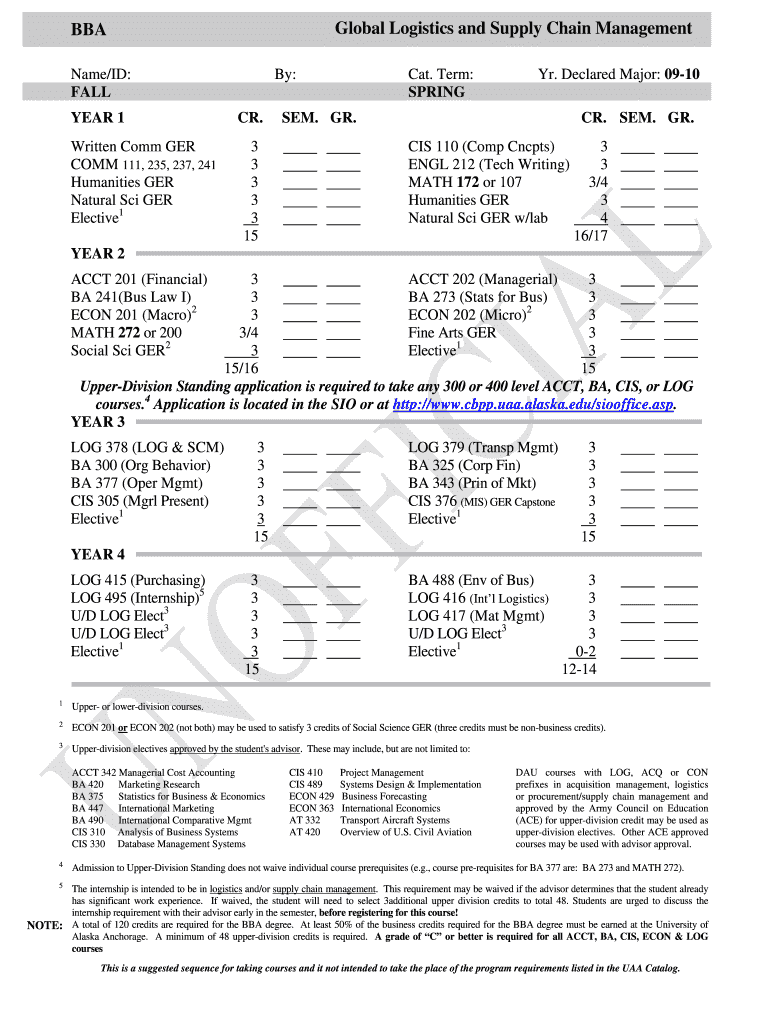
To complete the BBA in Global Logistics and Supply Chain Management, students must follow a structured curriculum over four years:
- Year One: Focus on general education requirements, including introductory courses in business and economics.
- Year Two: Begin specialized courses, such as principles of management and introductory supply chain management, alongside general business courses.
- Year Three: Advance to upper-division courses, covering areas like logistics strategies, operations management, and decision analysis.
- Year Four: Complete capstone courses and an internship in logistics or supply chain management to gain practical experience. Choose electives that further enhance sector-specific knowledge.
Key Elements of the BBA Global Logistics and Supply Chain Management
The BBA program encompasses several key components essential for success in logistics and supply chain roles:
- Coursework: Includes topics like supply chain management, international logistics, business law, and strategic management.
- Internships: Allows students to gain hands-on experience in real-world logistics and supply chains.
- Electives: Offers flexibility for students to explore related fields, such as marketing or information systems.
- Capstone Project: Encourages students to apply learned theories and practices to solve industry-related problems.
Important Terms Related to BBA Global Logistics and Supply Chain Management
Understanding logistics and supply chain management requires familiarity with essential terminology:
- Logistics: The process of planning, implementing, and controlling the efficient movement and storage of goods.
- Supply Chain: The network of organizations involved in producing and delivering a product.
- Procurement: The process of acquiring goods and services from external sources.
- Operations Management: Overseeing, designing, and controlling production processes.
- Distribution: The process of making a product available for consumption by a business or individual.
Examples of Using the BBA Global Logistics and Supply Chain Management
Graduates of the BBA program apply their knowledge to various real-world scenarios, such as:
- Optimizing Distribution Networks: Using data analysis to streamline processes and reduce costs in shipping networks.
- Procurement Strategy Development: Developing strategies for acquiring goods that balance cost-efficiency with sustainability.
- Supply Chain Risk Management: Identifying potential disruptions in supply chains and formulating contingency plans to mitigate risks.
Business Types That Benefit Most from the Program
Businesses that stand to benefit significantly from hiring professionals with a BBA in Global Logistics and Supply Chain Management include:
- Retailers: Efficient supply chain management is crucial to ensure timely product availability.
- Manufacturers: Need to manage raw materials and final product distribution effectively.
- Logistics Providers: Require expertise in optimizing transportation and warehousing operations.
- E-commerce Companies: Depend heavily on supply chain management to maintain competitive delivery timelines and inventory management.
Required Documents for Enrollment
Prospective students need to submit several key documents as part of their application to the program:
- Official Transcripts: Required from all previously attended schools.
- Letters of Recommendation: Preferably from educators or professionals familiar with the applicant’s aptitude for business studies.
- Personal Statement: Articulating career goals and interest in logistics and supply chain management.
- Standardized Test Scores: Depending on university requirements, scores from tests like the SAT or ACT may be necessary.
Eligibility Criteria
Before applying for the BBA program, prospective students must meet specific eligibility requirements:
- High School Graduation: Or equivalent qualification.
- Mathematics Proficiency: Demonstrated capability in high school-level mathematics, often through scores in standardized testing.
- English Language Proficiency: For non-native speakers, completion of proficiency tests like TOEFL or IELTS is required.
- Minimum GPA: Typically, universities have a minimum cumulative GPA requirement, frequently around a B average.

Form Submission Methods
Applicants can submit necessary documents and apply via several methods:
- Online Application: Many universities offer digital platforms for submitting applications and accompanying documents.
- Mail: Printed applications and documents can typically be sent to the university's admissions office.
- In-Person: Some students may prefer to deliver documents directly to the institution, often done during campus visits or open days.




