






Introduction to Recursive Search with Backtracking
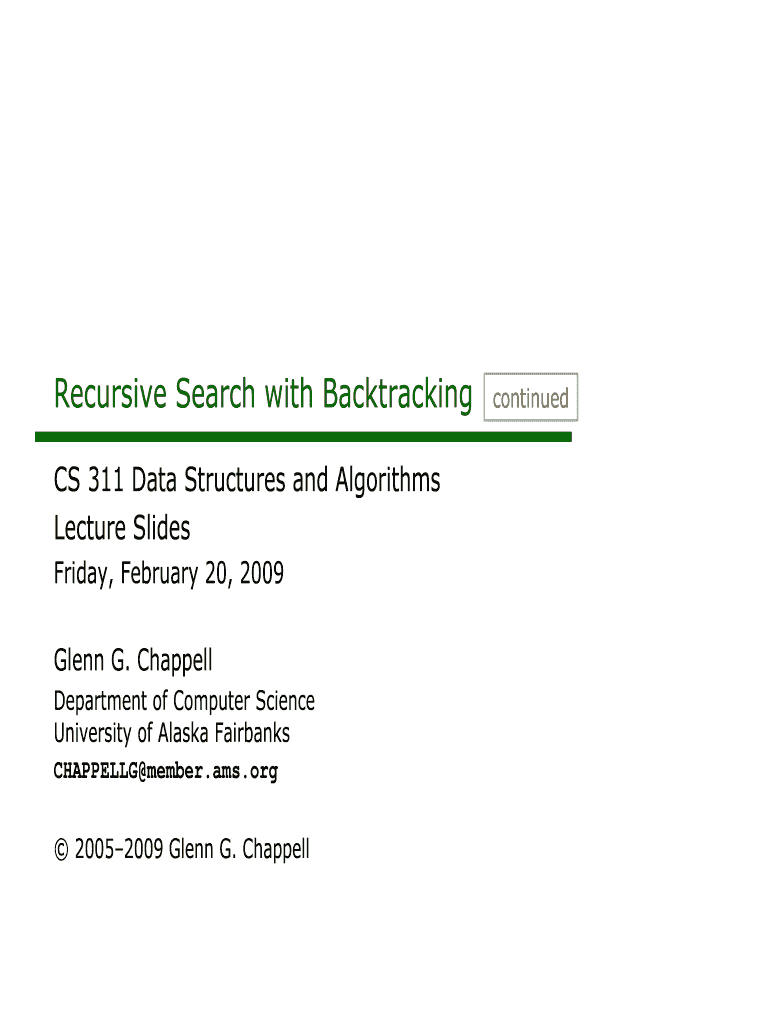
Recursive search with backtracking is a fundamental algorithmic technique used to solve complex problems by breaking them down into simpler subproblems. This method systematically explores all possible solutions and backtracks to previous choices whenever a dead end is reached. This technique is particularly effective for problems involving combinatorial search, where one needs to examine a large number of possible configurations or solutions.
Key Concepts in Recursive Search and Backtracking
Recursion in Problem Solving
Recursion is a core concept within computer science, characterized by functions that call themselves to solve subproblems. In recursive search, each call attempts to handle part of the problem, relying partly on other calls to address the rest.
- Base Cases: These are conditions under which the recursive function will directly return a solution without further calls. Base cases prevent infinite recursion by terminating the function once the problem is sufficiently simplified.
- Recursive Calls: These involve invoking the function on a smaller subset of the original problem, gradually working toward the base case.
Backtracking Fundamentals
Backtracking is used in conjunction with recursion to build solutions incrementally, allowing the algorithm to abandon any path that fails to solve the problem.
- Partial Solution Building: The process involves exploring and constructing partial solutions, retracting when a path leads to invalid or unsatisfactory outcomes.
- Pruning: It’s crucial to efficiently “prune” branches of the search tree that cannot yield a valid solution, which helps reduce computational overhead.
Practical Applications of Recursive Search with Backtracking
Recursive search with backtracking is used in various applications where dynamic exploration of possibilities is required.
N-Queens Problem
One classic example is the n-Queens problem, which involves placing n queens on an n×n chessboard such that no two queens threaten each other. Recursive search explores each possible placement, backtracking when an invalid position is encountered.
Holey Domino Tilings
Another application is Holey Domino tilings, where dominoes must cover a board with certain cells blocked, further illustrating the backtracking approach to handle constraints in configuration.
Steps to Implement Recursive Search with Backtracking
- Define the Problem Clearly: Begin by clearly articulating the constraints and the goal of the search.
- Identify the Base Case: Determine the termination condition for the recursive function.
- Establish a Recursive Structure: Develop a recursive logic that divides the problem into smaller parts.
- Incorporate Backtracking Logic: Implement backtracking by retracting choices when they lead to invalid states.
- Optimize with Pruning Techniques: Use strategies to eliminate unnecessary paths, reducing computational time and resource use.
Important Terminology in Recursive Search with Backtracking
Understanding specific terms is vital to effectively implement recursive search with backtracking.
- Depth-First Search (DFS): A search algorithm that explores as far as possible along a branch before backtracking.
- Exploration Tree: A conceptual tree structure representing all possible states or solutions explored during the search.
- Memoization: A technique for optimizing recursive algorithms by storing results of expensive function calls and reusing them when needed.
Examples and Scenarios for Recursive Search with Backtracking
Real-World Examples
- Sudoku Solver: Recursive search can solve sudoku puzzles by filling in numbers and backing out on encountering an invalid board state.
- Maze Navigation: Navigate through mazes, exploring paths until the exit is found and backtracking wherever dead ends occur.
Practical Case Studies
- Puzzle Games: Games involving sequence finding, like finding a target number in a grid of operations, often employ recursive search techniques.
- Algorithm-Based Trading: Some trading algorithms use recursive backtracking to generate and test potential investment strategies.
Variations and Versions of Recursive Search with Backtracking
Over time, several alternatives and variations have emerged to fine-tune the backtracking process.
Heuristic-Based Backtracking
Heuristic techniques help improve the efficiency of backtracking by guiding search strategies toward promising areas based on domain-specific insights.
Constraint Propagation
This approach involves pre-checking constraints at each recursive step to further reduce unnecessary exploration paths.
Business and Technical Use Cases
Who Uses Recursive Search with Backtracking?
- Software Developers: Engineers implementing algorithmic solutions for complex problems.
- Research Scientists: Those exploring large datasets or solving optimization problems.
- Game Developers: Individuals working on games requiring logical exploration and problem resolution.
Software and Tool Compatibility
Tools like TurboTax and QuickBooks might not directly use recursive search with backtracking, yet the underlying logic of their algorithms might incorporate similar decision-making structures in handling financial data, optimizing tasks, or conducting analytics.
Incorporating and understanding recursive search with backtracking allows for effective problem-solving in both theoretical and practical contexts, making it an invaluable tool for various fields.