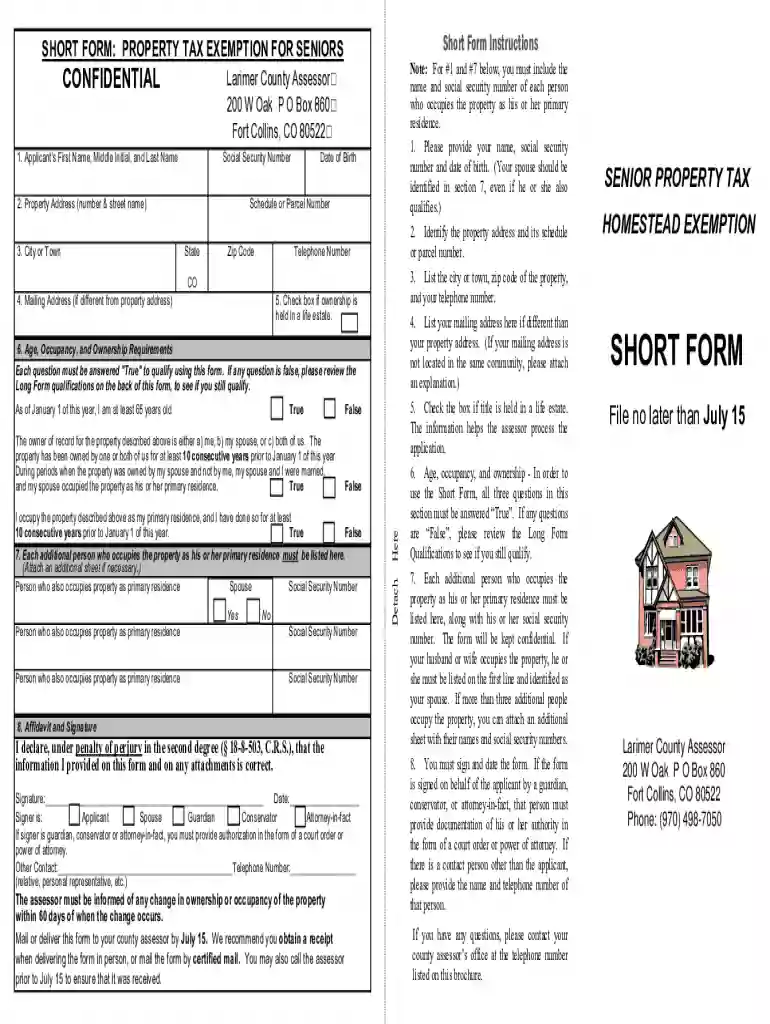
01. Edit your larimer county property tax exemption for seniors online
Type text, add images, blackout confidential details, add comments, highlights and more.

Type text, add images, blackout confidential details, add comments, highlights and more.

Draw your signature, type it, upload its image, or use your mobile device as a signature pad.

Send larimer county senior tax exemption via email, link, or fax. You can also download it, export it or print it out.
The Larimer County Property Tax Exemption for Seniors is designed to provide tax relief to senior citizens who meet specific qualifications. To be eligible, applicants must:
There are exceptions for surviving spouses, who may still qualify for the exemption if their spouse had previously met the requirements. The exemption does not apply to non-residential property or second homes.


Seniors interested in the property tax exemption must submit an application to the Larimer County Assessor's Office. The application typically opens in January and must be submitted by a set deadline, often the first working day in July, to qualify for that tax year.
After submission, the Assessor’s Office reviews the applications, and approval or denial notifications are typically sent within a few weeks. Approved exemptions take effect during the next billing cycle.
The property tax exemption in Larimer County for seniors lowers the taxable value of an eligible senior's primary residence. It reduces the taxable value by 50%, up to a maximum of $100,000 in property value. This results in a direct reduction in property taxes owed.
This exemption aims to assist seniors with managing living costs, particularly those on fixed incomes, by reducing their overall property tax burden.
Understanding the terms associated with this exemption is crucial:
Familiarity with these terms helps in the accurate completion of the application and maximizes the chances of approval.
To support the application for the property tax exemption, applicants need to provide several documents:
These documents verify the compliance with eligibility criteria. Missing documentation can delay or prevent approval.
Completing the application accurately is essential for obtaining the exemption:
Following these steps ensures that the application is complete and ready for review by the Assessor's Office.
Participating in this program offers significant financial benefits:
This exemption is a vital tool for supporting senior citizens' ability to age in place with financial security.
Several state-specific rules govern the property tax exemption for seniors in Colorado, where Larimer County is located:
Understanding these state-level nuances is critical for maintaining ongoing eligibility for the property tax exemption.
At DocHub, your data security is our priority. We follow HIPAA, SOC2, GDPR, and other standards, so you can work on your documents with confidence.