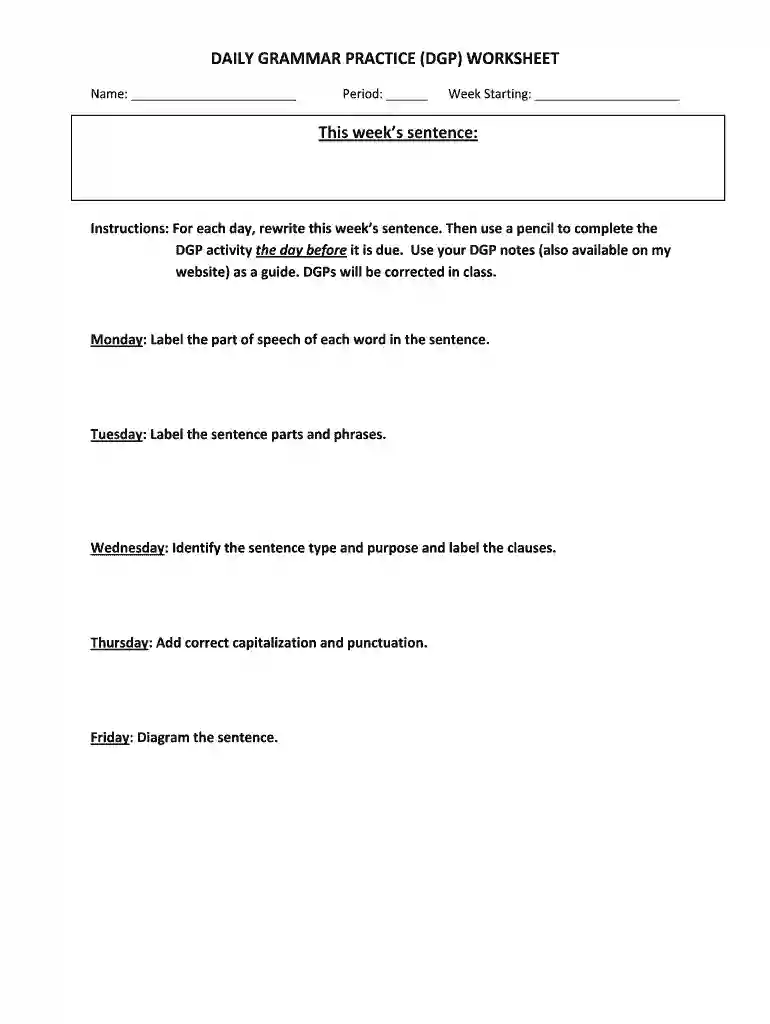
Definition and Meaning of DGP Worksheets
Daily Grammar Practice (DGP) worksheets are structured educational resources focused on enhancing students' grammatical skills through systematic daily exercises. Each worksheet is designed to incrementally build a student’s understanding of grammar, starting with basic sentence elements and advancing to more complex structures. It includes activities such as identifying parts of speech, analyzing sentence components, understanding punctuation rules, and practicing diagramming for visual sentence breakdowns. These worksheets provide a sequential and focused approach, benefiting students in grasping the intricate rules and applications of grammar in a practical and engaging manner.
How to Use DGP Worksheets
DGP worksheets are used by students to develop their grammar proficiency through consistent and targeted practice. Typically, the worksheets break grammar instruction into daily tasks, allowing students to focus on one aspect of grammar at a time. For instance, a single worksheet might begin the week with parts of speech identification, move to sentence structure analysis midweek, and conclude with punctuation and syntax. Educators are encouraged to integrate these worksheets into daily lesson plans, encouraging students to complete each exercise thoughtfully and thoroughly. This structured approach helps solidify grammar concepts through repetition and progressive learning.
Weekly Structure
- Monday: Parts of speech identification
- Tuesday: Sentence structure analysis
- Wednesday: Punctuation enhancement
- Thursday: Diagramming sentences
- Friday: Comprehensive review and application
Steps to Complete DGP Worksheets
Completing DGP worksheets requires systematic attention to each daily task. Here’s a typical process:
- Review the Instructions: Begin by carefully reading the day’s task and any examples provided.
- Identify Sentence Elements: For tasks focusing on parts of speech, underline or highlight the elements within the given sentences.
- Analyze Sentence Structure: Break down each sentence into its grammatical components, identifying subjects, predicates, and objects.
- Apply Punctuation Rules: Insert appropriate punctuation marks as necessary, adhering to standard grammar rules.
- Diagram Sentences: Draw diagrams illustrating the hierarchical structure and relationship of components within each sentence.
- Summarize Learning: At the end of the week, summarize key grammar points learned and areas for improvement.
Why Use DGP Worksheets
The primary purpose of DGP worksheets is to bolster a student's understanding and confidence in using correct grammar. They provide:
- Incremental Learning: Each day's focus allows students to build on previous knowledge without becoming overwhelmed by the complexity.
- Practical Application: Exercises mimic real-world scenarios, facilitating the practical application of grammar rules.
- Routine Practice: Daily engagement with grammar helps reinforce learning and improve long-term retention.
- Skill Assessment: Regular completion helps teachers gauge progress and identify areas needing additional support.
Who Typically Uses DGP Worksheets
DGP worksheets are widely used by:
- Elementary and Middle School Students: To build foundational grammar skills.
- High School Students: For refining advanced grammar techniques and preparing for standardized tests.
- Teachers: As a classroom resource for daily grammar lessons and student assessments.
- Parents: Homeschool parents often use these worksheets to supplement their grammar curriculum.
Important Terms Related to DGP Worksheets
Understanding key terms associated with DGP worksheets enhances their effective use:
- Parts of Speech: The categories that define how words function in sentences, such as nouns, verbs, adjectives, etc.
- Sentence Structure: The arrangement of words in a sentence to convey meaning, including elements like subject, verb, and object.
- Punctuation: Marks used to clarify meaning by indicating separation of words into sentences, clauses, etc.
- Diagramming: A visual representation of the grammatical structure of a sentence.
Key Elements of DGP Worksheets
DGP worksheets comprise several critical components designed to reinforce grammar skills:
- Daily Tasks: Each task targets a specific aspect of grammar.
- Examples: Sample sentences and exercises to guide student learning.
- Progressive Difficulty: Tasks increase in complexity over time.
- Feedback Section: Areas for teacher or self-evaluation upon completion of tasks.
Examples of Using DGP Worksheets
An example of using a DGP worksheet in practice might involve a student starting the week by identifying and labeling verbs and nouns in provided sentences. By midweek, they might be examining the sentence structure, determining the function of each word. By the week’s end, they could be punctuating complex sentences and creating diagrams to visualize grammatical relationships. This method solidifies concepts by revisiting and expanding on them every day.
Versions or Alternatives to DGP Worksheets
While DGP worksheets are popular, other forms may be used for similar purposes, such as:
- Grammar Workbooks: Provide comprehensive exercises covering broader grammar topics.
- Interactive Software Programs: Offer digital grammar quizzes and tutorials.
- Online Platforms: Websites like Khan Academy offer free instructional videos and exercises.
- Customized Teacher-Made Worksheets: Tailored to specific classroom needs or student competencies.
State-by-State Differences
While DGP worksheets serve a universal educational purpose, variations might occur based on state educational standards:
- Curriculum Alignment: States may have specific standards that dictate grammar skills per grade level—affecting worksheet choice.
- Assessment Requirements: Some states may incorporate specific grammar criteria into standardized testing, encouraging teachers to adapt DGP worksheets to meet these expectations.
Software Compatibility for DGP Worksheets
While these worksheets traditionally come as printed material, integrating digital tools like:
- Google Docs: For editing and sharing completed worksheets.
- PDF Editors: Such as DocHub, allow for annotating and storing worksheet copies digitally.
- Learning Management Systems (LMS): Facilitates the assignment and tracking of worksheets as part of student coursework.