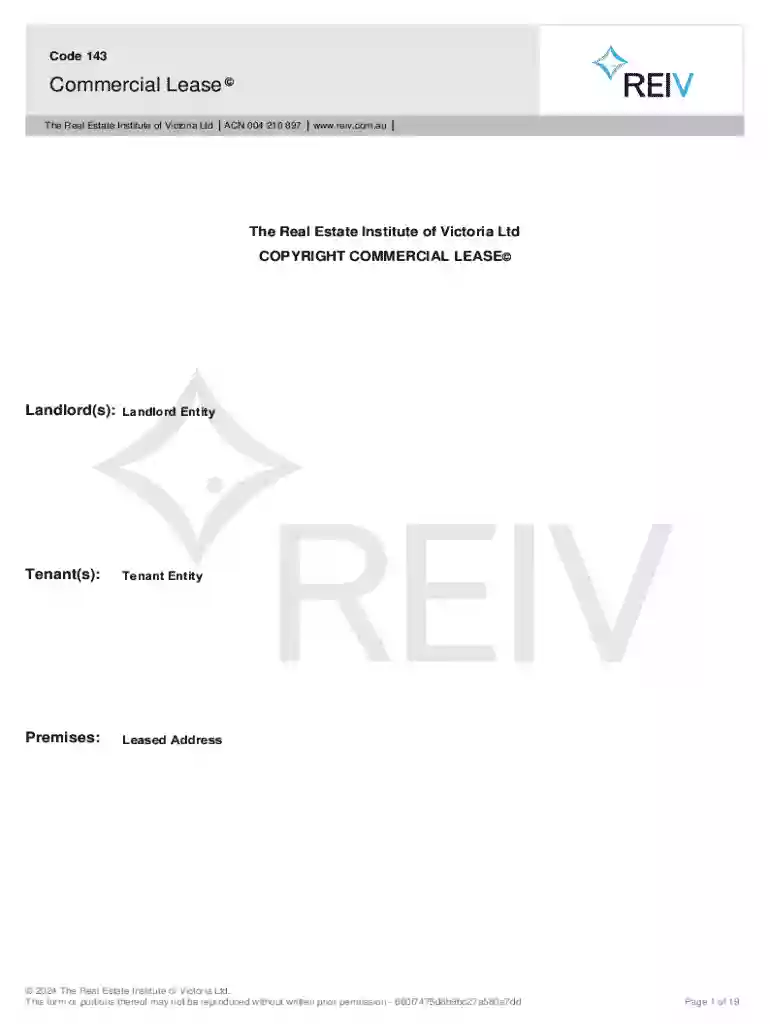
The REIV Commercial Lease Code 143 Pages 2026

Get Form
The REIV Commercial Lease Code 143 Pages Preview on Page 1

Here's how it works

01. Edit your form online
Type text, add images, blackout confidential details, add comments, highlights and more.

02. Sign it in a few clicks
Draw your signature, type it, upload its image, or use your mobile device as a signature pad.

03. Share your form with others
Send it via email, link, or fax. You can also download it, export it or print it out.

Definition and Meaning of The REIV Commercial Lease Code

The REIV Commercial Lease Code is a comprehensive legal document published by The Real Estate Institute of Victoria Ltd. It serves as a standard template for commercial lease agreements, articulating the contractual obligations between landlords and tenants. The document comprehensively covers terms such as rental payments, maintenance obligations, responsibility for outgoings, and conditions related to insurance and property alterations. Additionally, the lease code includes specific clauses addressing lease termination, dispute resolution mechanisms, and compliance with pertinent laws. By offering clarity and uniformity, it aims to facilitate smooth interactions between parties involved in commercial leasing.

How to Use The REIV Commercial Lease Code

Using the REIV Commercial Lease Code effectively involves several steps to ensure that all parties understand and agree to the stipulated terms.

  1. Review the Document: Begin by carefully reading through the lease code to become familiar with its terms and conditions.

  2. Seek Legal Advice: It is advisable to consult with a legal professional to interpret complex clauses and ensure that your interests are protected.

  3. Customize Clauses: Customize any special conditions or provisions based on tenant-landlord negotiations. This may include modifications related to rental terms or maintenance responsibilities.

  4. Fill in Required Details: Complete the form with specific information such as property address, rental amount, lease duration, and contact information for both parties.

  5. Verify All Information: Double-check all filled information for accuracy to avoid future disputes.

  6. Final Signatures: Both parties must sign the document to make it legally binding.

  7. Retain Copies: Keep copies of the signed document for reference throughout the lease term.

Steps to Complete The REIV Commercial Lease Code

Completing the REIV Commercial Lease Code involves an organized approach to ensuring all necessary sections are accurately filled out.

  1. Gather Required Information: Collect essential details, including legal names of both parties, business registration details, and property specifics such as address and size.

  2. Provide Financial Details: Accurately fill in rental amounts, payment schedules, security deposits, and any applicable taxes or fees.

  3. Detail Maintenance Obligations: Specify the responsibilities of each party regarding the maintenance and repair of the property to avoid future disagreements.

  4. Include Insurance Requirements: Document insurance coverage requirements, indicating who is responsible for obtaining various types of coverage.

  5. Outline Dispute Resolution Procedures: Clearly outline the procedures for handling any potential disputes, referencing specific dispute resolution pathways as per the document’s provisions.

  6. Finalize with Legal Review: Have a legal expert review the completed lease code to certify compliance with applicable laws before signing.

Key Elements of The REIV Commercial Lease Code

The REIV Commercial Lease Code encompasses several key elements critical for both landlords and tenants:

  • Rental Information: Specifies the rent amount, due dates, late payment penalties, and potential rent increase terms.
  • Outgoings and Maintenance: Details on who is responsible for paying business rates, utility bills, and property maintenance.
  • Insurance Obligations: Requirements for landlord and tenant insurance coverages to protect against liabilities and property damage.
  • Property Alterations: Permissions and conditions under which alterations to the property are allowed.
  • Termination Clause: Conditions under which the lease may be terminated by either party.
  • Dispute Resolution: Mechanisms and processes for resolving disputes arising during the lease term.
  • Compliance with Laws: Assurance that the lease complies with relevant state and federal laws.

Legal Use of The REIV Commercial Lease Code

The legal use of the REIV Commercial Lease Code ensures that leases adhere to established standards and protect both party interests:

  • Compliance with Local Laws: The lease code aligns with regional property laws, ensuring all agreements are legally sound.
  • Protective Provisions: Built-in legal protections for both landlord and tenant, covering various contingencies and liabilities.
  • Adaptation to Legal Changes: The code is periodically updated to reflect current legal standards and practices, maintaining its relevance and enforceability.

Variations and Versions of The REIV Commercial Lease Code

Understanding versions and variations of the REIV Commercial Lease Code can prove beneficial:

  • Updated Editions: Regular updates ensure the lease code reflects changes in commercial lease practices and laws.
  • Custom Editions: Remodeled versions might exist to cater to specific business needs, industry types, or regions.
  • Digital vs. Paper Versions: Options for digital completion and signatures increase efficiency and accessibility, contrasting with traditional paper methods.

Who Typically Uses The REIV Commercial Lease Code

The REIV Commercial Lease Code is utilized by various stakeholders involved in commercial property leasing:


  • Commercial Landlords: Owners of commercial properties use this code to formalize lease terms with tenants.
  • Commercial Tenants: Businesses renting commercial spaces engage with the lease code to understand obligations and protections.
  • Property Managers: Facilitate lease agreements between landlords and tenants, ensuring all code stipulations are met.
  • Legal Professionals: Lawyers use the code to provide advisory services on lease agreements, ensuring lawful compliance.
decoration image ratings of Dochub

Examples of Using The REIV Commercial Lease Code

  1. Retail Outlets: A clothing store negotiates terms with a mall landlord using the lease code, setting clear rental conditions and maintenance responsibilities.

  2. Office Spaces: A tech startup utilizes the lease code to finalize its leasing terms for a new workspace, ensuring clarity in tenant improvements pre-agreement.

  3. Industrial Facilities: A manufacturing company relies on the lease code to lease warehouse space, securing terms for extended lease duration and specific usage clauses.

By using the REIV Commercial Lease Code, businesses can confidently engage in leasing arrangements, ensuring clarity, compliance, and mutual understanding between landlords and tenants.

be ready to get more

Complete this form in 5 minutes or less

Get form

Got questions?

We have answers to the most popular questions from our customers. If you can't find an answer to your question, please contact us.
Contact us
Key Elements of a Commercial Lease Property Description. A clear and precise description of the property is fundamental. Lease Term. Rent and Payment Terms. Use of Property. Maintenance and Repairs. Alterations and Improvements. Insurance Requirements. Subleasing and Assignment.
Commercial lease agreements are typically 20-50 pages long. Usually, it takes 4-8 hours to manually summarize one commercial lease agreement into an abstract of 2-5 pages. Technically, thats one working day that could have been spent on more high-value tasks.
Common Reasons Leases Get Terminated Often, unexpected circumstances might prompt a necessary change. A few reasons you might be considering ending your commercial lease agreement early include: Financial hardship. Relocation of your business.
There is no such thing as a standard lease or rental agreement: Landlords are free to use their own forms, and tenants are always free to request that terms be added or removed. Your lease or rental agreement might be as short as one page or longer than 10.
The Lessee has paid to the Lessor / s a sum of Rs. only being month / s rent in respect of the said premises as deposit of rent to be adjusted towards the rent for the last month / s of the tenancy. also be borne and paid by lessor (landlord).

Security and compliance

At DocHub, your data security is our priority. We follow HIPAA, SOC2, GDPR, and other standards, so you can work on your documents with confidence.
Learn more
ccpa2
pci-dss
gdpr-compliance
hipaa
soc-compliance

People also ask

Hence, most landlords prefer to enter into a rental agreement that is 11 months long, with an option to renew at the end of the agreement period.
Lease extension (Part 1) There is no set rule about the length of a lease that is too short to sell. But when a lease falls below 80 years, the cost of extending it increases dramatically, making it harder to sell. Mortgage lenders, generally, will not lend on properties with a lease that is shorter than the mortgage.
The average apartment lease length is one year to 15 months from the time you move in. You and your landlord will then decide whether or not to renew the lease at the end of the year. However, many apartments also offer different types of short-term leases.

Related links