






Definition & Meaning
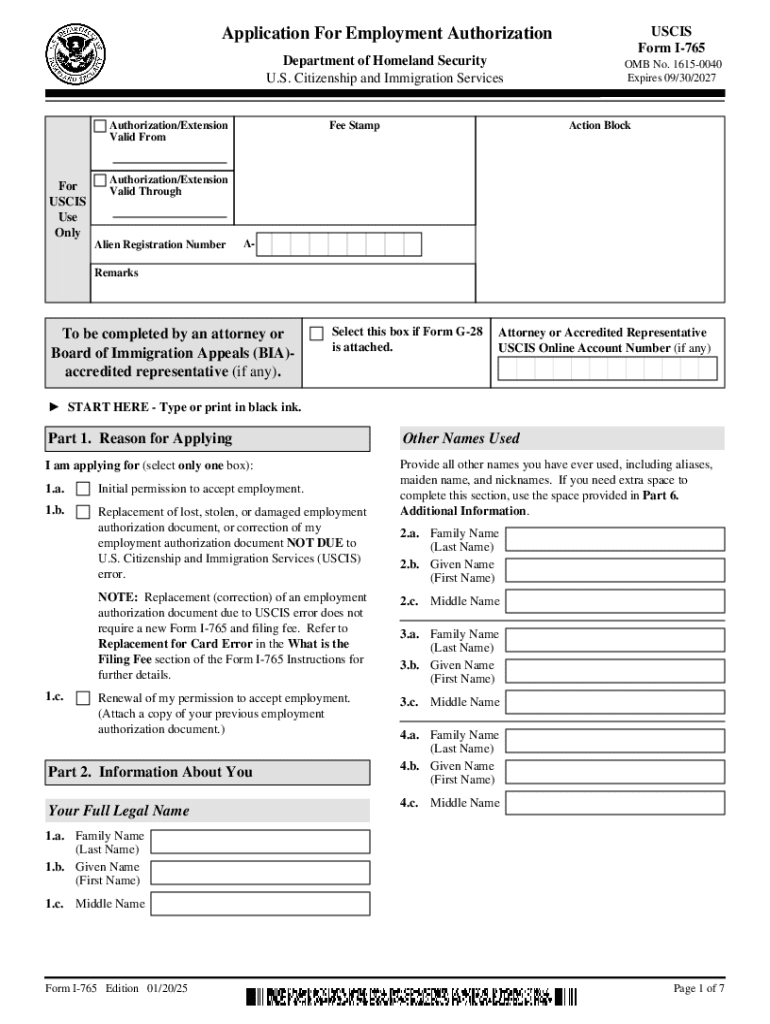
Form I-765, Application for Employment Authorization, is a crucial document used by non-U.S. citizens to apply for the legal right to work in the United States. Issued by the U.S. Citizenship and Immigration Services (USCIS), this form is primarily designed for those seeking initial employment authorization, renewal of their existing Employment Authorization Document (EAD), or replacement of a lost, stolen, or damaged EAD. By submitting this form, applicants formally request permission to work legally while residing under specific visa categories or pending another immigration status.
Practical Context and Use
The significance of Form I-765 extends beyond the immediate application; securing employment authorization is often integral to broader immigration goals, such as seeking permanent residency or citizenship. Understanding how this form fits into one's immigration strategy can be critical for individuals living in the U.S. under temporary or transitional status. For instance, international students transitioning to Optional Practical Training (OPT) post-graduation and asylees awaiting the decision on their asylum applications commonly utilize this form.
How to Obtain the Form I-765, Application for Employment Authorization
Securing a copy of Form I-765 is straightforward and involves several accessible methods. Primarily, the form is available for download directly from the USCIS website, ensuring applicants access the most recent and updated version. Alternatively, applicants can request a paper form through mail or obtain it during appointments at USCIS field offices. Advanced planning is recommended since obtaining and submitting the form is the first step toward gaining work authorization in the U.S.
Document Accessibility
The form is designed to be accessible, with provisions for digital and print formats. Ensuring applicants maintain copies of both their completed application and supporting documentation is critical, as this can prevent future complications if queries or resubmissions are required. Using available tools such as DocHub to manage and annotate these documents can streamline the process, facilitating easier organization and submission.
Steps to Complete the Form I-765, Application for Employment Authorization
Completing Form I-765 involves detailed attention to personal and eligibility information sections. Here are essential steps in the process:
-
Gather Personal Information: Start by accurately filling out your name, address, date of birth, and current immigration status.
-
Select Eligibility Category: Each applicant must select the appropriate eligibility category from those listed in the instructions. This might include categories like OPT for students (c)(3)(B) or adjustment of status categories (c)(9).
-
Include Supporting Documents: Attach necessary documents such as a copy of your current visa, previous EAD (if applicable), and photos meeting USCIS requirements.
-
Review and Sign: Double-check all sections for accuracy and completeness, then sign the form with the date.
-
Submit the Form: Depending on your situation, submit by mail directly to the specified USCIS service center or electronically through USCIS's e-Filing system when applicable.
Common Mistakes to Avoid
Errors in completing Form I-765 can lead to processing delays or denials. Common mistakes include selecting the wrong eligibility category, incomplete fields, or mismatched document names. Ensuring each section is meticulously checked before submission can prevent these setbacks.
Eligibility Criteria for Form I-765
Eligibility for Form I-765 is dictated by your current immigration status in the U.S. Generally, the form is applicable to asylum seekers, international students on F-1 visas, individuals with pending adjustment of status to permanent residency, and other special categories such as Deferred Action for Childhood Arrivals (DACA) recipients.


Specific Cases
- Students on F-1 Visa: Must apply for OPT or after receiving the recommendation for Curricular Practical Training (CPT).
- Asylum Seekers: Can apply for employment authorization while awaiting the decision on their asylum status, subject to specific filing timelines.
Legal Use of Form I-765, Application for Employment Authorization
Form I-765 serves as a legal avenue for non-U.S. citizens to gain permission to work, providing evidence of eligibility under U.S. immigration laws. The EAD acts as proof of right to employment and is legally binding upon its issuance. It must be carried and presented to employers to verify work eligibility.
Rights and Obligations
Holding an EAD confers the right to work but also entails obligations to comply with U.S. employment and tax laws. Understanding these is vital, as non-trivial violations can affect immigration status and compliance with workplace norms.
Key Elements of the Form I-765, Application for Employment Authorization
Form I-765 consists of multiple sections that collect comprehensive details from applicants. Key components include personal information, basis for eligibility, physical presence in the U.S., and intended employment details. The precision and accuracy of these sections directly affect the application's success.
In-Depth Component Analysis
Each key section requires meticulous input. For example, classification codes in the eligibility section must match your visa or status category precisely. Any discrepancies here can result in processing delays or denials, emphasizing the need for thorough preparation and possibly legal consultation.
State-Specific Rules for the Form I-765
While Form I-765 is governed by federal rules, state regulations may influence employment authorization indirectly, particularly regarding employment rights and workplace regulations. Applicants should familiarize themselves with state-specific labor laws impacting the employment of non-residents.
Geographical Considerations
Certain states might offer additional resources or guidance for immigrant workers. For example, states with higher immigrant populations, like California and New York, often provide advocacy and informational resources that can assist in comprehensively understanding both federal and state employment rights.
Form Submission Methods: Online vs. Mail
Applicants for Form I-765 have two main submission methods: online via the USCIS website or by traditional mail. Online submissions can speed up processing times and allow for digital tracking of application status, whereas mail submissions may suit those with limited internet access or who prefer paper records.
Comparative Advantages
- Online Submission:
- Faster processing and confirmation of receipt.
- Real-time status updates and document upload options.
- Mail Submission:
- Suitable for applicants with consistently slower internet access.
- Provides a tangible paper trail for record-keeping.
Decision-Making Factors
Applicants should consider personal convenience, access to technology, and comfort with digital platforms when choosing a submission method. Furthermore, staying informed about USCIS updates and procedural changes, especially during policy shifts, is essential for ensuring successful application processing.