




01. Edit your form online
Type text, add images, blackout confidential details, add comments, highlights and more.

Type text, add images, blackout confidential details, add comments, highlights and more.

Draw your signature, type it, upload its image, or use your mobile device as a signature pad.

Send it via email, link, or fax. You can also download it, export it or print it out.
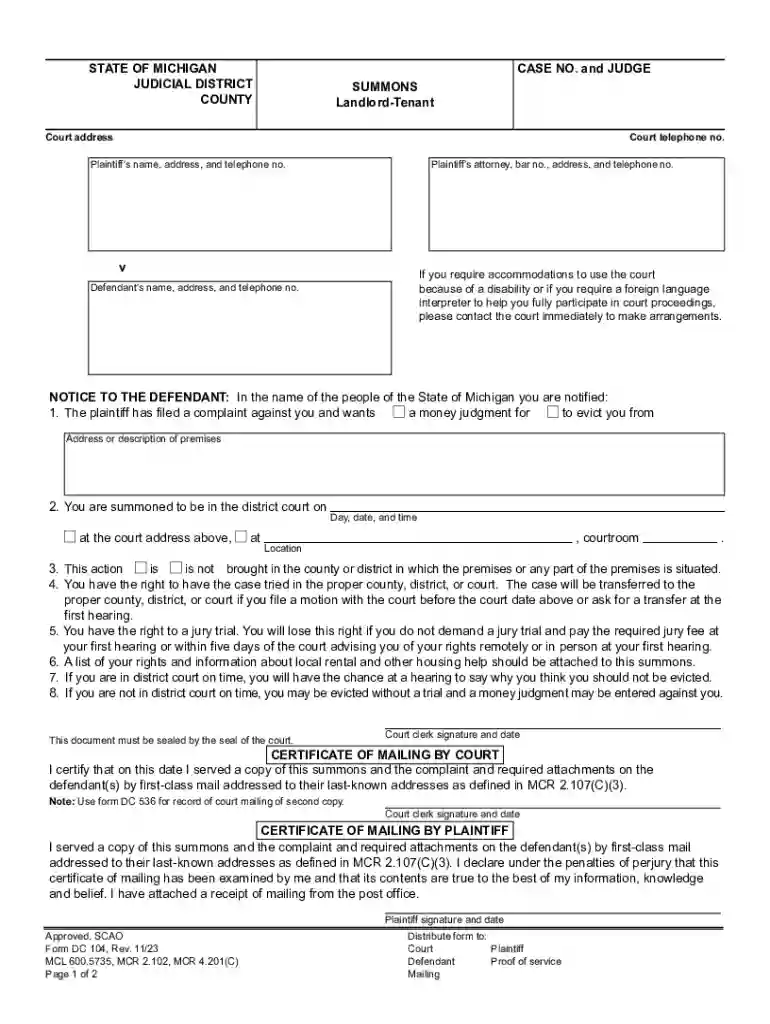
The DC 104, Summons, Landlord-TenantNEW is a legal document used in the State of Michigan to address disputes between landlords and tenants. Primarily, it serves as a formal notification to a tenant (the defendant) that a landlord (the plaintiff) has filed a legal complaint seeking eviction or a monetary judgment. The document informs the recipient of their legal rights, such as the right to contest the eviction in court and, if desired, request a jury trial.
Completing the DC 104 requires attention to detail to ensure that all necessary information is accurately provided. Here is a step-by-step guide:
Plaintiff Information: Start by filling in the landlord's (plaintiff’s) full name, address, and contact information in the designated spaces.
Defendant Details: Enter the tenant’s (defendant’s) name and address accurately to ensure the summons is directed to the correct individual.
Complaint Description: Clearly state the reasons for filing the complaint, whether it’s for unpaid rent, lease violations, or other grounds for eviction.
Legal Claims: Articulate any monetary claims, if applicable, highlighting the specific amounts sought and the basis for each claim.
Court Information: Specify the court where the case will be heard, including court location and relevant identifiers like the case number.
Service Method: Indicate the method of service used to deliver the summons to the tenant, ensuring compliance with legal requirements.
Signature and Date: Finalize the form with the plaintiff’s signature and the date of filing to validate its legality.
The DC 104 form is typically available through the Michigan Judicial Institute or the clerk’s office in Michigan courts handling landlord-tenant disputes.
Online Access: The form can be downloaded from the official Michigan courts website, providing convenient access for those with internet capabilities. It is often available in PDF format, suitable for both print and digital use.
In-Person Availability: Physical copies of the DC 104 can be obtained directly from local courthouse offices, where staff can provide additional guidance if necessary.
The DC 104 Summons serves as a vital legal instrument within landlord-tenant proceedings. Its issuance is governed by specific statutes:
Rights Notification: The document outlines tenants' rights, emphasizing their right to a defense, representation, and an understanding of any potential legal consequences.
Eviction Grounds: It explicates the legal grounds for initiating eviction or financial claims, ensuring that the plaintiff's actions are permissible under state law.
Court Appearance: Defendants are instructed to appear in court to respond to the claims, offering a fair chance to contest allegations or settle disputes.
Documentation and Evidence: The summons may detail requirements for documentation and evidence needed to support or contest claims.
Understanding certain legal terms used in the DC 104 enhances comprehension:
Plaintiff: The party initiating the lawsuit, typically the landlord seeking court intervention.
Defendant: The party against whom the lawsuit is filed, generally the tenant facing eviction or monetary claims.
Eviction: A legal process by which a landlord seeks to remove a tenant from the property.
Monetary Judgment: A court-issued financial ruling in favor of one party, often involving unpaid rent or damages.
Right to a Jury Trial: An option for the defendant to request a trial by jury to adjudicate the dispute.
While the DC 104 form is a standardized document, Michigan law incorporates specific guidelines:
Notice Periods: Michigan statutes outline notice periods and requisite legal actions before filing a summons, such as providing a notice to quit or demand for possession.
Tenant Protections: State law mandates certain tenant protections, such as the need for just cause in eviction cases, barring retaliatory evictions.
Fee Requirements: Filing fees vary by jurisdiction and court, necessitating confirmation with the appropriate court office to ascertain the correct amounts.
Real-world scenarios illustrate the form’s application:
Unpaid Rent: A landlord in Detroit files a DC 104 to reclaim possession of an apartment and seek reimbursement for three months of overdue rent.
Lease Violation: In Grand Rapids, a landlord issues a DC 104 after a tenant repeatedly breaches noise restrictions outlined in their lease agreement.
Property Damage: A case in Lansing involves a landlord using the DC 104 to pursue compensation for significant property damage caused by tenant negligence.
By understanding the DC 104 Summons and these practical applications, both landlords and tenants can navigate Michigan’s landlord-tenant legal landscape more effectively.
We've got more versions of the DC 104, Summons, Landlord-TenantNEW form. Select the right DC 104, Summons, Landlord-TenantNEW version from the list and start editing it straight away!
At DocHub, your data security is our priority. We follow HIPAA, SOC2, GDPR, and other standards, so you can work on your documents with confidence.


