01. Edit your form online
Type text, add images, blackout confidential details, add comments, highlights and more.

Type text, add images, blackout confidential details, add comments, highlights and more.

Draw your signature, type it, upload its image, or use your mobile device as a signature pad.

Send it via email, link, or fax. You can also download it, export it or print it out.
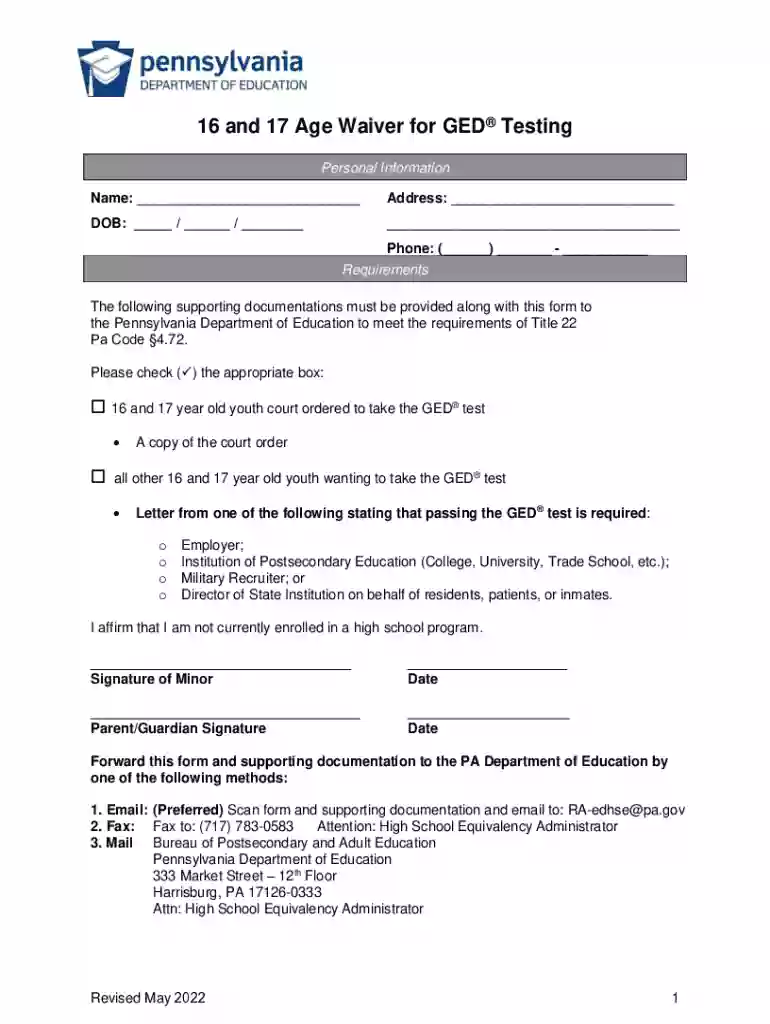
The FDOE Underage Testing Information provides guidance for 16 and 17-year-old individuals in Florida seeking to partake in GED® testing under certain conditions. The information outlines the criteria, necessary documentation, and the steps involved in applying for permission to take the test. Understanding this information is crucial for young individuals aiming to meet academic progression or career advancement goals.
To qualify for the underage GED® testing in Florida, certain eligibility criteria must be satisfied. Applicants should typically be between 16 and 17 years of age. Additional requirements may include having valid reasons for early testing, such as educational advancement or workforce entry. Documented proof that supports the application, such as letters from educational institutions or employers, should be ready for submission.


Applicants need to prepare specific documents to support their waiver requests. Essential documents may include:
Completing the application for underage GED® testing involves several key steps to ensure compliance with FDOE guidelines.
The legal framework around underage GED® testing ensures that all parties comply with educational standards and state regulations. By adhering to the rules set forth by the Florida Department of Education, applicants ensure legal compliance, which ultimately supports their academic or professional objectives. Non-compliance or false documentation may lead to penalties or disqualification from the testing process.
Understanding the critical elements of the FDOE Underage Testing Information is crucial:
This information is widely used by young individuals aged 16 and 17 who are unable to meet the traditional high school graduation requirements but need a high school equivalency credential for work, higher education, or military purposes. Additionally, guardians and educators play a key role in facilitating the application process.

The underage testing procedures can have specific variations across different states. In Florida, the rules are guided by the FDOE to align with state-specific educational laws. These rules ensure a structured approach to education and maintain standards comparable to traditional high school diploma achievements.
Applicants have multiple avenues for submitting their applications:
From submission to approval, the time frame can vary depending on documentation completeness and application accuracy. Generally, applicants should expect a response or decision within a few weeks post submission, provided all criteria are met and there are no deficiencies in the application package.
We've got more versions of the fldoe hseunderage-testing-infoUnderage Testing Information - Florida Department of Education form. Select the right fldoe hseunderage-testing-infoUnderage Testing Information - Florida Department of Education version from the list and start editing it straight away!
At DocHub, your data security is our priority. We follow HIPAA, SOC2, GDPR, and other standards, so you can work on your documents with confidence.