
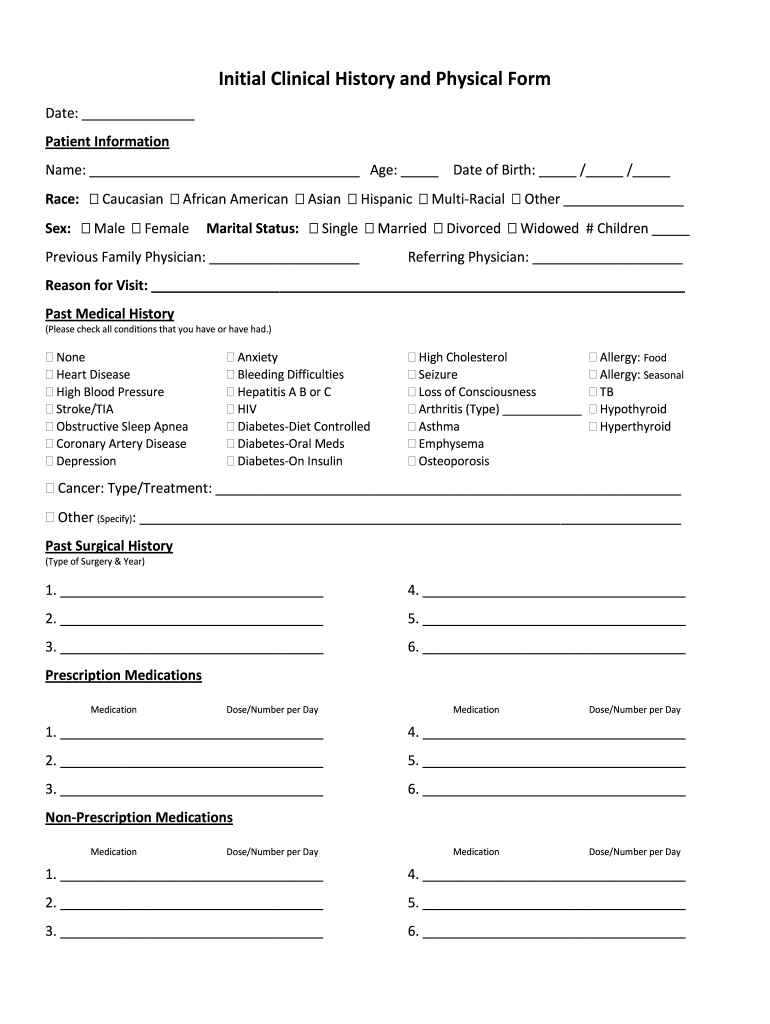







Comprehensive Overview of the History and Physical Template
The history and physical (H&P) template is a vital document used primarily by healthcare providers to collect and assess comprehensive patient data. This standard form serves a crucial role in a patient’s initial evaluation and lays the groundwork for ongoing medical care. Below are key components of the H&P template that detail its structure and utility.
Essential Elements of a History and Physical Template
An effective H&P template encompasses several integral components that ensure the collection of exhaustive patient information. Each section plays a pivotal role in forming a complete medical profile.
-
Patient Identification
- Includes patient demographics, such as name, age, sex, and contact information.
- Vital for verifying patient identity and linking the record to the correct individual.
-
Chief Complaint (CC)
- A concise statement capturing the primary reason for the patient’s visit.
- Provides insight into the patient's immediate concerns and helps guide further inquiry.
-
History of Present Illness (HPI)
- Detailed narrative describing the chronological development of the current medical issue.
- Includes symptoms, onset, duration, and any previous treatments.
-
Past Medical History (PMH)
- Documented accounts of prior health issues, surgical interventions, and hospitalizations.
- Essential for understanding the patient's medical background and risk factors.
-
Medications and Allergies
- A current list of medications, dosages, and any known allergies.
- Vital in preventing adverse drug interactions and ensuring safe prescribing practices.
Structure of a Comprehensive Physical Exam
The physical examination section is critical in evaluating a patient’s overall health status. It typically includes:
-
Vital Signs
- Documenting temperature, pulse, blood pressure, respiratory rate, and oxygen saturation.
- Important for assessing immediate health status and stability.
-
General Appearance
- An overview of the patient's wellbeing, including any noticeable distress or abnormalities.
- Initial impressions can guide further examination and investigations.
-
Body Systems Review
- An organized review of multiple systems (e.g., cardiovascular, respiratory, gastrointestinal).
- Helps identify symptoms that may not have been reported by the patient but are essential for comprehensive care.
Specialized Sections in the H&P Template
Certain templates may also include additional specialized sections that provide enhanced details, particularly for specific practices or populations.
-
Family History
- Information regarding health conditions prevalent among immediate family members.
- Useful for understanding hereditary risks and conditions that may affect the patient.
-
Social History
- Covers lifestyle factors, such as tobacco use, alcohol consumption, and occupation.
- Provides context to the patient's living conditions and potential health risks.
-
Review of Systems (ROS)
- A systematic inquiry into various bodily systems to ensure no issues are overlooked.
- Facilitates a thorough assessment and aids in diagnosing any additional health concerns.
Importance of the H&P Template in Patient Care
Utilizing a structured H&P template serves multiple important functions within healthcare settings:
-
Standardized Documentation
- Ensures that all healthcare providers are consistently gathering the same essential information, reducing variability in patient assessment.
-
Enhanced Patient Safety
- By capturing comprehensive and detailed medical histories, healthcare providers can make more informed decisions, reducing the likelihood of errors.
-
Legal and Compliance Assurance
- Helps fulfill legal documentation requirements, ensuring records are complete and maintain compliance with healthcare regulations.
Examples of H&P Templates in Practice
Healthcare providers often adapt their H&P templates to suit various specialties or patient populations. Examples include:
-
Pediatric H&P Template
- Adjusted for children, incorporating developmental milestones and vaccination history.
-
Geriatric H&P Template
- Focused on age-related health issues and multiple comorbidities.
-
Primary Care H&P Template
- A general template suitable for a broad patient demographic.
Using these templates not only standardizes care but also enhances communication across healthcare teams, ultimately improving patient outcomes. Each section is designed to collect essential data necessary for informed clinical decisions.
Free Resources for Downloading H&P Templates
Various platforms offer free printable history and physical templates that healthcare providers can easily access and customize. These resources often include:
-
PDF Formats
- Downloadable templates that can be printed and filled out by hand or digitally.
-
Word Document Formats
- Editable templates that allow practitioners to tailor the content to suit their needs.
-
Customizable Online Forms
- Interactive versions that can be filled out digitally, making the documentation process more efficient.
Having access to these free resources can enhance the efficiency and accuracy of patient evaluations in various healthcare settings, ensuring high standards of care are consistently met.




