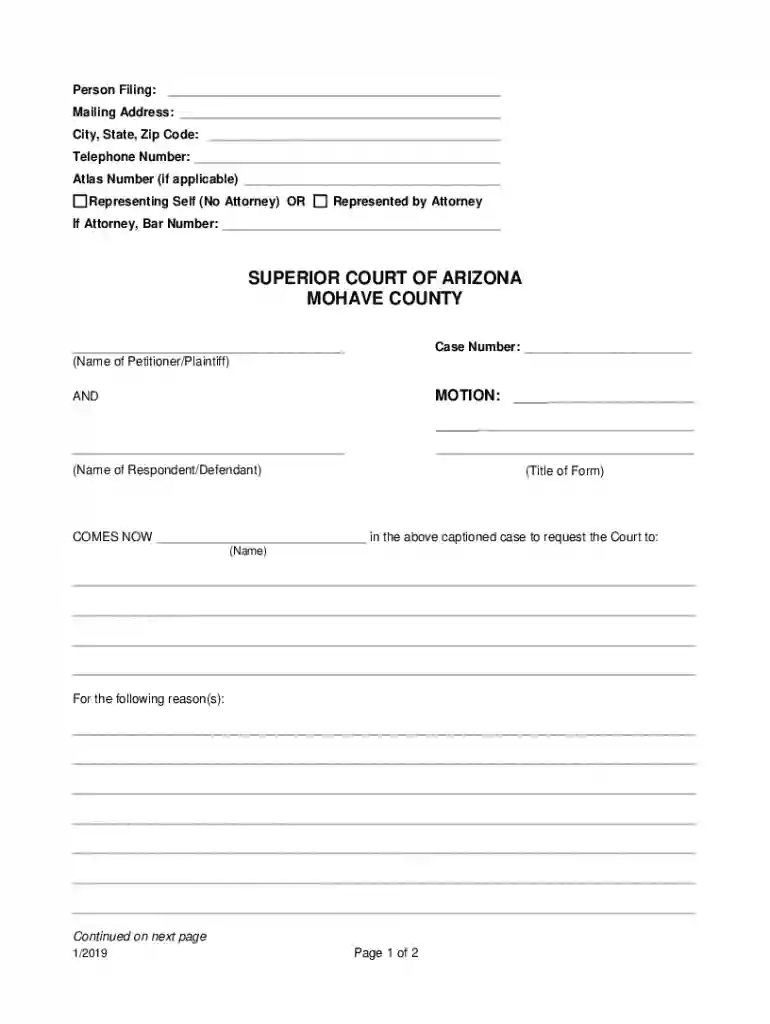
What to do with the motion when you have filled it out 2026

Get Form
what to do with the motion when you have filled it out Preview on Page 1

Here's how it works

01. Edit your form online
Type text, add images, blackout confidential details, add comments, highlights and more.

02. Sign it in a few clicks
Draw your signature, type it, upload its image, or use your mobile device as a signature pad.

03. Share your form with others
Send it via email, link, or fax. You can also download it, export it or print it out.

Steps to Complete a Motion in Superior Court

Once you have filled out the motion form for the Superior Court of Arizona in Mohave County, follow these steps to ensure it is properly submitted. Submitting a motion involves several detailed stages, which include reviewing, signing, and potentially serving the document to relevant parties.

  1. Review the Completed Motion

    • Check all sections for accuracy, especially personal information and case details.
    • Ensure the reasons for your motion are clearly stated and supported with evidence if required.
    • Confirm that you've included all necessary attachments or exhibits.
  2. Sign the Motion

    • Depending on the form, your signature may need to be notarized. Ensure each required signature field is properly signed.
    • For electronic submissions, utilize a platform like DocHub to apply a legally binding electronic signature.
  3. Serve the Motion

    • Arizona courts often require that the other party be notified of your motion.
    • Serve the motion through certified mail, a process server, or electronic service if applicable.
    • Retain proof of service, as this is often required by the court.
  4. File the Motion with the Court

    • Submit your completed and signed motion to the clerk of Superior Court.
    • Filing can usually be done in person or via the court’s online filing system.
    • Pay any required filing fees or apply for a fee waiver if eligible.

Legal Use and Implications of Filing a Motion

Understanding the legal implications of filing a motion is crucial. Motions can impact the progression of a legal case, and their outcomes are binding.

  • Purpose of a Motion

    • Motions are requests to the court for a specific ruling or order.
    • They might seek to compel or restrict certain actions, such as a motion to dismiss or a motion for summary judgment.
  • Possible Outcomes

    • The court may approve, deny, or schedule a hearing to discuss the motion.
    • Approved motions can significantly affect case proceedings, affecting timelines and legal rights.
  • Legal Guidance

    • Consulting with a lawyer can provide clarity on the necessity and implications of your motion.
    • Legal representation might be beneficial, especially for complex legal arguments.

Who Typically Uses These Motion Forms

Motion forms are commonly used by individuals involved in legal disputes, whether as plaintiffs, defendants, or third-party participants. Here are typical users:

  • Individuals Seeking Court Intervention

    • Plaintiffs or defendants needing judicial decisions on specific issues within a case.
  • Legal Representatives

    • Attorneys filing motions on behalf of their clients for procedural or strategic reasons.
  • Pro Se Litigants

    • Individuals representing themselves in court proceedings often need these forms to make formal requests or respond to actions from the opposing party.
decoration image ratings of Dochub

Important Elements of a Motion Form

Key components of a motion form for the Superior Court necessitate attention to detail. Each part serves a unique purpose and must be completed accurately.

  • Identification Information

    • Includes personal details like name, contact info, and relationship to the case (e.g., petitioner, respondent).
  • Motion Details

    • Describes the action you are requesting from the court and elaborates on the reasons behind this request.
  • Supporting Evidence

    • Attachments or exhibits that support your motion's claims should be listed and included.

State-Specific Rules for Arizona

While motion forms share similarities nationwide, rules and processes can vary by state. In Arizona:

  • Local Court Rules

    • Verify Mohave County Superior Court rules, as they may have specific filing protocols or deadlines.
    • Ensure compliance with any local forms or procedures required in addition to state forms.
  • Timelines and Deadlines

    • Adhere to any response or filing deadline to avoid dismissals or unfavorable rulings.
    • Familiarize yourself with Arizona's rules of civil procedure as they relate to motions.

How to Use DocHub for Motion Forms

DocHub offers tools to simplify the management and submission of motion forms online.

  • Editing and Annotation

    • Use DocHub to fill out motion forms digitally, insert necessary text, add annotations for clarity, and securely sign documents.
  • Collaboration and Sharing

    • Share forms with legal representatives or other parties for review or signature through integrated sharing options.
  • Security and Compliance

    • Ensure motion forms are securely stored and transmitted, using DocHub’s encryption and access protections.

Examples of Motion Cases

Understanding practical applications of motion forms can enhance comprehension.

  • Motion to Dismiss

    • A defendant might file this if the plaintiff failed to state a valid claim or if jurisdiction is challenged.
  • Motion for Summary Judgment

    • Often used when one party believes there are no factual disputes and that the case can be decided on legal issues alone.
  • Motion to Compel

    • Filed when a party needs the court's help to obtain discovery responses from the opposing party.

Penalties for Non-Compliance

Failing to adhere to motion requirements can lead to significant consequences.

  • Dismissal or Default Judgment

    • Missing deadlines or improperly filling out forms might result in your motion being denied or your case dismissed.
  • Fines or Sanctions

    • Courts may impose monetary penalties for frivolous or non-compliant filings.
  • Adverse Rulings

    • Non-compliance might lead to rulings that limit or bar evidence or arguments in court.
be ready to get more

Complete this form in 5 minutes or less

Get form

Got questions?

We have answers to the most popular questions from our customers. If you can't find an answer to your question, please contact us.
Contact us
A motion is a written request or proposal to the court to get an asked-for order, ruling, or direction. There are a variety of motions, and it has become standard practice to file certain motions with the court based on the type of case.
A motion or petition is a request for the court to make a decision. A hearing or trial is the time when the court (a judge, general magistrate, or a hearing officer) makes the decision on a partys motion or petition. Generally, motions are decided at a hearing and petitions are decided at a trial.
When you file your motion, the court clerk will insert the date, time, and place of the hearing on your motion. You must then serve (mail) a copy of your filed motion (including all exhibits and the date, time, and place of hearing) to all other parties in the case.
0:21 3:30 For instance The type of motion and the courts. Workload play a big. Role according to a study onMoreFor instance The type of motion and the courts. Workload play a big. Role according to a study on civil case processing in federal district courts. The time to rule on motions can range widely.
A motion is an application to the court made by the prosecutor or defense attorney, requesting that the court make a decision on a certain issue before the trial begins. The motion can affect the trial, courtroom, defendants, evidence, or testimony. Only judges decide the outcome of motions.

Security and compliance

At DocHub, your data security is our priority. We follow HIPAA, SOC2, GDPR, and other standards, so you can work on your documents with confidence.
Learn more
ccpa2
pci-dss
gdpr-compliance
hipaa
soc-compliance

People also ask

Seek to lay out a summary of your position, which should include (1) what your argument is and (2) what you want the court to do. The more concise and simple you can make the introduction, the more the readerthe judge or their clerkwill be responsive to the more detailed arguments coming in the body of the motion.

Related links