






Definition & Meaning
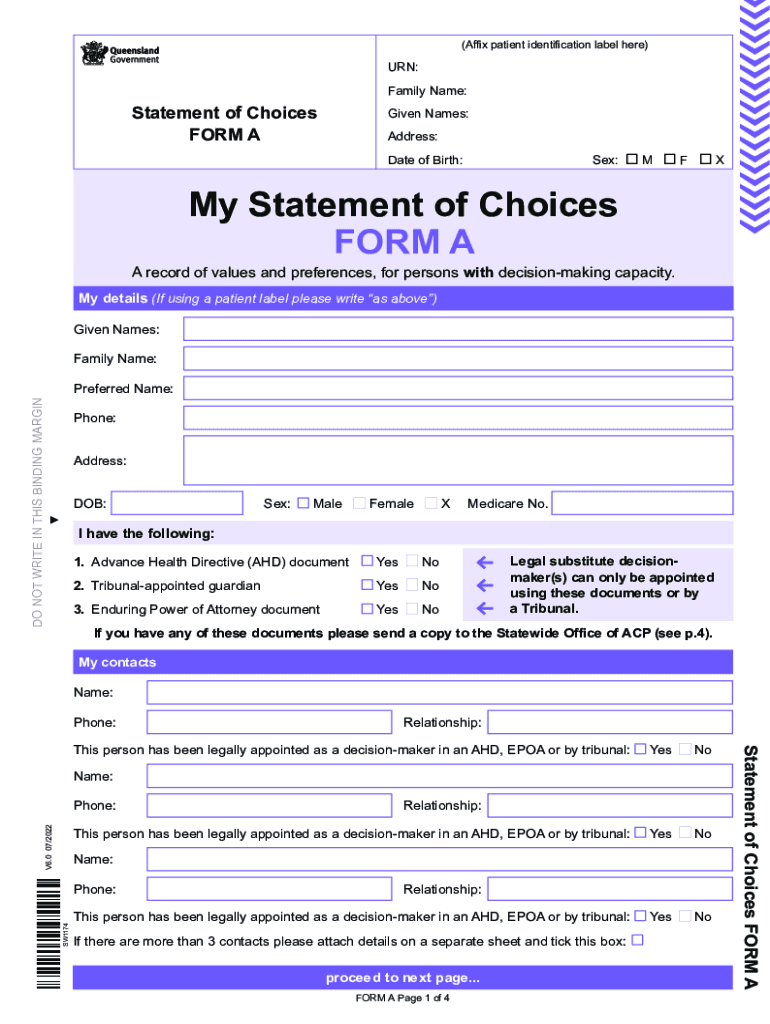
The "Statement of Choices (Form A) for Aboriginal and Torres Strait Islander People - Advance Care Planning" is a document designed for Aboriginal and Torres Strait Islander individuals to articulate their preferences and values concerning future medical care. This form aids in Advance Care Planning, ensuring healthcare providers understand cultural considerations and personal wishes, should the individual become unable to communicate.
Importance of Advance Care Planning
Advance Care Planning (ACP) is crucial as it allows individuals to express their healthcare preferences before a crisis occurs. This proactive approach ensures that decisions about medical treatments align with personal values and cultural beliefs, leading to more satisfactory care outcomes for the individual and their family.
How to Use the Statement of Choices
Using the Statement of Choices form involves several key steps:
- Reflection: Consider personal values, cultural beliefs, and health care preferences.
- Discussion: Engage with family, friends, and healthcare providers to communicate your wishes.
- Documentation: Fill out the form with clear and concise information reflecting your desires.
The completed form should be shared with key individuals to guide healthcare decisions in incapacity cases.
Steps to Complete the Statement of Choices
Completing the Statement of Choices involves:
- Providing personal information.
- Listing significant health conditions or medications.
- Detailing specific health care preferences.
- Assigning a trusted decision-maker, if desired.
- Signing and dating the form for validation.
Include thorough explanations for each section to ensure clarity.
Legal Use of the Statement of Choices
This form serves as a legal document under specific statutory frameworks. While it does not replace a legal will, it complements other Advance Care Directives by focusing uniquely on health care preferences. It should be reviewed regularly and updated to reflect any changes in preferences or circumstances.
Key Elements of the Form
- Personal Information: Includes name, contact details, and identifiers.
- Healthcare Preferences: Specific instructions on treatments and interventions.
- Cultural Considerations: Emphasis on incorporating cultural beliefs into care decisions.
- Appointed Decision-Maker: Details of a person authorized to make decisions if necessary.
Each section requires accurate and thoughtful completion to ensure effectiveness.
Important Terms Related to the Form
- Advance Care Plan (ACP): A document outlining future health care wishes.
- Substitute Decision-Maker: Someone legally appointed to make decisions on behalf of another.
- Cultural Sensitivity: Awareness and incorporation of cultural beliefs in health care decisions.
Understanding these terms ensures clarity and effectiveness in using the Statement of Choices.
State-Specific Rules
Despite being widely used across regions, it's essential to verify any state-specific regulations that may affect how the Statement of Choices is recognized legally. This step ensures compliance and validity within your residing state.
Sharing Your Preferences
After completing the Statement of Choices, share it with doctors, family members, and any appointed decision-makers. This sharing step guarantees that everyone involved understands your preferences and is prepared to honor them if necessary.
Who Typically Uses the Form
This form is primarily used by Aboriginal and Torres Strait Islander communities, emphasizing cultural beliefs in medical decision-making. It’s particularly vital for those wanting to ensure their cultural and medical preferences are respected and followed.


Scenarios and Examples
Consider the case of an individual who prefers traditional healing methods alongside conventional medicine. Using the Statement of Choices, they can explicitly document this preference, ensuring healthcare providers respect their wishes during incapacitating health events.
By providing these detailed insights and contextual understanding, users can effectively utilize the Statement of Choices to fulfill their personal and cultural health care objectives.