






Definition & Meaning
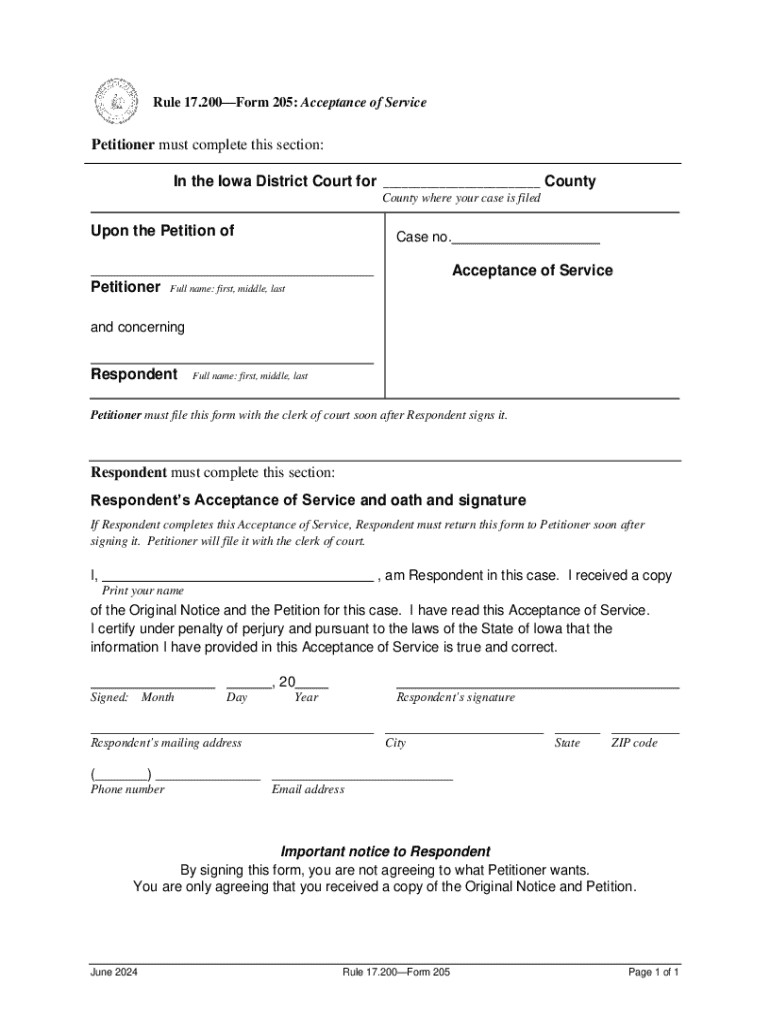
The form titled "In the Iowa District Court for County Upon the Petition of Acceptance" is typically involved in the judicial process within the Iowa court system. This form is used specifically for accepting service in a court case, indicating that the recipient acknowledges having received the legal documents related to the proceedings. It does not imply agreement with the details or requests of the petition, merely acknowledging receipt.
How to Use the Form
To utilize this form effectively, it must be completed and returned by the party being served. The respondent must sign the document to confirm receipt of the legal petition associated with the court case. It is crucial to complete all required fields accurately to avoid delays in legal proceedings. Signing the form is a procedural step and does not equate to an admission of any claims or requests made by the petitioner.
How to Obtain the Form
The form is accessible through the Iowa District Court where the case is filed. Obtaining it can be done in person by visiting the court clerk’s office or by downloading it from the official court website if available. It is important to ensure that the correct version is utilized, as using an outdated or incorrect form may lead to rejection or additional legal complications.
Steps to Complete the Form
- Review the Form: Read all sections thoroughly to understand what information is required.
- Fill Out Personal Information: Enter details such as name, address, and contact information as required.
- Acknowledge Receipt: Clearly indicate receipt of the petition by signing where indicated.
- Return the Form: Submit the completed and signed form to the Iowa District Court by mail or in person, as stipulated in the court's instructions.
Who Typically Uses the Form
This form is predominantly used by respondents in legal proceedings within the Iowa District Court system. Respondents can be individuals or entities who have been served with a petition and are required to formally acknowledge receipt. Legal professionals representing clients may assist in completing the form to ensure compliance with court requirements.


Key Elements of the Form
- Identification Information: Contains sections for the recipient’s name and contact details.
- Service Acknowledgment: Confirms the receipt of legal documents.
- Signature Line: Requires the respondent’s signature to validate acknowledgment.
- Filing Instructions: Provides details on submitting the form to the court.
Legal Use of the Form
The legal use of this form is primarily procedural, serving as an acknowledgment of receipt rather than admission or agreement. It is a critical step in ensuring that parties involved in legal actions are officially notified and that all legal documentation has been received, therefore maintaining due process.
Filing Deadlines / Important Dates
Timeliness is crucial when handling this form. The deadlines for filing are generally specified in the accompanying legal documents. Failure to submit the form within the designated timeframe can lead to default judgments or other legal penalties, emphasizing the importance of adhering to specified deadlines.
Required Documents
Along with the form, respondents may need to provide a copy of the served petition. This helps in correlating the acknowledgment to the specific legal action. Legal representatives may also require documentation proving the identity and capacity of the person submitting the form on behalf of an entity, if applicable.
Form Submission Methods
- Online Submission: If available through the court's online portal.
- Mail Submission: Sending the completed form through certified mail is often recommended to obtain a delivery receipt.
- In-Person Submission: Directly handing over the documents to the court clerk for immediate acknowledgment and processing.
State-Specific Rules
Given its use in the Iowa District Court system, this form adheres to state-specific rules and regulations. It is imperative to understand these local nuances to ensure compliance. Certain details and procedural steps may vary depending on the specific county or district involved, requiring consultation with legal counsel or court officials when necessary.