






Definition and Purpose of FL-100 Petition for Marriage/Domestic Partnership
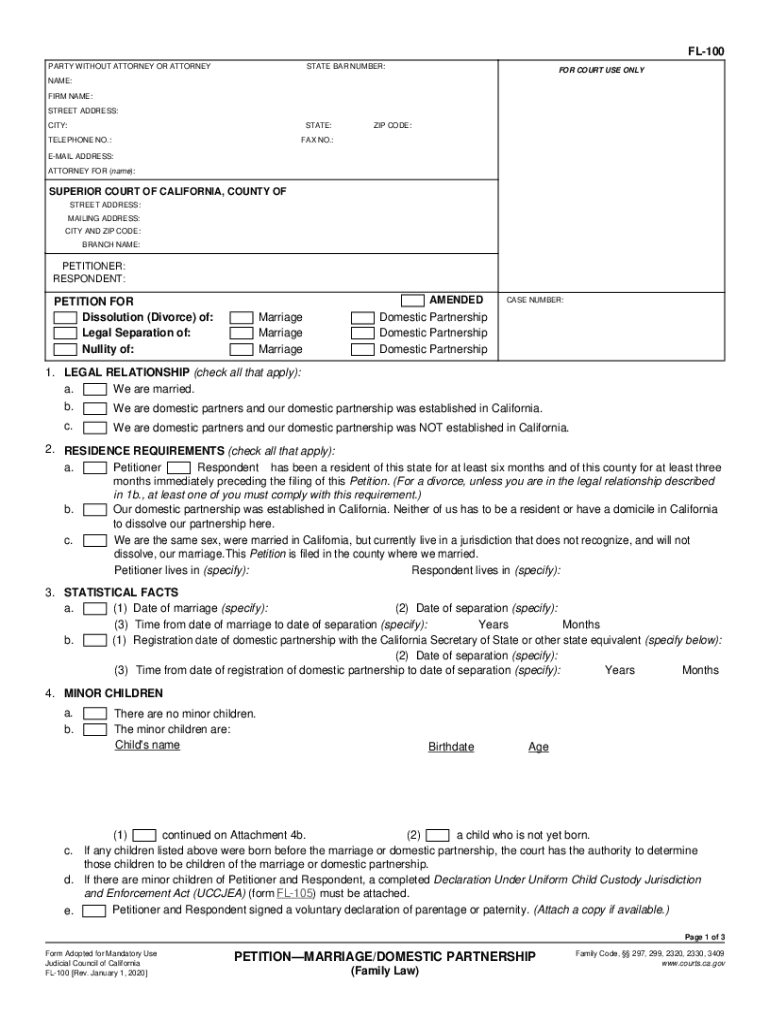
The FL-100 form is a legal document employed in the state of California to initiate the process of dissolving a marriage or domestic partnership. This petition is essential for officially beginning proceedings for divorce, legal separation, or nullity of marriage. The form is typically filled out by one party in the relationship, known as the petitioner, and submitted to the court alongside additional required documentation. This establishes the legal grounds for the dissolution and outlines the basic terms and requests concerning child custody, property division, and spousal support.
Steps to Complete the FL-100 Form
-
Provide Personal Information:
- Include full names and contact details for both parties involved.
- Specify the date and location where the marriage or domestic partnership took place.
-
State the Grounds for Dissolution:
- Clearly indicate the legal reason for seeking dissolution, such as irreconcilable differences.
-
Detail Child Custody Arrangements:
- Outline plans for the care and custody of any minor children, including living arrangements and visitation schedules.
-
Address Property Division:
- List all assets and debts and propose a division between the parties.
-
Sign and Date the Form:
- The petitioner must sign the document under penalty of perjury, affirming that the information provided is truthful.
Obtaining the FL-100 Form
- Court Website: The California courts' official website provides downloadable PDF versions of the FL-100 form.
- Local Court Clerk's Office: Visit the Family Law division for physical copies or additional guidance.
- Legal Aid Organizations: Some offer assistance in acquiring and completing these forms.
Eligibility for Using the FL-100 Form
- Residency Requirements: At least one spouse must meet California's residency criteria: living in the state for a minimum of six months and in the county of filing for at least three months.
- Legal Standing: The petitioner must have a valid marriage or registered domestic partnership recognized in California.
Key Elements of the FL-100 Petition
- Petitioner's Information: Basic identification details of the filing party.
- Respondent's Information: Details of the non-filing spouse or partner.
- Residency Declaration: Confirmation of the residency requirements.
- Legal Relationship Status: Current status and intentions regarding marital or partnership dissolution.
Legal Use and Context
In California, the FL-100 is necessary for commencing judicial proceedings related to marriage or domestic partnership dissolution. It serves as the formal request to the court to terminate the marriage or partnership and addresses all incidental demands, such as spousal support or division of property.
Important Terms Related to FL-100
- Petitioner: The party initiating the legal action.
- Respondent: The other party in the marriage or domestic partnership.
- Dissolution: Legal term for ending a marriage or partnership.
- Nullity: The declaration that a marriage or partnership is void.
State-Specific Rules for FL-100
- Filing Fees: Noticeable variation exists in court fees between counties; waivers are available under specific income conditions.
- Court Jurisdiction: File in the county where at least one party meets the residency requirement.
Examples and Scenarios
- Example Scenario: A couple married in California, but now living in different states, can initiate proceedings if one maintains residency in California.
- Practical Application: A petitioner can request the court to grant spousal support based on significant financial disparity between parties.
Penalties for Non-Compliance
Failure to correctly file or provide accurate information on the FL-100 can lead to legal repercussions, including case dismissal or a perjury charge, altering eventual legal outcomes such as property settlements or custody decisions.