






Definition and Importance of Lost Profit or Lost Chance
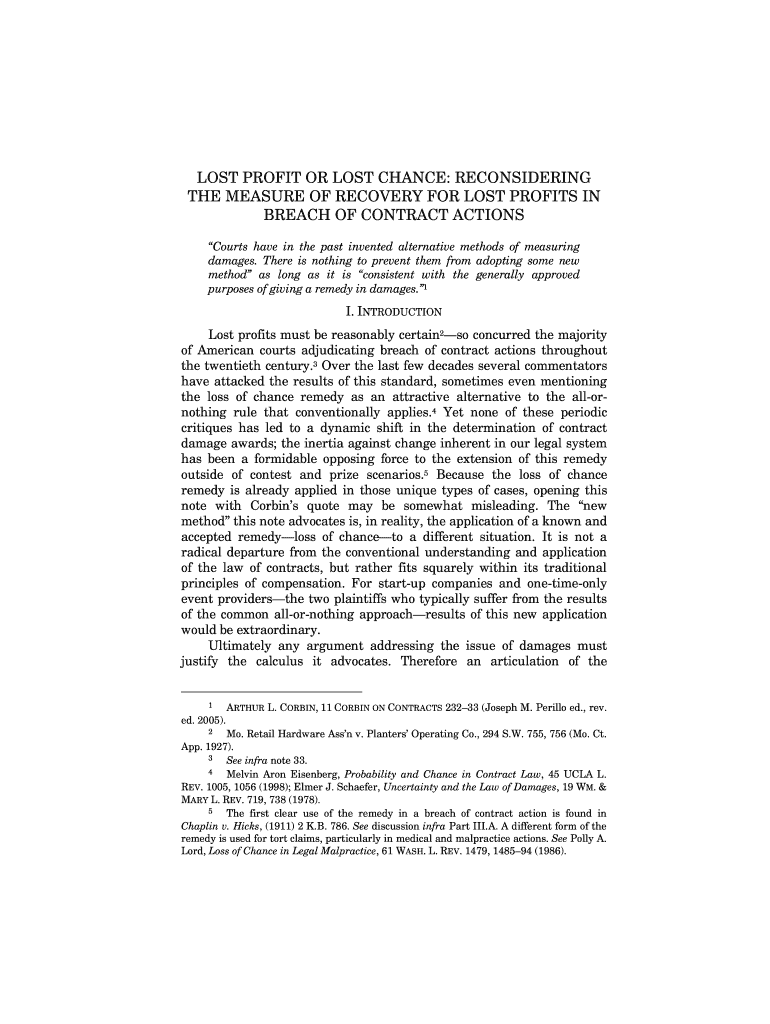
The concept of "lost profit" refers to the forgone earnings that a party anticipates they would have made if not for a breach of contract or an unfulfilled obligation. On the other hand, "lost chance" focuses on valuing the opportunity missed, rather than the profits that were never realized. This distinction is crucial in legal discussions, especially in contract law, where determining compensation relies significantly on understanding these terms.
Real-World Application
For instance, a start-up company expecting significant revenue from a new partnership could claim lost profits if the partnership is unjustly dissolved. Alternatively, courts might evaluate the lost chance to reflect the startup's missed business opportunity, focusing on potential rather than guaranteed profits.
Legal Context and Historical Background
"Lost profit" and "lost chance" have evolved within legal frameworks, reflecting an ongoing debate over fair compensation methods. Traditional methods often required proof of "reasonable certainty" to claim lost profits, presenting challenges in cases with speculative earnings, such as those involving fledgling businesses or single-event providers.
Historical Perspective
Historically, courts have leaned towards the reasonable certainty standard to prevent speculative claims. However, this often results in either overcompensation or undercompensation. The alternative "lost chance" approach, which some argue better adheres to restorative justice principles, aims to balance these inequities by valuing missed opportunities.
Key Elements and Legal Considerations
The "lost profit" and "lost chance" framework involves several critical elements that determine the nature and scope of any claims or remedies.
Essential Components
- Proof of Breach or Occasion: There must be an identifiable breach or missed opportunity due to another party's actions.
- Causation: Demonstrating that the breach directly resulted in lost profits or a lost chance is pivotal.
- Valuation Techniques: Reliable methods must be used to estimate either the lost profits or the value of the lost chance.
Legal Implications
Aligning with the ESIGN Act, the platform's electronic processes validate the binding nature of agreements and encourage standardized compensation practices, which are essential when dealing with these concepts in a legal setting.
Methods for Implementing Lost Chance Remedy
Implementing a "lost chance" remedy requires a strategic approach to evaluate missed opportunities effectively.
Steps and Techniques
- Identification of Opportunity: Clearly define the opportunity lost due to the breach.
- Evaluation of Probability: Assess the likelihood of success had the opportunity been pursued.
- Valuation of Potential Outcomes: Estimate the economic value of the lost opportunity.
- Adjustment for Risks: Account for inherent risks or external factors that might have influenced the outcome.
Practical Applications
Courts might employ statistical models or expert testimony to gauge the probability and valuation of the lost chance, potentially providing a fairer outcome than traditional profit calculations.
Who Typically Engages with Lost Profit or Lost Chance
While both terms are applicable across various business and individual contexts, certain entities frequently find themselves dealing with these concepts.
Typical Users
- Start-up Companies: Predominantly because they often operate in uncertain markets where profits are less predictable.
- One-time Event Providers: Those reliant on singular opportunities (e.g., concerts, festivals) that face unique challenges in predicting exact profits.
- Legal Teams: Especially those specializing in contract and tort law, often engage with these concepts to advocate for or against claims.
Important Terms Related to Lost Profit or Lost Chance
Several terms are integral to understanding and assessing lost profit or lost chance scenarios.
Glossary of Terms
- Reasonable Certainty: A traditional legal standard used to determine potential damages.
- Restorative Justice: A legal principle focusing on restoring a claimant to the position they would have been in absent the breach.
- Speculative Earnings: Potential profits that cannot be established with certainty or exact figures.
State-Specific Rules for Addressing Lost Profits and Lost Chances
Understanding state-specific variations is crucial when assessing lost profits or lost chances, as legal interpretations and compensatory guidelines can vary.
Notable Variations
- Jurisdictional Differences: Different states may have varied precedents on how these concepts are approached.
- Court Interpretations: Some states might prioritize lost chance evaluations over lost profits, affecting litigation strategies.
Software and Digital Tools for Managing Lost Profit and Lost Chance Evaluations
With advancements in digital solutions, managing lost profit or lost chance evaluations has become more efficient.
Integration with DocHub
- Document Management: Tools that facilitate the organization and secure sharing of case-related documents.
- Collaboration Features: Allow legal teams to collaboratively evaluate claims by sharing analyses and feedback in real-time.
- Secure Signing and Authorization: Ensure that all agreements and evaluations are legally binding through secure electronic signatures.
This comprehensive exploration of "lost profit or lost chance" provides critical insights into the legal and practical considerations of addressing these concepts, particularly through digital platforms like DocHub that streamline document workflows while ensuring legal compliance.