






Definition & Meaning
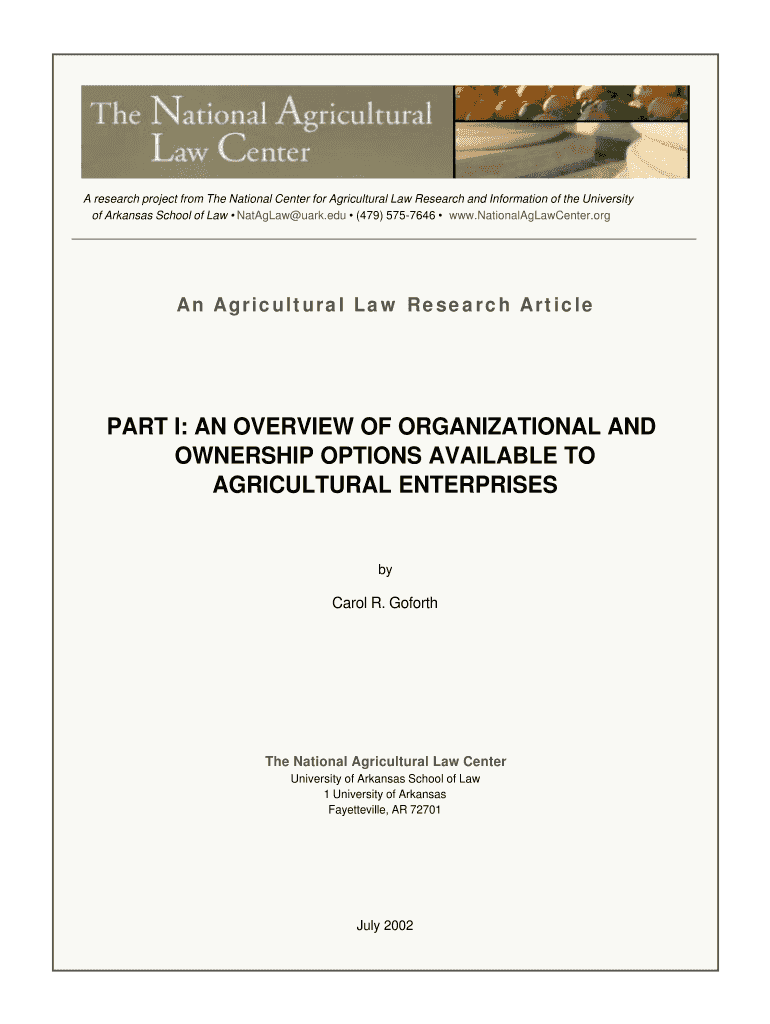
The "NALC Agricultural Entities Article - Department of Agricultural - agecon okstate" refers to a comprehensive research article provided by the National Center for Agricultural Law Research and Information. Authored by Carol R. Goforth, this article offers a detailed exploration of various organizational and ownership structures available to agricultural entities. It provides crucial insights into business structures such as sole proprietorships, general and limited partnerships, limited liability partnerships (LLPs), limited liability companies (LLCs), corporations, and cooperatives. Each structure's attributes, legal implications, and tax considerations pertinent to agricultural operations are examined thoroughly.
How to Use the NALC Agricultural Entities Article
Understanding the application of the NALC Agricultural Entities Article involves familiarizing oneself with the various business forms and their respective implications. Individuals or businesses looking to establish or restructure their agricultural operations can use this article as a guide to evaluate the suitability of different organizational types. Each section of the article serves as a decision-making tool, providing the necessary information to weigh the pros and cons associated with each business structure.
Practical Steps:
- Identify business goals: Define the primary objectives of the agricultural entity.
- Assess each structure: Evaluate the tax and legal characteristics detailed in the article.
- Consider future growth: Account for scalability and future business needs.
- Consult legal counsel: Verify information and implications with a legal expert.
Steps to Complete the NALC Agricultural Entities Article
Navigating the complexity of agricultural business structures through the NALC Agricultural Entities Article involves a systematic approach to reading and analyzing the text. Each section should be comprehensively reviewed to ensure a nuanced understanding of the options available.
- Read thoroughly: Begin with a full read-through of the article to gain an overview.
- Note specifics: Highlight key aspects related to specific business structures.
- Compare structures: Use comparative analysis methods to see which structures align best with business objectives.
- Document insights: Record findings to facilitate discussions with stakeholders or legal advisors.
Important Terms Related to Agricultural Entities
Business Structures
- Sole Proprietorship: A business owned by a single individual, offering simplicity but limited liability protection.
- Partnership: Multiple owners with shared responsibilities; variations include general and limited partnerships.
- LLC: Provides liability protection to owners while offering flexibility in taxation and management.
Legal and Tax Considerations
- Limited Liability: Legal structure that limits owners' personal liability for business debts.
- Taxation: The method by which income is taxed—can vary significantly with different structures.
Legal Use of the NALC Article
The NALC Agricultural Entities Article serves as a legal resource that informs decision-makers within the agricultural sector about the appropriate and strategic choice of business structures. Its legal use extends to serving as a reference in legal consultations, aiding in decision-making and planning for legal compliance, and forming a basis for structuring contracts and internal agreements within agricultural organizations.
Key Elements of the NALC Agricultural Entities Article
Central to the article are the discussions surrounding legal and tax implications for business entities. It provides specific examples of how these considerations impact operational decisions in agriculture. The article thoroughly addresses various scenarios where different structures may prove advantageous or detrimental.
Key Elements Include:
- Risk Management: Directions on mitigating potential legal risks.
- Tax Efficiency: Strategies to optimize taxation based on entity choice.
- Operational Flexibility: Considerations for management and control across different forms.
State-Specific Rules for Agricultural Entities
While the article provides a general overview, it also highlights the necessity of considering state-specific regulations. Differences in state laws can affect the registration, taxation, and operation of agricultural entities. It emphasizes the importance of consulting state-specific resources or legal experts familiar with local agricultural laws.
Business Types That Benefit Most from the Article
Agricultural enterprises contemplating restructuring or new formations will find the NALC Agricultural Entities Article invaluable. It is particularly beneficial for:
- Family Farms: Evaluating succession planning and liability protection.
- Corporate Farms: Assessing the scaling of operations and tax implications.
- Small Agricultural Businesses: Exploring flexible and protective business structures.
Each block provides thorough understanding and practical applications of the information contained within the NALC Agricultural Entities Article, ensuring that agricultural businesses make informed decisions concerning their organizational structures.