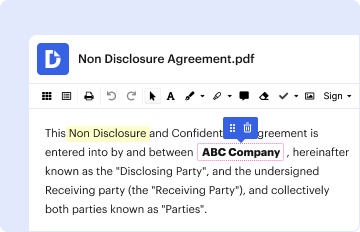
Type text, add images, blackout confidential details, add comments, highlights and more.
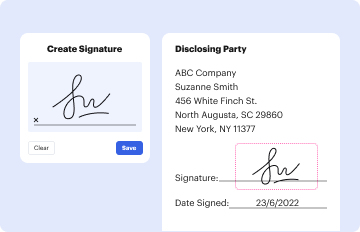
02. Sign it in a few clicks
Draw your signature, type it, upload its image, or use your mobile device as a signature pad.
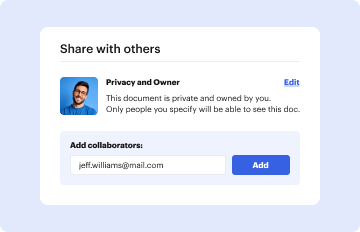
03. Share your form with others
Send it via email, link, or fax. You can also download it, export it or print it out.
How to use or fill out The Lost Compromise: with our platform
Ease of Setup
DocHub User Ratings on G2
Ease of Use
DocHub User Ratings on G2
Click ‘Get Form’ to open it in the editor.
Begin by reviewing the introduction section, which outlines the purpose of the document. This will help you understand the context as you fill out the form.
Proceed to Section I, where you will find fields related to your personal information. Fill in your name, address, and contact details accurately.
In Section II, focus on the questions regarding your understanding of the incorporation theory. Provide thoughtful responses based on your interpretation of the material.
Review Section III for any additional comments or insights you wish to share about The Lost Compromise. This is an opportunity to express your views.
Once all sections are completed, double-check your entries for accuracy and completeness before submitting.
Engage with our platform today to streamline your document editing and completion process for free!
The final compromise came to be known as the Compromise of 1850 and consisted of five separate bills. The first of these bills created a new, stricter, Fugitive Slave Law.
What were the 5 points of the Compromise of 1850?
The acts called for the admission of California as a free state, provided for a territorial government for Utah and New Mexico, established a boundary between Texas and the United States, called for the abolition of slave trade in Washington, DC, and amended the Fugitive Slave Act.
What are the four major compromises?
Great Compromise, 1787. Issue: Representation in Congress. Missouri Compromise, 1820. Issue: Missouri would disrupt balance of free and slave states; Should slavery extend into new territories? Compromise of 1850. Compromise of 1877.
What happened in the compromise?
The Compromise of 1877 was an informal, unwritten deal that settled the disputed 1876 U.S. Presidential election; through it Republican Rutherford B. Hayes was awarded the White House on the understanding that he would remove the federal troops from South Carolina, Florida and Louisiana.
What are the 5 Ws of the Compromise of 1850?
The 5 Ws of the Compromise of 1850 are: Who proposed it (notably Henry Clay), What it entailed (a series of laws regarding slavery and territories), When it occurred (1850), Where it impacted (mainly new U.S. territories), and Why it was needed (to address tensions over slavery expansion).
Related Searches
Kansas-Nebraska ActCompromise of 1850Missouri CompromiseCompromise of 1820How did the Compromise of 1850 lead to the Civil WarCompromise of 1850 impactWhat did the Compromise of 1850 doCompromise of 1850 map
People also ask
What was the significance of the Compromise of 1877?
Under the compromise, Democrats controlling the House of Representatives allowed the decision of the Electoral Commission to take effect, securing political legitimacy for Hayess legal authority as President.
What were the 5 parts of the Compromise of 1850 Quizlet?
Part 1. California is admitted into the union as a free state. Part 2. Popular sovereignty will be used in Utah and New Mexico territories. Part 3. Texas and New Mexico borders settled, Texas gets $10 Million to help pay debts. Part 4. Part 5. Compromise of 1850. Fugitive Slave Act.
Related links
Compromise of 1850 (1850)
May 10, 2022 The Compromise was actually a series of bills passed mainly to address issues related to slavery. The bills provided for slavery to be decided by popular
Jan 11, 2025 Spoiler warning! This page contains details about Fallen London Actions. From: Exploit your Compromising Documents. Perhaps love is in the fog.
Cookie consent notice
This site uses cookies to enhance site navigation and personalize your experience.
By using this site you agree to our use of cookies as described in our Privacy Notice.
You can modify your selections by visiting our Cookie and Advertising Notice.