






Definition and Meaning of Justifications and Excuses
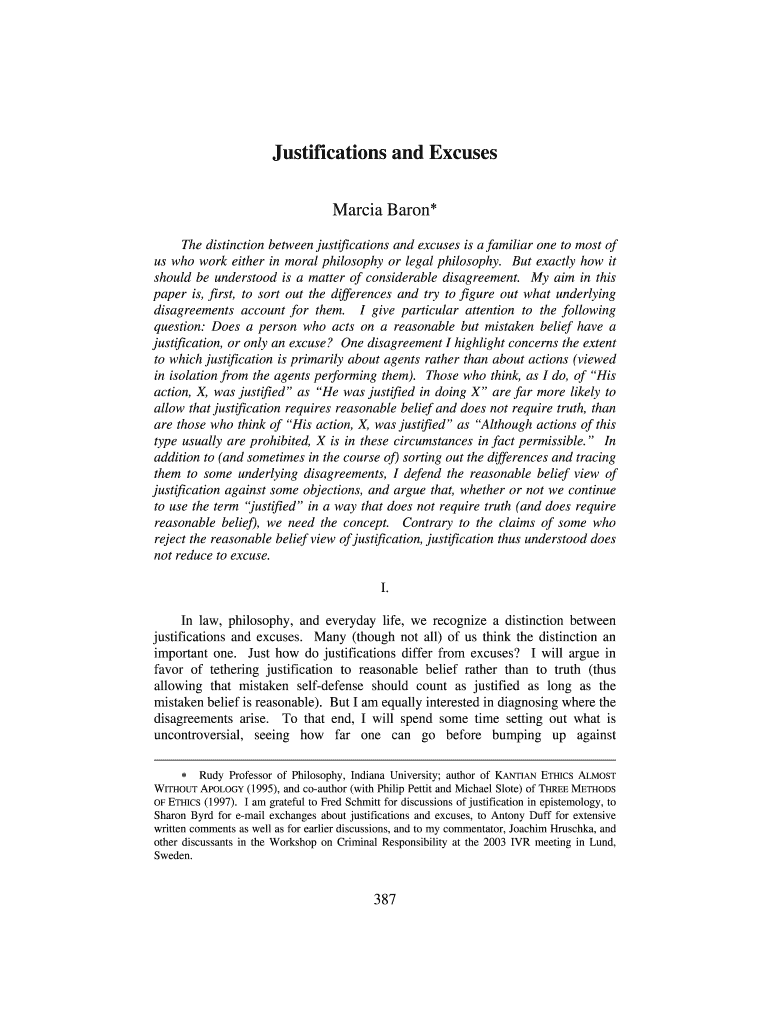
In philosophical, moral, and legal discussions, the distinction between justifications and excuses is crucial. A justification accepts that an action was rightful under the circumstances, while an excuse admits the action was wrong but forgives the actor due to mitigating circumstances. Marcia Baron's exploration brings this into focus by examining whether actions based on reasonable yet mistaken beliefs can be considered justifiable or merely excusable. Her argument emphasizes that justification should be based on reasonable belief, not just the truth. This perspective enriches our understanding of moral responsibility by allowing experts and laypeople alike to re-evaluate the roles of beliefs in moral and legal assessments.
How to Use Justifications and Excuses
The application of justifications and excuses can vary significantly across different contexts. For instance, in legal scenarios, demonstrating a justification often requires proving that an action was necessary and for a greater good. Conversely, an excuse might be invoked to argue that despite a wrongful act, the actor's culpability should be mitigated due to an error of judgment or circumstance. In daily life, understanding these distinctions helps individuals frame their responses to various situations, allowing for a more mindful assessment of actions and the motivations behind them. Mastering this differentiation helps individuals communicate more effectively and align actions with moral and social norms.
Important Terms Related to Justifications and Excuses
Familiarizing oneself with the terminology associated with justifications and excuses is essential for a comprehensive understanding. Key terms include "reasonable belief," which explores the actor's perception at the time of the action, and “mitigating circumstances,” which refer to factors that lessen culpability. The term "moral responsibility" is also paramount, focusing on the obligations individuals have to account for their actions within ethical parameters. Legal terms like "duress" and "necessity" come into play as they may offer defenses akin to justifications or excuses in court, shaping verdicts and influencing legal outcomes. Understanding these terms is crucial for navigating discussions around these concepts effectively.
Legal Use of Justifications and Excuses
Justifications and excuses are frequently employed in legal contexts to influence judicial outcomes. A legal justification might be self-defense, where the action is deemed necessary to prevent imminent harm. An excuse might involve a scenario where the actor claims temporary insanity, aiming to mitigate legal responsibility despite the wrongful act. These defenses are grounded in legal principles that weigh the actor's intention and contextual factors. In U.S. law, established precedents and statutes provide frameworks for these defenses, guiding how they are invoked and argued in court. Mastery of these legal principles is critical for practitioners and those engaged in legal proceedings.
Key Elements of Justifications and Excuses
Understanding the core components that make up justifications and excuses affords clarity in both theoretical and practical applications. Justifications often require a demonstration of necessity, proportionality, and a lack of lawful alternatives. Excuses, on the other hand, typically rely on establishing an actor's impaired capacity to make rational decisions due to factors like coercion, lack of knowledge, or unavoidable circumstances. These elements frame how cases are assessed both morally and legally, ensuring a fair evaluation of actions and intent. Accurate grasp of these components aids in crafting coherent arguments and judgments, fostering a deeper appreciation of ethical and legal reasoning.
Examples of Using Justifications and Excuses
Illustrative scenarios elucidate how justifications and excuses operate. A home invasion may lead to self-defense claims, justifying the homeowner's actions. Conversely, a driver experiencing a medical emergency may be excused for traffic violations due to the circumstances. Such examples underscore the nuances present in applying these concepts. In educational settings, a student's misunderstanding of instructions may lead to an excuse for the lack of timely assignment submission. These scenarios exemplify how these distinctions play pivotal roles in resolving conflicts and framing narratives in both everyday situations and formal adjudications.
Steps to Complete the Justifications and Excuses Process
Engaging with justifications and excuses often involves methodically assessing situations and identifying applicable frameworks. Key steps include identifying the action under scrutiny, assessing necessity versus culpability, gathering relevant evidence, and applying philosophical or legal principles to establish a defense. Each step requires careful analysis to determine the most appropriate defense strategy. In legal settings, these processes are fortified by witness testimonies, forensic analysis, and expert opinions to substantiate claims. Systematically approaching these steps enables individuals and legal professionals to build robust defenses and understandings of actions, ensuring fair consideration of circumstances and motives.
Penalties for Non-Compliance with Justifications and Excuses
Failure to correctly apply justifications and excuses, particularly in legal contexts, can result in significant consequences. Misjudging an appropriate justification or excuse can lead to harsher penalties, such as fines, imprisonment, or reputational damage. Legal systems impose penalties based on the gravity of offenses, taking into account whether the defense provided aligns with established norms and legal frameworks. In ethical discussions, misapplication may result in loss of credibility or trust within personal and professional relations. Awareness of potential penalties underscores the importance of accurately employing these defenses to mitigate negative outcomes and uphold personal integrity and societal standards.