






Definition & Meaning
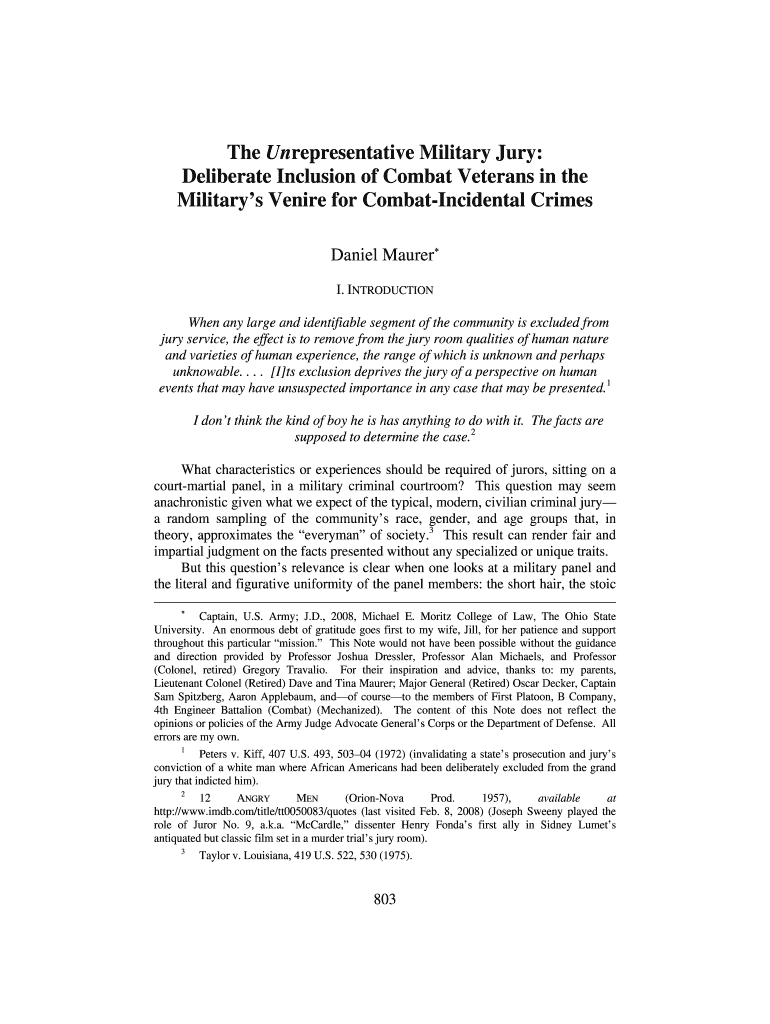
The term "The Unrepresentative Military Jury" refers to the composition of jury panels in military court-martial cases that often exclude members with relevant combat experience. This lack of diversity can result in a jury that may not fully appreciate the context of actions taken during combat. Under the Uniform Code of Military Justice (UCMJ), the current selection process tends to yield panels that do not adequately represent the backgrounds and experiences of those being tried, particularly in cases involving combat-incidental crimes. The inclusion of such essential experience is argued to be vital for fair and informed verdicts.
Key Elements of The Unrepresentative Military Jury
- Jury Composition: Current panels often consist predominantly of individuals without combat experience. This can skew the appreciation and understanding of combat-related actions.
- Article 25 of the UCMJ: This article guides jury selection but does not currently mandate combat experience as a requirement. Proposed amendments suggest designating a portion of the jury to have this necessary background.
- Fairness and Accuracy: The perceived fairness of trials could greatly improve by including combat veterans, thereby promoting verdicts that account for combat dynamics.
- Traditional Command Authority: Proposals ensure that while increasing diversity within juries, traditional command authority and the structure of military trials remain respected.
Steps to Complete the The Unrepresentative Military Jury:
- Evaluate Current Jury Selection Practices: Identify the degree to which combat experience is represented within typical panels.
- Propose Amendments to Article 25: Suggest changes emphasizing experience-based selection criteria for enhancing jury panels.
- Implement Training for Members: Ensure potential panel members without combat experience receive context-based training to improve understanding of combat scenarios.
- Monitor and Adjust: Continually assess the impacts of these changes and make adjustments based on observed outcomes to reinforce the fairness of military trials.
Legal Use of the The Unrepresentative Military Jury
- Authenticating Processes: Ensures that constitutional rights and legal protections are upheld within military judicial settings.
- Voir Dire Protocols: Engage comprehensive questioning to ascertain the capability and impartiality of potential jurors, adapted to include considerations of combat experience.
- Jury Nullification: Address potential nullification scenarios by equipping juries with members who realistically understand the complexities of combat.
Important Terms Related to The Unrepresentative Military Jury
- Uniform Code of Military Justice (UCMJ): Governing body of laws for military justice, with jury selection processes falling under its purview.
- Combat-Related Crimes: Offenses that occur in a combat setting, where situational context can drastically influence interpretations of actions.
- Voir Dire: A preliminary examination to assess the biases and qualifications of potential jurors, crucial in ensuring fair trial procedures.
Examples of Using the The Unrepresentative Military Jury
- Impactful Cases: Historical cases where combat-related context was critical to the trial's outcome could illustrate the necessity for reform in jury selection.
- Case Studies: A detailed analysis could demonstrate instances where the inclusion of veterans led to more nuanced decisions, aligning verdicts more closely with realistic combat scenarios.
Who Typically Uses the The Unrepresentative Military Jury
- Military Personnel: Individuals subject to court-martial proceedings, particularly those charged with combat-incidental offenses.
- Military Legal Experts: Lawyers and advocates involved in reforming military justice procedures to secure fair representation in juries.
- Policy Makers: Legislative and military officials crafting amendments to ensure more inclusive jury selection.


Proposed Changes to the Unrepresentative Military Jury
- Amend Article 25: Advocate for specific legislative changes to include a percentage of jurors with combat experience.
- Ongoing Evaluation: Create evaluation frameworks to ensure that these changes have the desired effect on courtroom processes.
- Training Programs: Initiate extensive training for all jurors to better prepare them for understanding the complexities they may encounter.
State-Specific Rules for The Unrepresentative Military Jury
While military law is federally governed, differing perspectives across states can influence attitudes toward jury composition reforms. States prioritizing veteran support may advocate more strongly for the inclusion of veterans in military juries compared to areas with less emphasis on military engagement.