






Understanding the Calamitous Law of Notes
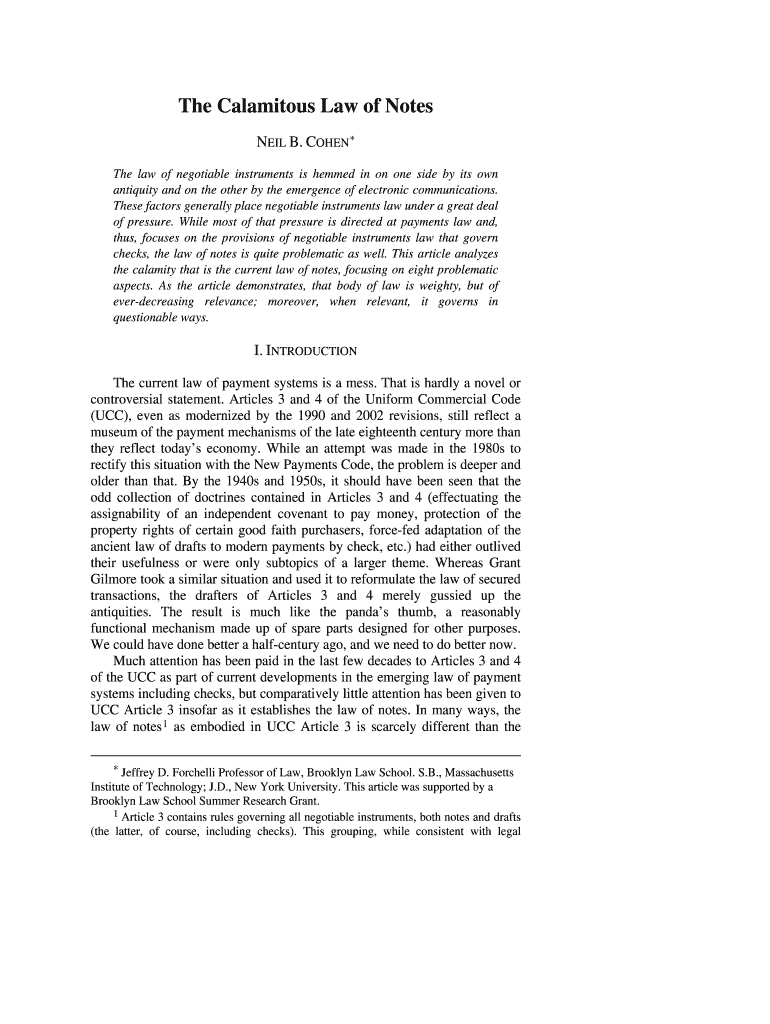
The Calamitous Law of Notes, as critically evaluated by Neil B. Cohen, provides insight into the complex world of negotiable instruments under the Uniform Commercial Code (UCC) Article 3. This set of regulations is responsible for governing the creation, transfer, and enforcement of notes, which are financial instruments representing a written promise to pay a certain amount. Despite its thoroughness, many of these provisions are considered outdated, particularly as electronic transactions become prevalent.
Key Elements of the Calamitous Law of Notes
To fully grasp the Calamitous Law of Notes, it is vital to understand its foundational components:
- Negotiability Requirements: Notes must meet strict criteria to be negotiable, such as being an unconditional promise to pay a fixed amount of money.
- Indorsements and Transfers: The law outlines how notes can be endorsed or transferred, affecting the rights of holders and potential defenses against payment.
- Holder in Due Course Doctrine: This principle protects certain holders from claims or defenses that the issuer might have against the original payee.
- Presentment and Dishonor: Procedures for demanding payment and the consequences of non-payment are detailed under the relevant rules.
Critiques and Calls for Reform
The critique by Cohen emphasizes the need for a re-evaluation of the existing legal structures:
- Outdated Provisions: Many parts of Article 3 are seen as obsolete in light of digital financial interactions.
- Alternatives through Contract Law: The necessity of certain negotiable instrument laws is questioned, given that similar outcomes can often be achieved through contract law.
- Irrelevance in Modern Commerce: Many negotiable instrument laws pertain to scenarios infrequent in contemporary transactions.
Legal Use and Compliance
Since the Calamitous Law of Notes governs financial and commercial exchanges, adherence is crucial for legal compliance:
- Legal Enforceability: To ensure enforceability, notes need to fulfill all stipulated legal requirements, from being in writing to including specific terms.
- Contracts vs. Negotiable Instruments: Comparisons between outcomes achievable via contract law versus negotiable instrument law highlight potential simplifications in legal requirements.
- Security Features: Despite technological progression, traditional security features remain vital in authenticating physical and electronic financial documents.
Important Terminology and Concepts
Understanding the specific language and terms used within the Calamitous Law of Notes is essential for anyone engaged in related transactions:
- Maker and Payee: The individual or entity promising payment is the maker, while the entity entitled to receive it is the payee.
- Endorser and Endorsee: Endorsers transfer notes, while endorsees receive them, impacting the obligation to honor the note terms.
- Negotiability: A negotiable note must be transferable and fulfill conditions that protect the rights of holders in due course.
Digitization and the Future of the Law
The impact of electronic transactions raises questions about the continued relevance of traditional note law:
- Electronic Notes and Digital Signatures: As businesses transition towards digital, electronic notes and digital signatures underscore a need for legal updates.
- Security in Electronic Transfers: While the transformation to digital notes enhances efficiency, ensuring robust security through encryption and authentication is critical.
- Reform Proposals: Discussions continue around potential reforms, focusing on aligning legal frameworks with modern-day commercial practices.
Who Typically Uses the Calamitous Law of Notes
The law primarily affects entities involved in the issuance and handling of notes:
- Financial Institutions: Banks and lenders use notes to manage loans and credit facilities.
- Business Transactions: Companies that frequently engage in sales and credit transactions.
- Legal Professionals: Lawyers advising businesses on the drafting and negotiation of financial instruments must be conversant with these laws.


Compliance and Penalties for Non-Adherence
Neglecting compliance with note regulations can lead to severe consequences:
- Legal Disputes: Failure to adhere to requirements can result in disputes and litigation over the enforceability of notes.
- Financial Penalties: Non-compliance could attract financial penalties, impacting a business’s financial standing and reputation.
- Loss of Rights: Incorrect handling of notes may lead to the loss of holder in due course protection and other legal rights.
State-Specific Rules and Variations
While the UCC provides a standardized framework, variations can occur:
- State Modifications: Individual states may adopt modifications or supplementary rules affecting the application of Article 3.
- Compliance Differences: Businesses operating in multiple states must be aware of any jurisdiction-specific alterations to avoid potential compliance pitfalls.
Examples of the Calamitous Law of Notes in Practice
Practical examples illustrate the application of these laws:
- Loan Agreements: A promissory note ensuring repayment terms follows Article 3 guidelines to maintain enforceability.
- Mortgage Notes: These are used in the real estate industry, requiring compliance with both Article 3 and state-specific housing laws.
- Trade and Commercial Finance: Businesses utilize notes for trade credit, which demands adherence to legal standards for negotiability.