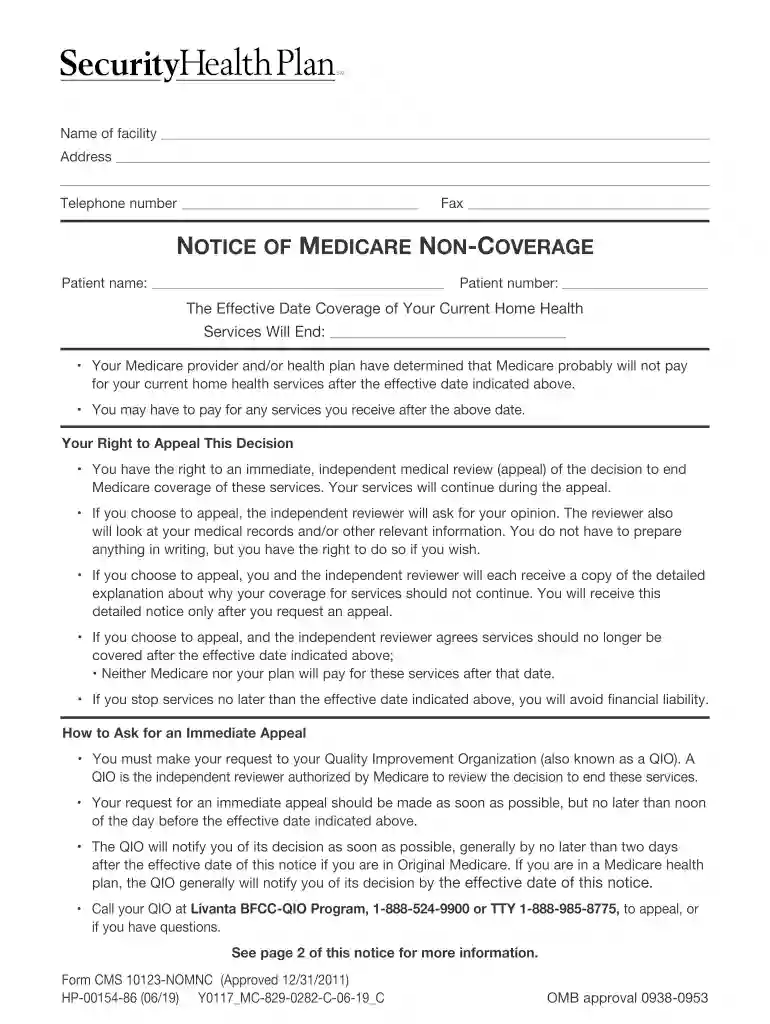
Our Medicare provider and or health plan have determined that Medicare probably will not pay 2026

Get Form
our Medicare provider and or health plan have determined that Medicare probably will not pay Preview on Page 1

Here's how it works

01. Edit your form online
Type text, add images, blackout confidential details, add comments, highlights and more.

02. Sign it in a few clicks
Draw your signature, type it, upload its image, or use your mobile device as a signature pad.

03. Share your form with others
Send it via email, link, or fax. You can also download it, export it or print it out.

Definition and Purpose

The Notification of Medicare Non-Coverage (NOMNC) form, frequently referred to by its long-form description "our Medicare provider and or health plan have determined that Medicare probably will not pay," is a critical communication tool used by healthcare providers to inform patients about the likelihood of non-payment by Medicare for certain healthcare services. The form outlines specific reasons why services may not be covered, which is crucial for patients in managing potential out-of-pocket expenses.

Objectives of the Notification

  • Inform beneficiaries about non-coverage decisions in a clear and timely manner.
  • Provide a basis for patients to understand potential financial responsibilities.
  • Offer a structured way for patients to contest coverage determinations through appeals.

How to Use the Notification of Medicare Non-Coverage

Patients receiving the NOMNC form should carefully review the document to understand which services are not expected to be covered. It is essential to:

  1. Read the Details: Examine the specific services mentioned and the reasoning provided for the likely non-coverage by Medicare.
  2. Contact Providers: Reach out to your healthcare provider or health plan for clarification or to address any questions.
  3. Explore Alternatives: Consider other funding options or discuss with your provider about more affordable care alternatives.

How to Obtain the Notification

Receiving the NOMNC is a routine process for Medicare beneficiaries when there is a determination of non-coverage. Typically, this notification is issued by the healthcare provider or the Medicare health plan. Here's how it works:

  • During Discharge Planning: Often provided during the transition from one care setting to another, such as from hospital inpatient care to a home healthcare setting.
  • Upon Service Request: If certain services are requested that Medicare may not cover, the provider must issue the notification before the service is administered.

Steps to Complete an Appeal

If you disagree with the content of the NOMNC, here's how you can proceed with an appeal:

  1. Review Your Rights: The NOMNC should contain information about your rights to appeal. Understand timelines and contacts for initiating this process.
  2. Contact the Quality Improvement Organization (QIO): A designated QIO will assist with the immediate appeal request. Follow the instructions given in the NOMNC.
  3. Prepare Supporting Documents: Collect all relevant medical records, provider notes, and any additional documentation that supports the necessity of the services.
  4. Submit Your Appeal: Send all documentation to the QIO within the specified timeframe.

Why Review and Utilize the Notification

Engagement with the NOMNC is vital for patients for several key reasons:

  • Financial Planning: Anticipating medical costs not covered by Medicare aids in better financial management.
  • Informed Decision-Making: Knowing which services are non-covered helps in making informed healthcare decisions.
  • Right to Appeal: Exercising the right to appeal may result in overturned decisions, securing necessary coverage.

Key Terms Related to the Notification

Understanding specific terms related to the NOMNC can aid in comprehension:

  • Medicare Advantage (MA) Plans: Private health plans offered by Medicare that sometimes prompt the issuance of NOMNCs.
  • Quality Improvement Organization (QIO): An independent group that reviews the quality of care and handles appeals.
  • Appeal: A formal request to review and potentially overturn a non-coverage decision.

Legal Use of the Notification

The use of the NOMNC is governed by strict legal protocols to ensure transparency and protect patients' rights. Healthcare providers are legally obligated to:

  • Provide clear and accurate information regarding coverage decisions.
  • Adhere to timelines for issuing the notice.
  • Facilitate the appeals process through coordinated efforts with QIOs.

Examples of Using the Notification

Consider these scenarios to understand how the NOMNC might be used:

  • Home Health Services: A patient transitioning from hospital to home care receives a NOMNC indicating certain home health services may not be covered.
  • Rehabilitation Services: Before starting physical therapy, a NOMNC is issued indicating potential non-coverage of specific sessions.

These situations illustrate the preemptive nature of the NOMNC in setting patient expectations and outlining available recourse through appeals.

be ready to get more

Complete this form in 5 minutes or less

Get form

Got questions?

We have answers to the most popular questions from our customers. If you can't find an answer to your question, please contact us.
Contact us
You can file an appeal if Medicare or your plan refuses to: Cover a health care service, supply, item, or drug you think Medicare should cover. Pay for a health care service, supply, item, or drug you already got.
Generally, youre first eligible to sign up for Part A and Part B starting 3 months before you turn 65 and ending 3 months after the month you turn 65. If you dont sign up when youre first eligible, youll have to wait to sign up and go months without coverage.
Medicares reasons for denial can include: Medicare does not deem the service medically necessary. A person has a Medicare Advantage plan, and they use a doctor who is outside of the plan network. The Medicare Part D prescription drug plans formulary does not include the medication.
If Medicare denies payment: Youre responsible for paying. However, since a claim was submitted, you can appeal to Medicare.
There are many reasons Medicare might deny you coverage. Some common ones include: Medicare feels the service was not medically necessary. Youve exceeded the maximum allowed days in a hospital or care facility.

Security and compliance

At DocHub, your data security is our priority. We follow HIPAA, SOC2, GDPR, and other standards, so you can work on your documents with confidence.

Learn more
ccpa2
pci-dss
gdpr-compliance
hipaa
soc-compliance
be ready to get more

Complete this form in 5 minutes or less

Get form

People also ask

Though Medicare covers most of your health care costs when youre 65 or older or have an eligible disability, confusing enrollment periods and decisions about which coverage works best for you can complicate the sign-up. Missing deadlines, delaying enrollment or choosing the wrong plan can cost you.

Related links