01. Edit your form online
Type text, add images, blackout confidential details, add comments, highlights and more.

Type text, add images, blackout confidential details, add comments, highlights and more.

Draw your signature, type it, upload its image, or use your mobile device as a signature pad.

Send it via email, link, or fax. You can also download it, export it or print it out.
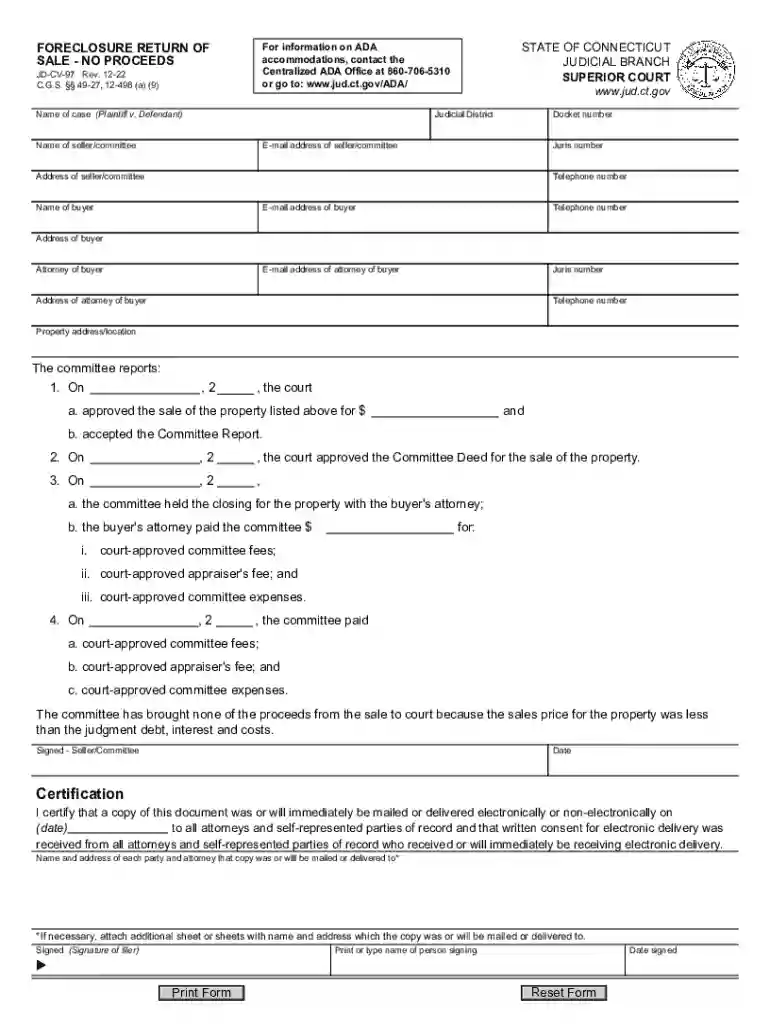
The "Foreclosure Return of Sale - No Proceeds" is a formal document used primarily within the judicial systems of certain states, like Connecticut, to report the outcomes of property foreclosure sales where the sales price is less than the amount owed on the mortgage debt. Typically, such a document provides documentation of the foreclosure process completion, confirms a deficiency where no surplus funds are available for distribution, and legitimizes the sale and internal financial transactions in adherence to court approval processes.
Review the Form's Purpose: Understand that this document is for communicating the lack of proceeds following a foreclosure sale.
Gather Financial Data: Collect details about the sale, including the sales price and the outstanding mortgage balance, to ensure the accuracy of submission.
Document Court Approval: Include confirmation of sale approval from the court, ensuring the process complies with judicial requirements.
Certification of Parties: Certify that necessary documentation has been delivered to all involved parties, meeting both legal and procedural obligations.
Complete Personal and Property Information:
Enter Financial Details:
Include Required Signatures:
Ensure Court Filing and Approval:
Connecticut Case Study: A property in Guilford sold for $150,000, while the mortgage debt was $200,000, leading to a foreclosure return with no available proceeds and a deficit condition.
Judicial Review Scenario: A court in Fairfield County reviews a foreclosure sale where competing lienholders are notified, and procedural justice requires a no-proceeds filing within a specific timeline.
Visit Judicial Websites: Access relevant legal forms through the official websites of judicial departments.
Contact County Clerks: Request templates or guides directly from court offices or legal professionals.
Utilize Legal Platforms: Access documents via legal document management platforms such as DocHub for form previews and collaboration.
Legal Repercussions: Potential for court sanctions, including fines or mandatory compliance sessions, if the filings are incomplete or untimely.
Financial Liabilities: Misreporting could result in financial penalties or return processes, demanding additional fees or repossession in severe cases.
State-Specific Deadlines: Adherence to filing dates, subject to each state’s foreclosure processing schedule.
Court Mandated Timelines: Compliance with dates set forth by judicial officers overseeing foreclosure matters, ensuring procedural integrity.
We've got more versions of the FORECLOSURE RETURN OF SALE - NO PROCEEDS form. Select the right FORECLOSURE RETURN OF SALE - NO PROCEEDS version from the list and start editing it straight away!
At DocHub, your data security is our priority. We follow HIPAA, SOC2, GDPR, and other standards, so you can work on your documents with confidence.