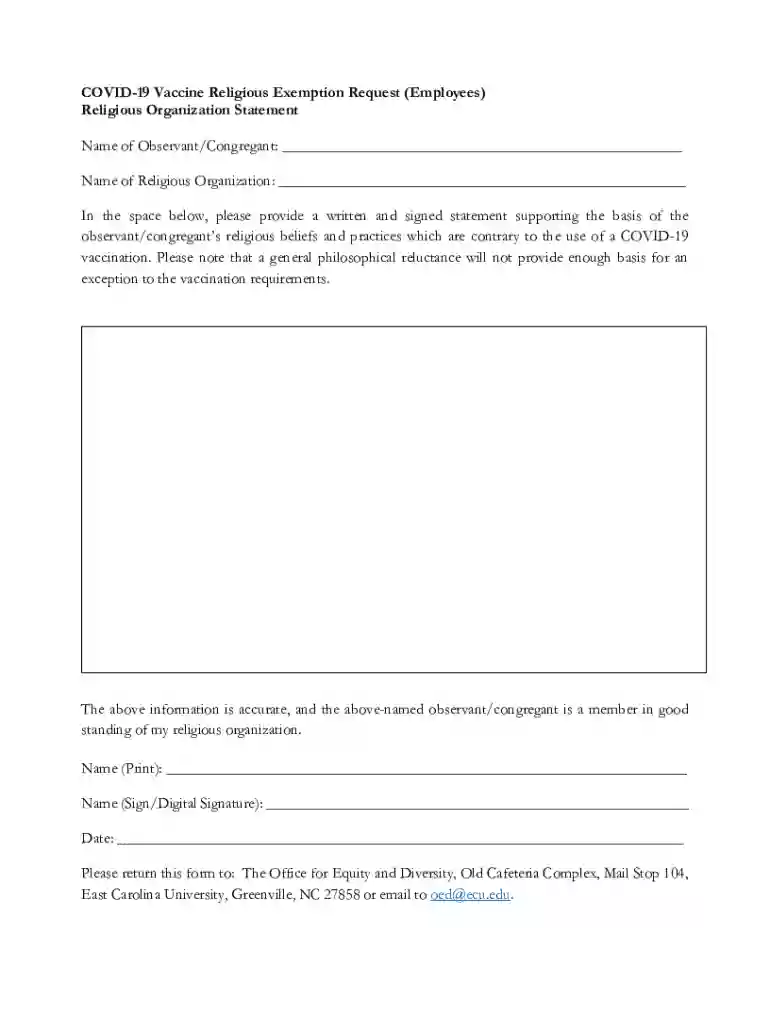
COVID-19 Vaccine Religious Exemption Request (Employees) 2026

Get Form
COVID-19 Vaccine Religious Exemption Request (Employees) Preview on Page 1

Here's how it works

01. Edit your form online
Type text, add images, blackout confidential details, add comments, highlights and more.

02. Sign it in a few clicks
Draw your signature, type it, upload its image, or use your mobile device as a signature pad.

03. Share your form with others
Send it via email, link, or fax. You can also download it, export it or print it out.

Definition and Meaning

The COVID-19 Vaccine Religious Exemption Request (Employees) is a formal document used by employees to request exemption from a mandatory COVID-19 vaccination policy based on religious beliefs. This exemption acknowledges that certain individuals may have sincerely held religious beliefs that conflict with vaccination. It is important to distinguish that this exemption does not extend to philosophical or political objections. The document typically requires a declaration signed by a religious leader that affirms the individual's beliefs against receiving the COVID-19 vaccine, ensuring the claim is genuine rather than a general opposition to the vaccine.

How to Use the COVID-19 Vaccine Religious Exemption Request

To effectively use the COVID-19 Vaccine Religious Exemption Request, employees must thoroughly complete the form, providing all necessary personal details and religious affiliation information. The process generally involves:

  1. Obtaining the form from the employer's human resources department or the appropriate organizational body.
  2. Completing personal information sections accurately.
  3. Writing a detailed statement explaining the religious beliefs that prohibit vaccination.
  4. Acquiring a signed attestation from a religious leader or official representative, supporting the claim.
  5. Submitting the completed form to the designated authority for review and awaiting confirmation or further instructions.

Understanding each requirement ensures a higher likelihood of approval, especially when the religious beliefs are clearly articulated and substantiated.

Steps to Complete the COVID-19 Vaccine Religious Exemption Request

Filling out the COVID-19 Vaccine Religious Exemption Request involves several critical steps, which must be clearly understood to avoid errors:

  1. Personal Information: Fill in your full name, employee ID, department, and contact details. Ensure accuracy to facilitate identification and processing.
  2. Description of Religious Belief: Write a concise yet comprehensive explanation of your religious beliefs. Articulate why these beliefs prevent vaccination against COVID-19.
  3. Religious Organization Endorsement: Secure a written statement from a recognized religious leader within your organization. This statement should affirm your beliefs and their incompatibility with vaccination.
  4. Review and Sign: Carefully read over the completed form, ensuring all sections are filled out correctly. Sign and date the document to authenticate your request.
  5. Submission: Submit your form as per the guidelines provided by your employer – this could be through email, an online portal, or by delivering a hard copy to the HR office.

Completing all sections with due diligence is key to submitting a valid request.

Legal Use and Compliance

The religious exemption request operates within a legally sensitive framework, as it intersects employment law and rights to religious freedom. Legal compliance involves:

  • Ensuring that requests are made in good faith and not as a means to circumvent workplace health policies.
  • Employers must balance public health considerations with accommodation of sincerely held religious beliefs.
  • Documentation must be thorough to withstand potential legal scrutiny, given the burden of proof often lies with the employee.

Employers are generally obligated under U.S. law to accommodate these requests where reasonable unless granting the exemption results in undue hardship or compromises workplace safety.

Who Typically Uses the COVID-19 Vaccine Religious Exemption Request

The exemption request is predominantly used by employees in sectors with mandatory vaccination policies, including healthcare, education, and government services. This group includes:

  • Individuals with deep-rooted religious beliefs explicitly opposing vaccinations.
  • Employees whose religious customs are governed by group mandates or beliefs prohibiting medical interventions like vaccinations.
  • Workers in states or companies where vaccination is a condition of continued employment, making the need for formal exemption requests more frequent.

Awareness of industry-specific policies is essential for those seeking exemptions within these sectors.


decoration image ratings of Dochub

Key Elements of the COVID-19 Vaccine Religious Exemption Request

The request form comprises several critical sections that must be completed:

  • Employee Information: Contact and identification details of the employee requesting exemption.
  • Religious Affiliation: Details of the religious beliefs that conflict with vaccination requirements.
  • Supporting Statement: A narrative or letter from a religious leader affirming the individual's beliefs.
  • Administrative Section: Space for employer's decision and any notes or comments regarding the exemption outcome.

These components work together to provide a comprehensive overview of the request, ensuring that each submission is assessed on consistent criteria.

Important Terms Related to the COVID-19 Vaccine Religious Exemption Request

Understanding specific terminology related to the COVID-19 Vaccine Religious Exemption Request can assist in completing the document properly:

  • Sincerely Held Belief: A conviction or faith that an individual genuinely adheres to, distinguishing it from mere opinion or personal preference.
  • Undue Hardship: A legal standard determining whether accommodating an employee's request imposes significant difficulty or expense on an employer.
  • Reasonable Accommodation: Adjustments or modifications that allow employees to practice their religion without undue burden on the employer.
  • Attestation: A formal confirmation by a religious leader regarding the validity of an employee's religious claims.

Grasping these terms is crucial for fulfilling the form's requirements and comprehending the exemptive process.

Eligibility Criteria for Obtaining a Religious Exemption

The eligibility for requesting a religious exemption from the COVID-19 vaccine generally revolves around two principal criteria:

  • Demonstrating that the belief is religious in nature and sincerely held.
  • Providing verifiable evidence or documentation from a recognized religious authority or organizational doctrine.

Organizations may have specific requirements regarding what constitutes a valid claim, making it imperative for employees to check with their HR departments for precise guidelines. Compliance with these criteria increases the likelihood of an exemption being granted.

decoration image
be ready to get more

Complete this form in 5 minutes or less

Get form

Got questions?

We have answers to the most popular questions from our customers. If you can't find an answer to your question, please contact us.
Contact us
A medical condition or disability that does not allow an individual to get vaccinated against COVID-19; or. A sincerely held religious belief, practice, or observance that conflicts with an individuals ability to receive a COVID-19 vaccine.
Because the COVID Vaccination Policy conflicts with my sincerely held religious beliefs and practices or membership in a church or religious body or, with my strongly held moral or ethical beliefs of what is right and wrong, I request approval to decline COVID vaccination at this time.
It is morally wrong to receive a vaccine that used fetal cells in the development stagethe most commonly cited religious objection to the vaccines; The body is a temple that should not receive foreign or unnatural substances, and God will protect the body from sickness; and.
California removed its personal and religious exemption option in 2015. Parent/guradian must complete an online educational module to receive a non-medical exemption. Connecticut removed its religious exemption option in 2021.
Title VII of the Civil Rights Act of 1964 requires employers to make reasonable accommodations for an applicant or employee whose sincerely held religious belief, practice, or observance conflicts with a work requirement, unless providing the accommodation would create an undue hardship for the employer.

Security and compliance

At DocHub, your data security is our priority. We follow HIPAA, SOC2, GDPR, and other standards, so you can work on your documents with confidence.

Learn more
ccpa2
pci-dss
gdpr-compliance
hipaa
soc-compliance
be ready to get more

Complete this form in 5 minutes or less

Get form

People also ask

There are a number of ways that someone can prove strongly held religious beliefs that getting the vaccine would contradict. Writing a formal letter requesting exemption. Getting a close friend, family member or fellow member of the clergy to write a letter. Filling out and submitting a religious exemption request form:
Objection to vaccination was also related to: faith in divine protection and healing for Protestants, Catholics, Jewish and Muslims (10); the use of aborted fetal cells for vaccines production among Amish and Catholic communities (including during the COVID-19 outbreak when Senior Catholic leaders from the US and

Related links