Request-for-Production-of-Documents-Notice-to-Produce 2026

Get Form
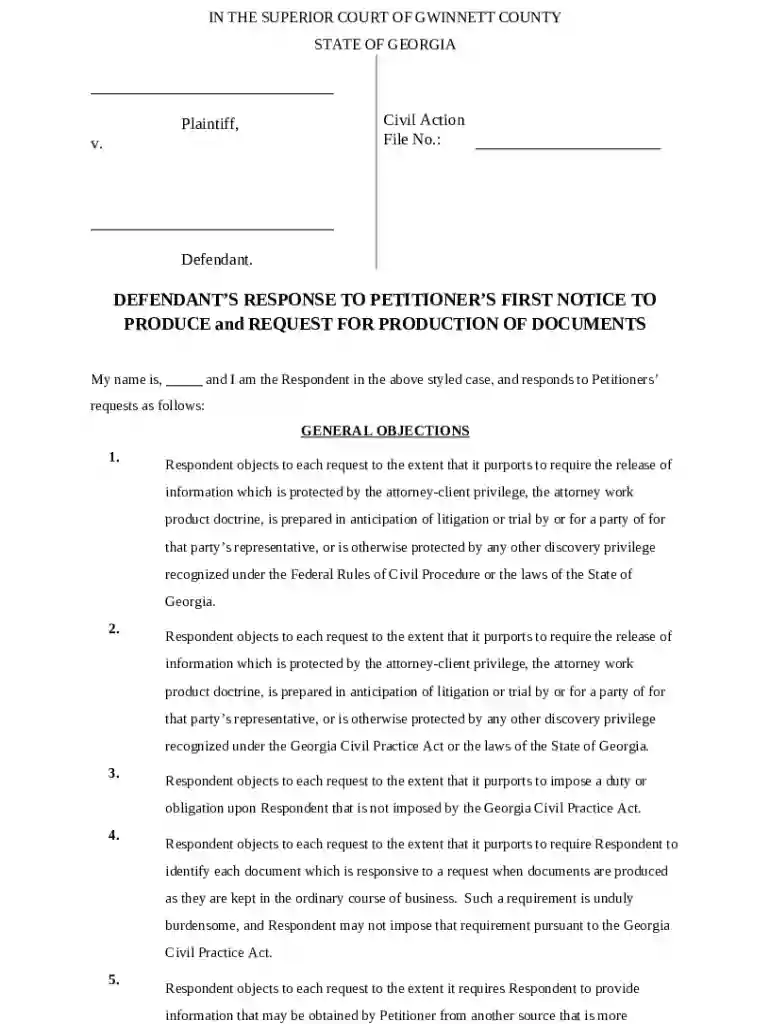
Request-for-Production-of-Documents-Notice-to-Produce Preview on Page 1

Here's how it works

01. Edit your form online
Type text, add images, blackout confidential details, add comments, highlights and more.

02. Sign it in a few clicks
Draw your signature, type it, upload its image, or use your mobile device as a signature pad.

03. Share your form with others
Send it via email, link, or fax. You can also download it, export it or print it out.

Definition & Meaning

The Request for Production of Documents, also known as a Notice to Produce, is a legal mechanism used in the discovery phase of litigation. It enables one party in a lawsuit to request specific documents from the opposing party, which are essential to the case. This tool is crucial in gathering evidence that may not otherwise be accessible. The process promotes transparency and fairness by ensuring both parties have access to relevant documents, enhancing the ability to argue their case effectively.

How to Use the Request for Production of Documents

To utilize a Request for Production of Documents, one must draft a formal request that specifies the documents needed. This request should be comprehensive, detailing each document or category of documents with precision to avoid ambiguity. After drafting, the request is served to the opposing party. It's important to adhere to court rules concerning timelines and procedures to ensure that the request is valid and enforceable. Following service, the opposing party is obliged to provide the requested documents or state a valid objection within a specified timeframe.

Steps to Complete the Request for Production of Documents

  1. Identify Required Documents: Begin by listing all documents that are relevant to your case.
  2. Draft the Request: Create a detailed request specifying each document, using clear and precise language.
  3. Serve the Opposing Party: Deliver the request to the opposing party as per the legal service requirements.
  4. Await Response: The opposing party must respond within the timeframe set by court rules.
  5. Review Documents: Once received, review the documents for completeness and relevance.
  6. Address Objections: If there are any objections, negotiate or file a motion to compel if necessary.

Key Elements of the Request for Production of Documents

  • Parties Involved: Identifying the requesting and responding parties.
  • Specific Document Descriptions: Clearly articulated categories or specific documents requested.
  • Relevance Explanation: Justification for why the documents are pertinent to the case.
  • Deadline for Response: The legal timeframe in which the party must respond to the request.
  • Certification: A statement affirming the truthfulness and necessity of the request.

Legal Use of the Request for Production of Documents

This request is primarily utilized in civil litigation within the United States. It is governed by both federal and state rules of civil procedure, which outline how and when the request can be used. Legal professionals must ensure they comply with these procedural rules to avoid challenges that could invalidate their request. These rules also provide the guidelines for addressing any objections made by the opposing party regarding the documents requested.

Important Terms Related to the Request for Production of Documents

  • Discovery: The pre-trial phase in litigation where parties exchange information pertinent to the case.
  • Document: Any tangible item, including electronic records, that can provide evidence in a case.
  • Motion to Compel: A court motion filed when one party fails to respond adequately to a discovery request.
  • Objection: A formal response indicating any issues with the request, such as irrelevance or undue burden.

Who Typically Uses the Request for Production of Documents

Attorneys representing parties in civil lawsuits are the primary users of Requests for Production of Documents. These legal professionals employ this tool to gather evidence to support their clients’ cases. It is typically used in a variety of legal settings, including contract disputes, personal injury cases, and employment litigation. Individuals who are self-representing in court may also use this tool, though it requires a high degree of legal understanding and precision.


decoration image ratings of Dochub

Examples of Using the Request for Production of Documents

A plaintiff in a personal injury case might use this request to obtain medical records and insurance documentation from the defendant. In a business litigation scenario, a corporation could request internal communications or financial statements from another company to support claims of breach of contract. These examples illustrate the utility of the request in gathering pivotal evidence necessary for case development and trial strategy.

be ready to get more

Complete this form in 5 minutes or less

Get form

Got questions?

We have answers to the most popular questions from our customers. If you can't find an answer to your question, please contact us.
Contact us
Generally, a request for production asks the responding party to make available the original documents, but a requesting party may permit photocopies of the requested documents be sent instead, if inspection of the original document is not necessary.
Rule 34(a) enables a party to produce and permit the requesting party or its representative to inspect, copy, sample, or test any designated documents or ESIincluding drawings, writings, graphs, charts, sound recordings, photographs, images, and other data or data compilations.
A notice to produce is a formal request made by one party in a civil action, asking the opposing party to provide specific documents or evidence that are in their possession for examination at trial.
Any party may serve upon any other party a written request to produce, and permit the party making the request, or someone acting on the requestors behalf, to inspect, copy, test, or sample any designated documentsincluding writings, drawings, graphs, charts, photographs, sound recordings, images, and other data or
Requests for production may be used to inspect and copy documents or tangible items held by another party. Although these requests are most commonly used to obtain copies of documents, they can also be used to test, measure, photograph, etc., any type of physical evidence in the other partys possession or control.

Security and compliance

At DocHub, your data security is our priority. We follow HIPAA, SOC2, GDPR, and other standards, so you can work on your documents with confidence.

Learn more
ccpa2
pci-dss
gdpr-compliance
hipaa
soc-compliance

People also ask

A subpoena is a legal document that commands a person or entity to testify as a witness at a specified time and place (at a deposition, trial, or other hearing), and/or to produce documents or other tangible objects in a legal proceeding. Subpoenas are time-sensitive with court-imposed deadlines.
It includes but is not limited to contracts, notes, memoranda, correspondence, diaries, desk or other calendars, statistics, letters, telegrams, minutes, business records, personal records, account statements, reports, studies, checks, receipts, bills, returns, charts, summaries, pamphlets, books, notations of any sort
A Request for Production (also known as a Demand for Inspection) asks the other side to produce and allow copying or inspection and measuring of a document or thing.

Related links