Definition & Meaning
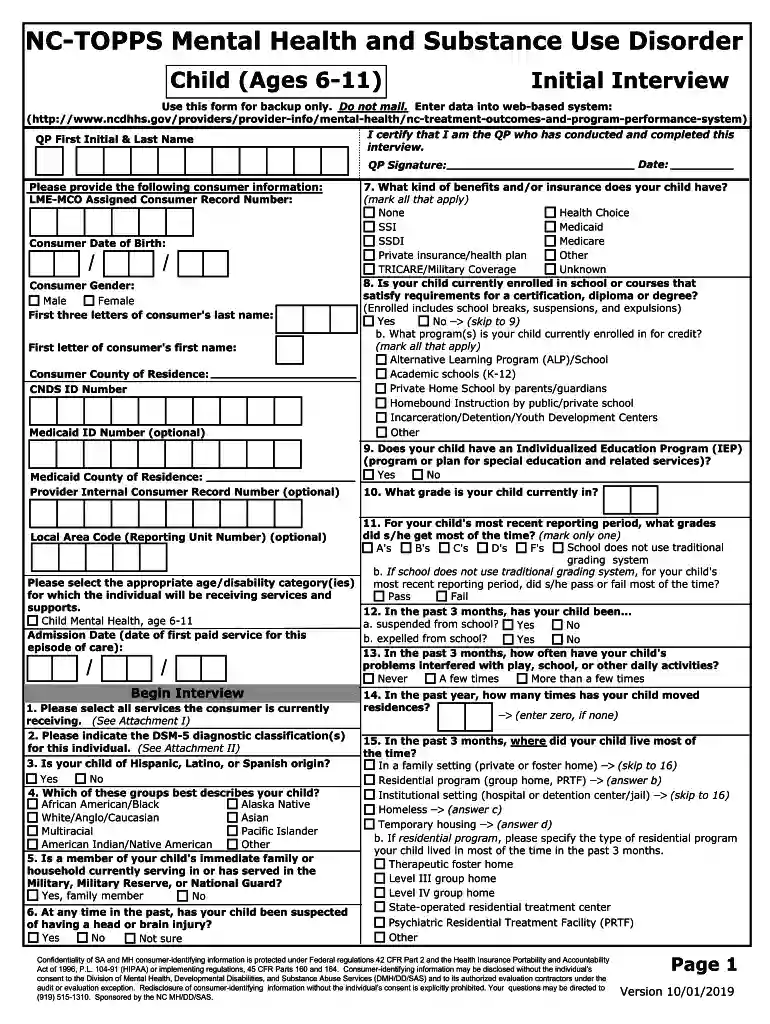
The 2019 NC-TOPPS Mental Health and Substance Use Disorder Child (Ages 6-11) Initial Interview form is designed to gather essential information about children in North Carolina who are entering mental health and substance use disorder programs. The aim of this form is to collect comprehensive data on various aspects of a child's life, including demographics, educational background, symptomology, and treatment needs. It ensures a standardized intake process that facilitates accurate service planning and provision. By emphasizing confidentiality, the form aligns with legal standards and ethical practices in mental health care.
- Purpose: Collect detailed consumer information to enhance service delivery.
- Confidentiality: Essential for protecting patient privacy and adhering to legal requirements.
- Standardization: Ensures uniform data collection for effective service planning.
How to Use the 2019 NC-TOPPS Mental Health and Substance Use Disorder Child (Ages 6-11) Initial Interview
To effectively use the 2019 NC-TOPPS form, service providers should follow specific steps to ensure comprehensive and accurate data collection:
- Prepare the Interview Environment: Ensure a quiet, private setting to protect the child's confidentiality.
- Explain the Process: Briefly describe the form's purpose and how the information will be used, assuring the child and guardian of confidentiality.
- Collect Demographic Information: Gather data such as name, age, and contact details to complete the initial sections.
- Discuss Educational and Health Background: Explore the child's educational status and any existing health records.
- Identify Mental Health Symptoms: Use specific questions to identify symptoms related to mental health and substance use.
- Assess Service Needs: Discuss and record any immediate and long-term support requirements.
Sample Interview Questions
- "Can you describe any challenges faced at school?"
- "Has the child experienced any significant changes in mood or behavior?"
Steps to Complete the 2019 NC-TOPPS Mental Health and Substance Use Disorder Child (Ages 6-11) Initial Interview
Completing the NC-TOPPS form involves several detailed steps for accuracy:
- Review the Form's Instructions: Understand the guidance provided for each section to ensure proper documentation.
- Complete Demographic Details: Enter personal information about the child and guardian with precision.
- Fill in Health History: Record any past medical or mental health conditions and previous treatments received.
- Document Current Symptoms: Use clinical accuracy to describe symptoms, behaviors, or challenges experienced by the child.
- Identify Support Systems: List any existing support networks, including family, friends, or community services.
- Final Review: Ensure the form is thoroughly reviewed for completeness and accuracy before submission.
Common Challenges
- Accurately capturing the child's symptoms
- Ensuring the family's understanding of confidentiality terms
Key Elements of the 2019 NC-TOPPS Mental Health and Substance Use Disorder Child (Ages 6-11) Initial Interview
The form includes several critical components that must be addressed:
- Demographic Information: Captures fundamental details like age and contact information.
- Educational Background: Provides context on school performance and learning challenges.
- Symptoms and Behaviors: Documents specific mental health symptoms and behaviors.
- Diagnostic Categories: Aligns symptoms with DSM-5 classifications, aiding in diagnosis.
- Service Needs: Identifies current and anticipated support requirements.
- Confidentiality Attestations: Ensures participants' understanding of privacy measures.
Documentation Tips
- Prioritize clarity in symptom description.
- Use precise language for diagnostic sections to aid evaluation.
Who Typically Uses the 2019 NC-TOPPS Mental Health and Substance Use Disorder Child (Ages 6-11) Initial Interview
This form is primarily utilized by professionals in the mental health field who engage with children aged six to eleven experiencing mental health and substance use challenges. Common users include:

- Mental Health Clinicians: Therapists and counselors performing intake assessments.
- Social Workers: Engaging with families for child protection or welfare services.
- Educators and School Counselors: Assisting in school-based support or external referrals.
Professional Scenarios
- School counselors using the form for school intervention planning.
- Clinicians preparing for initial therapy sessions.
Important Terms Related to the 2019 NC-TOPPS Mental Health and Substance Use Disorder Child (Ages 6-11) Initial Interview
Understanding key terms enhances the effectiveness of using the form:
- DSM-5: Diagnostic and Statistical Manual of Mental Disorders, Fifth Edition; used for diagnostic criteria.
- Confidentiality: Legal and ethical obligation to protect the child's information.
- Initial Interview: The first step in assessing the child's mental health and support needs.
- Service Planning: Developing a treatment or intervention plan based on assessed needs.
Key Term Examples
- DSM-5 Code: Used to classify mental health conditions, aiding in accurate diagnosis.
- Service Needs: Specify resources like therapeutic services or educational support.
Legal Use of the 2019 NC-TOPPS Mental Health and Substance Use Disorder Child (Ages 6-11) Initial Interview
Compliance with legal standards is essential when using the NC-TOPPS form:
- HIPAA Regulations: Ensures the protection of health information privacy.
- State Laws: Follow North Carolina-specific regulations for mental health documentation and service provision.
- Mandatory Reporting: Understanding obligations to report child abuse or neglect if noted during the interview.
Legal Compliance Examples
- Securely storing completed forms to protect patient information.
- Informing guardians about how their child's data will be used and shared.
Why Use the 2019 NC-TOPPS Mental Health and Substance Use Disorder Child (Ages 6-11) Initial Interview
This form offers clear benefits in clinical and educational settings due to:
- Standardization: Provides a consistent approach to evaluating child mental health and substance use.
- Comprehensive Evaluation: Enables a detailed understanding of each child's needs.
- Efficient Data Collection: Facilitates planning for individualized support based on documented information.
Benefits in Practice
- Enabling targeted interventions by identifying specific behavioral issues.
- Improving service coordination through detailed reporting of symptoms and needs.