






Definition & Meaning
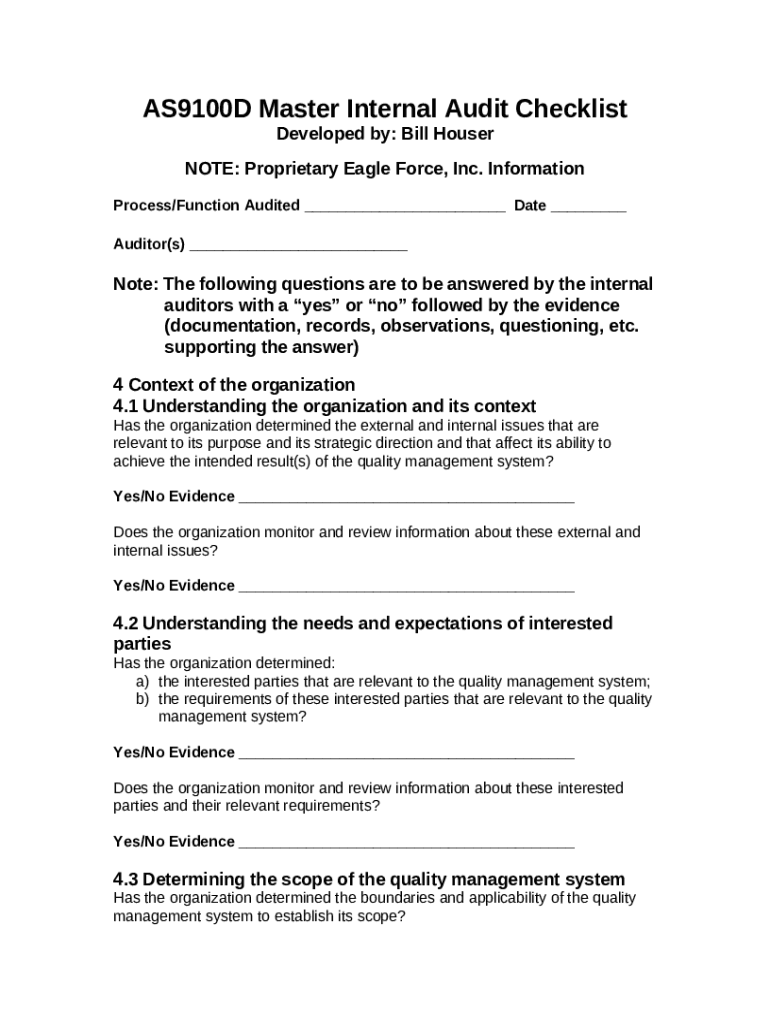
The AS9100 Rev D internal audit checklist is a fundamental component of maintaining compliance with aerospace industry standards. Designed to align with the AS9100D quality management system, the checklist serves as a structured guide for internal auditors to evaluate an organization's adherence to these standards. It includes a series of questions and checkpoints that cover critical areas such as leadership involvement, resource management and operational effectiveness. The purpose is to ensure that aerospace companies consistently meet quality and safety requirements, ultimately contributing to their ability to supply parts and services to the industry.
How to Use the Free AS9100 Rev D Internal Audit Checklist
Utilizing the AS9100 Rev D internal audit checklist involves a methodical approach to auditing different aspects of a company's operations. Users should begin by familiarizing themselves with the checklist's questions, which touch upon various elements of the AS9100D standard. Auditors typically conduct the assessment by:
- Reviewing documentation to understand existing processes and controls.
- Interviewing key personnel to gather insights into daily operations.
- Observing processes in action to validate compliance.
The checklist is versatile, accommodating both large-scale companies and smaller businesses in the aerospace sector, ensuring thorough coverage no matter the scope of the operation.
Steps to Complete the AS9100 Rev D Internal Audit Checklist
Completing the internal audit checklist is a step-by-step process intended to systematically evaluate compliance. Critical steps in the process include:
- Preparation: Identify audit objectives and scope, gather relevant documents, and assemble an audit team.
- Execution: Conduct interviews, observe operations, and record findings against each checklist item.
- Review: Compare findings with AS9100D standards, identifying any deviations or areas for improvement.
- Reporting: Document audit results, including non-conformities and recommendations for corrective actions.
- Follow-Up: Implement recommended changes and conduct subsequent audits to verify compliance improvement.
Key Elements of the AS9100 Rev D Internal Audit Checklist
The checklist comprises several key elements designed to provide comprehensive coverage of the AS9100D standards:
- Leadership and Commitment: Evaluating how leadership drives quality management initiatives.
- Risk Management: Understanding how potential risks are identified and mitigated.
- Resource Management: Reviewing the allocation and competence of resources necessary to meet quality objectives.
- Operational Control: Assessing processes in terms of planning, execution, and monitoring.
- Performance Evaluation: Measuring the effectiveness of processes and identifying opportunities for improvement.
These elements ensure the checklist captures a holistic view of the organization's compliance status.
Business Types That Benefit Most from the Checklist
The AS9100 Rev D internal audit checklist is advantageous for a diverse range of aerospace businesses, including but not limited to:
- Manufacturers of Aerospace Parts: Ensuring production processes meet stringent quality standards.
- Maintenance, Repair, and Overhaul (MRO) Facilities: Assessing compliance with maintenance protocols and safety standards.
- Aerospace Service Providers: Verifying adherence to service quality benchmarks and customer satisfaction requirements.
These business types rely heavily on maintaining high-quality standards to fulfill contractual obligations and customer expectations within the aerospace industry.
Software Compatibility
While the AS9100 Rev D internal audit checklist is traditionally paper-based, many companies have digitized this process for greater efficiency. Popular software solutions include platforms like QuickBooks and industry-specific audit management software that allow users to:
- Import checklist templates for digital assessments.
- Record and track audit findings in real-time.
- Generate reports for management review and decision-making.
These software tools streamline the auditing process, eliminating manual paperwork and enabling more precise data collection and analysis.
Legal Use of the AS9100 Rev D Internal Audit Checklist
The use of the AS9100 Rev D internal audit checklist is guided by legal standards that ensure compliance with industry regulations. Aerospace companies must conduct internal audits using standardized checklists to maintain AS9100 certification, which is often a contractual requirement for trading with aerospace sector stakeholders. Legal use involves maintaining accurate records of audit outcomes, implementing corrective actions for non-conformities, and making these records available during external audits as evidence of compliance.
Important Terms Related to the Checklist
Understanding specific terminology associated with the AS9100 Rev D checklist enhances the effectiveness of the audit:
- Non-Conformity: Any finding that deviates from the AS9100 Rev D standard requirements.
- Corrective Action: Steps taken to address and rectify non-conformities uncovered during the audit.
- Continual Improvement: An ongoing process of enhancing the quality management system to improve performance and customer satisfaction.
- Audit Trail: Documented evidence of all audit processes, findings, and actions taken, critical for future audits and compliance reviews.
These terms form the foundation of conducting a thorough and effective AS9100 Rev D internal audit.