01. Edit your form online
Type text, add images, blackout confidential details, add comments, highlights and more.

Type text, add images, blackout confidential details, add comments, highlights and more.

Draw your signature, type it, upload its image, or use your mobile device as a signature pad.

Send it via email, link, or fax. You can also download it, export it or print it out.
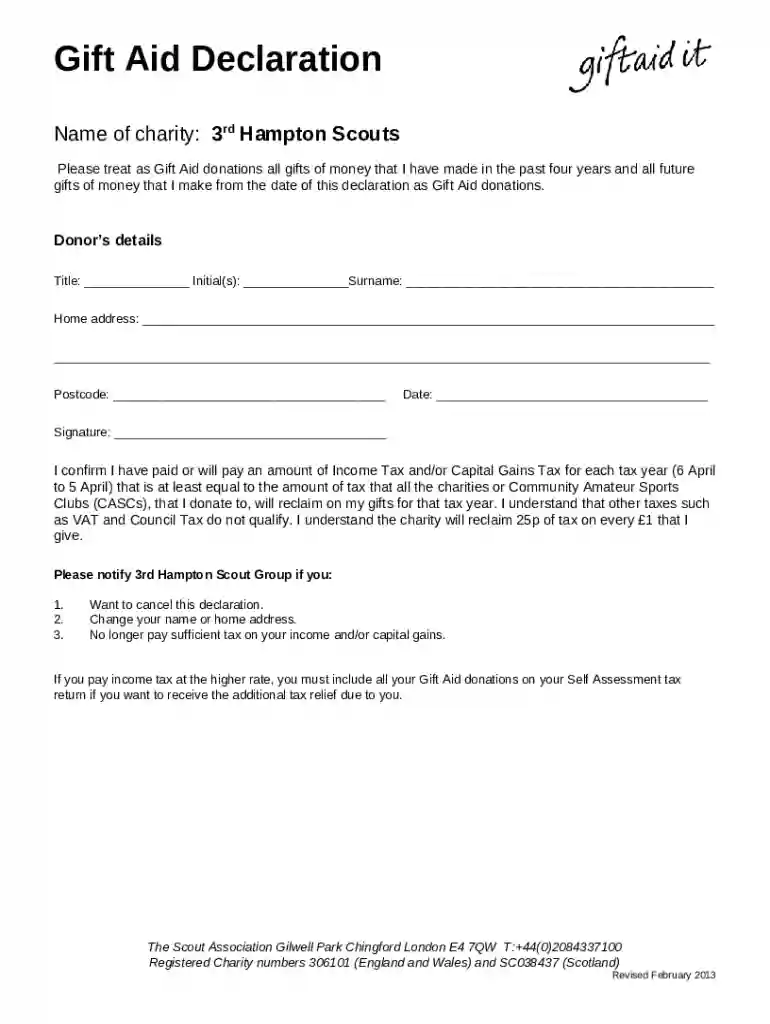
The Gift Aid Declaration form is a tool used by charities in the United Kingdom to increase the value of donations from taxpayers by claiming Gift Aid. This form allows donors to ensure their contributions are treated as Gift Aid donations, enabling charities to reclaim 25 pence for every one pound donated. The reclaim is achieved by the charity treating the donations as having already been taxed at the basic rate, thus maintaining compliance with UK tax laws. The form captures essential elements such as donor's name and address, and their taxpayer confirmation, offering charities the necessary information to claim additional funds through this government initiative.
To effectively use the Gift Aid Declaration form, charities and donors must collaborate closely. Donors fill out the form with details such as their full name, home address, and the date, confirming they are UK taxpayers and understanding the implications of their Gift Aid declaration. Once completed, the charity compiles these forms to claim the additional funds from HM Revenue and Customs (HMRC). This process not only enhances the financial support for charitable activities but also ensures legal compliance with tax regulations.
Filling out the Gift Aid Declaration form involves straightforward steps that ensure proper documentation for tax reclamation:
The form comprises several critical components ensuring legality and clarity. These elements include the donor's personal details, confirmation of taxpayer status, and consent for reclaims. This structured approach facilitates the effective reclaim of tax on donations, aligning with UK legal requirements.
The legal function of the form is integral for compliance with UK tax laws. By using this form, charities ensure they can legally reclaim tax from donations, providing an audit trail required by HMRC. Both the charity and donor must adhere to these regulations, emphasizing accuracy and taxpayer status.
The form is predominantly used by UK charities and their benefactors. It’s beneficial for those wishing to optimize their charitable contributions while offering additional support through government funds. The form sees use across numerous sectors, including religious, educational, and health charities that depend on consistent donations.


Understanding the terminology associated with Gift Aid enhances clarity when completing the form:
Consider a donor, Jane, who contributes £100 to a charity. By completing the Gift Aid Declaration form, her donation effectively becomes £125 after the charity claims the additional 25% from HMRC. This increase emphasizes the broader impact possible through thoughtful and compliant charitable practices.
Submission of the Gift Aid Declaration form can occur in multiple formats depending on the charity's capabilities and the donor's preferences:
By understanding these varied methods, donors and charities can choose the most convenient and secure option for their interactions, fostering a cooperative and supportive relationship that enhances the charitable impact.
These comprehensive explanations and practical examples ensure anyone involved with the Gift Aid Declaration form can efficiently and accurately complete, submit, and process the necessary documentation to benefit both the charity and the donor.
At DocHub, your data security is our priority. We follow HIPAA, SOC2, GDPR, and other standards, so you can work on your documents with confidence.