






Understanding the Virginia Form 500
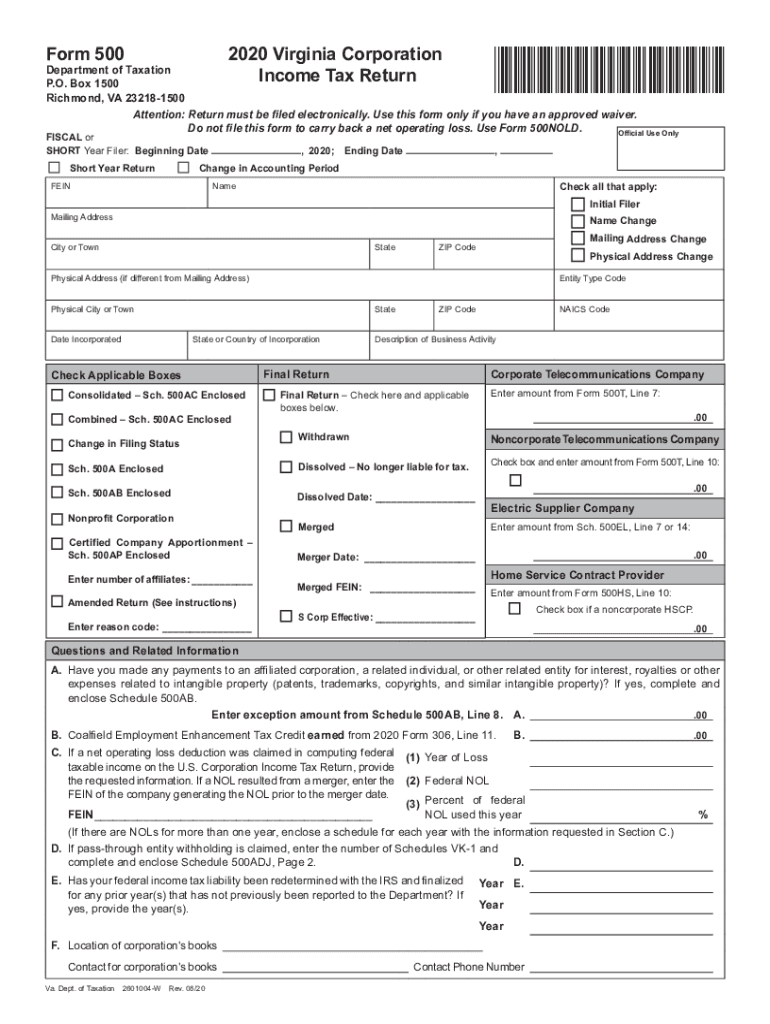
Virginia Form 500 is the official document used by corporations to report corporate income tax in Virginia. It's essential for businesses operating within the state to file this form to comply with state tax laws. The form includes various sections for reporting federal taxable income, calculating state tax adjustments, and computing the overall tax liability of the corporation.
Steps to Complete the Virginia Form 500
-
Report Federal Taxable Income: Begin by entering the federal taxable income as reported on the corporation's federal tax return. This forms the basis for calculating state-specific tax obligations.
-
Adjustments and Deductions: Carefully review state-specific adjustments that must be made to the federal income, including additions and subtractions such as state income taxes or certain interest incomes.
-
Tax Computations: Calculate the total tax owed by applying the appropriate Virginia corporate tax rate to the adjusted income. Factor in any applicable credits or pre-payments to deduce the final amount.
-
Payment and Signature: Ensure that the correct payment is made if there's a tax liability. The form must be signed by an authorized officer of the corporation to be valid.
How to Obtain the Virginia Form 500
-
Online: Corporations can download Form 500 from the official Virginia Department of Taxation website. It's available in a fillable PDF format, allowing for easy electronic completion and submission.
-
Mail: Request a paper copy through the mail by contacting the Virginia Department of Taxation directly. This is a viable option if digital access is limited.
-
Tax Preparation Software: Many tax preparation software packages, such as TurboTax or QuickBooks, will automatically include Form 500 if they are configured for Virginia state taxes.
Important Terms Related to Form 500
-
Federal Taxable Income: The income reported on a corporation's federal tax return, serving as the starting point for state tax calculations.
-
Additions and Subtractions: Adjustments made to federal income to align with state tax laws. Include items like state tax refunds or interest deductions.
-
Tax Credits: Deductions that reduce the overall tax liability, often offered for specific business activities or investments.
Legal Use of the Virginia Form 500
Filing Form 500 is a legal requirement for all corporate entities operating in Virginia. It ensures that corporations pay the correct amount of state income tax based on their earnings and is a crucial compliance tool to avoid legal penalties.
Key Elements of the Virginia Form 500
-
Affiliated Payments and Tax Credits: Sections where corporations must report transactions with affiliated entities and claim any eligible tax credits.
-
Waivers and Electronic Filing: Information about electronic filing capabilities and conditions under which a corporation might qualify for a filing waiver.
-
Corporate Status: Indicators for initial filers, mergers, or corporations in dissolution, which guide specific reporting requirements.
Filing Deadlines and Important Dates
-
Annual Filing Deadline: The Virginia Form 500 must typically be filed by the 15th day of the fourth month following the close of the corporation’s taxable year. Extensions may be available, but they do not extend the time for payment of taxes owed.
-
Estimated Payments: Corporations may be required to make quarterly estimated tax payments throughout the year if the expected tax liability meets certain thresholds.
Required Documents for Filing
-
Federal Tax Return: Necessary for accurate federal income reporting and state adjustment calculations.
-
Financial Statements: May be required to support income, deductions, and tax credit claims.
-
Affiliated Transaction Records: Documentation of any inter-company transactions that may affect taxable income.
Penalties for Non-Compliance
Failure to file Form 500 on time, or submitting incorrect or incomplete information, can lead to severe penalties. These may include fines, interest on unpaid taxes, and potential audits. It's crucial for corporations to ensure accurate and timely filing to avoid these consequences.