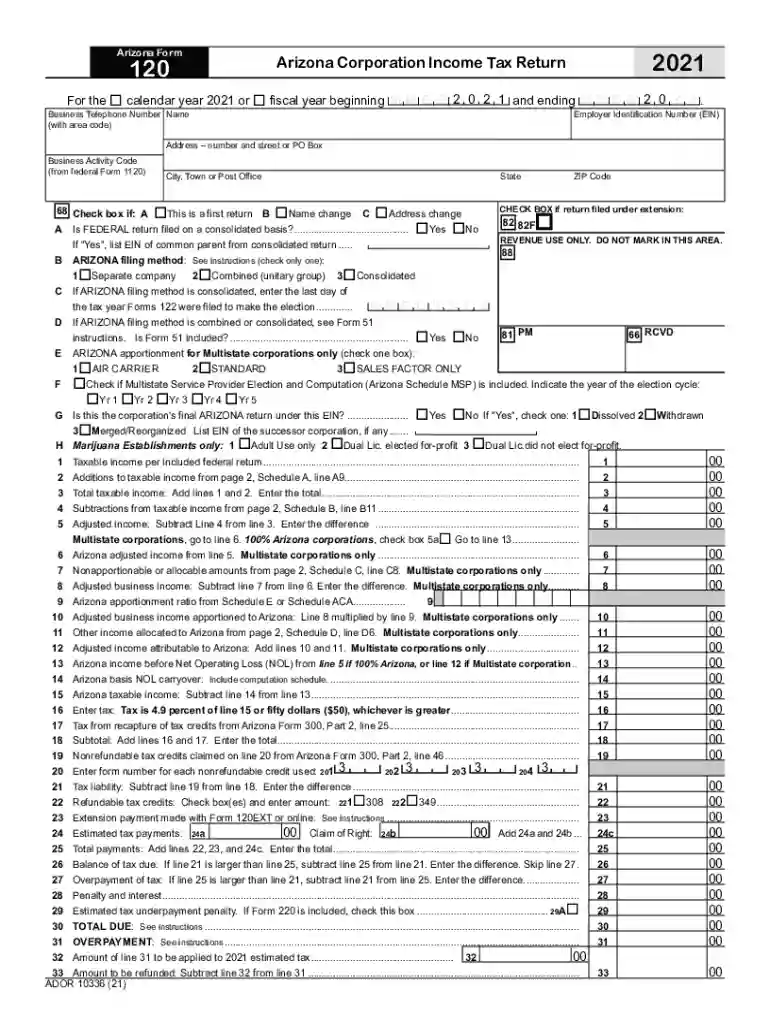
Corporate Income Tax HighlightsArizona Department of Revenue - AZDOR 2026

Get Form
Corporate Income Tax HighlightsArizona Department of Revenue - AZDOR Preview on Page 1

Here's how it works

01. Edit your form online
Type text, add images, blackout confidential details, add comments, highlights and more.

02. Sign it in a few clicks
Draw your signature, type it, upload its image, or use your mobile device as a signature pad.

03. Share your form with others
Send it via email, link, or fax. You can also download it, export it or print it out.

Definition and Meaning of Corporate Income Tax Highlights from AZDOR

Corporate Income Tax Highlights provided by the Arizona Department of Revenue (AZDOR) offers a comprehensive overview of the state tax obligations and considerations for corporate entities operating in Arizona. This information is crucial for corporations to understand the specific tax requirements they must meet in order to remain compliant with state laws. The highlights typically cover topics such as income calculations, deductions, and apportionment rules, providing clarity on how corporate taxes are assessed and expected to be filed within the state.

Components Included in the Highlights

  • Income Calculations: Guidelines on determining taxable income.
  • Deductions: Information on allowable deductions and adjustments.
  • Apportionment Rules: Details on how multi-state income is apportioned for Arizona taxes.
  • Tax Credits: Available credits that can reduce tax liabilities.
  • Filing Requirements: Specifics on forms and schedules needed for compliance.

Steps to Complete the Tax Highlights Form

Completing the Corporate Income Tax Highlights form involves a series of critical steps to ensure accuracy and compliance with Arizona state tax laws. Detailed attention is necessary to avoid errors that could result in penalties or fines.

  1. Gather Required Documentation:

    • Collect business financial statements and relevant tax documents.
    • Ensure access to previous tax returns and audit reports for reference.
  2. Calculate Adjusted Gross Income:

    • Determine your company's gross income for the reporting period.
    • Subtract allowable deductions and adjustments to arrive at adjusted gross income.
  3. Apply State Tax Credits:

    • Identify eligible tax credits applicable to your business operations in Arizona.
    • Calculate the total benefit and deduct from your income tax liability.
  4. Complete Income Apportionment:

    • Use Arizona's formulas to apportion income accurately if operating in multiple states.
    • Fill in the required schedules with specific ratios and financial data.
  5. Review and Submit the Form:

    • Double-check the form for discrepancies or missed entries.
    • Submit via your chosen submission method (online, mail, in-person).

Key Considerations

  • Ensure all figures are supported by accurate financial documentation.
  • Verify that apportionment and deductions conform to Arizona tax laws.
  • Submission deadlines must be adhered to prevent lateness penalties.

Important Terms Related to the Tax Highlights

Understanding the terminology used in the Corporate Income Tax Highlights is essential for accurate completion and compliance. These terms elucidate the process of corporate tax filing and ensure that necessary parts of the form are accurately filled.

Key Terms and Their Importance

  • Apportionment: The division of income across multiple states to determine taxable income in Arizona.
  • Adjusted Gross Income: Income calculated after deductions, forming the basis for tax liability calculations.
  • Tax Credits: Specific reductions applied to tax liabilities, often incentivizing particular business activities.
  • Deductions: Allowable expenses that can be subtracted from gross income to reduce taxable income.
  • Amendments: Adjustments made to a previously filed tax report if errors are identified post-filing.

Filing Deadlines and Important Dates

Adherence to the filing deadlines is pivotal to avoid penalties. The specific dates indicate when corporate tax returns must be submitted and any extensions to existing deadlines.

Key Deadlines

  • Annual Return Due Date: Typically on the 15th day of the fourth month following the close of the fiscal year.
  • Extension Requests: Should be filed before the original due date for a possible six-month filing delay.
  • Amendments Deadline: Must be filed within a statutory period after discovering inaccuracies in a submitted return.

Software Compatibility

For businesses using digital tools for tax preparation, ensuring compatibility with software like TurboTax or QuickBooks simplifies the process.

Compatible Software Platforms

  • TurboTax: Offers support for Arizona corporate taxes with step-by-step guidance.
  • QuickBooks: Provides tracking features for business expenses and tax preparation.
  • DocHub: Compatible for organizing, editing, and distributing tax documents digitally.

Benefits of Software Utilization

  • Streamlines calculations and form completion processes.
  • Provides tools for electronic submission, reducing the risk of errors associated with manual entry.
  • Offers audit trail and function-specific features for compliance assurance.

Taxpayer Scenarios: Common Situations

Different scenarios can affect how corporations tackle their tax obligations in Arizona. Self-employed individuals, start-ups, or long-established corporations must navigate specific aspects of the tax system.


decoration image ratings of Dochub

Example Scenarios

  • Self-Employed Entrepreneurs: Must track all income and expenses meticulously, applying appropriate deductions.
  • New Start-Ups: Need specific guidance on eligible business incentives and initial tax filings.
  • Multi-State Corporations: Require detailed apportioning of income for proper tax assessment in Arizona.

Penalties for Non-Compliance

Failure to adhere to Arizona's corporate tax requirements can lead to significant financial and legal repercussions. Understanding these penalties helps motivate compliance.

Types of Penalties

  • Late Filing Penalty: Charged for returns not filed by the deadline.
  • Accuracy-Related Penalty: Issued for significant errors in reported income or deductions.
  • Underpayment Penalty: Applies if taxes due are not paid by the deadline.

Consequences of Non-Compliance

  • Financial burden due to accrued penalties and interest charges.
  • Increased scrutiny and audits from Arizona's tax authorities.
  • Potential reputational damage for the corporation involved.

Why Understanding the Highlights Is Crucial

Comprehending the details within the Corporate Income Tax Highlights from AZDOR is not only pivotal to maintaining legal compliance but also offers financial advantages through savvy tax planning and effective filing practices. By staying informed and attentive to these highlights, corporations can optimize their tax strategy, ensure compliance, and ultimately conserve financial resources.

be ready to get more

Complete this form in 5 minutes or less

Get form

Got questions?

We have answers to the most popular questions from our customers. If you can't find an answer to your question, please contact us.
Contact us
Arizona Apportionment Methods There are three apportionment methods for multistate corporate income tax returns filed to Arizona: (1) air carrier apportionment, (2) standard apportionment, and (3) sales factor only apportionment. Air carriers are required to use revenue miles.
Customer Care Live chat representatives are available Monday through Friday from 7 a.m. to 6 p.m. (MST) to answer general questions and guidance. Email correspondence is available to make appointments, send correspondence, and questions at AZTaxHelp.
Some returns, filed electronically or on paper, may need manual review if our systems detect a possible calculation error, missing information, or there is suspected identity theft or fraud, thereby delaying the process. Some of these situations require us to correspond with taxpayers, but some do not.
Corporate Income Tax Filing Requirements Every corporation subject to the Arizona Income Tax Act of 1978 must file an Arizona corporate income tax return. A limited liability company that makes a valid federal election to be taxed as a corporation must file an Arizona corporate income tax return.
Main. Main Phone Number: 602-542-4285. Elections. Elections Services: 602-542-8683. Business Services. Business Services: 602-542-6187. Services. Address Confidentiality Program: 602-542-1653. Rules. Administrative Rules: 602-364-3223. Other. Arizona State Library, Archives Public Records: 602-926-4035.

Security and compliance

At DocHub, your data security is our priority. We follow HIPAA, SOC2, GDPR, and other standards, so you can work on your documents with confidence.

Learn more
ccpa2
pci-dss
gdpr-compliance
hipaa
soc-compliance

People also ask

Taxpayers can call (602) 255-3381, and, after making the language selection, select Option 2 for refund status. Taxpayers should have their tax information ready before calling.
Retirees living in Arizona are required to pay Arizona state income taxes on any taxable distribution from the ASRS over $2,500 per year. Retirees living in other states are not required to pay Arizona state tax and the ASRS cannot withhold for any other states income tax liability.
RANGE OF STATE CORPORATE INCOME TAX RATES STATETAX RATE (percent)NUMBER OF BRACKETS ARIZONA 4.9 (b) 1 ARKANSAS 1.0 - 5.1 5 CALIFORNIA 8.84 (b) 1 COLORADO 4.4 147 more rows

Related links