




01. Edit your form online
Type text, add images, blackout confidential details, add comments, highlights and more.

Type text, add images, blackout confidential details, add comments, highlights and more.

Draw your signature, type it, upload its image, or use your mobile device as a signature pad.

Send it via email, link, or fax. You can also download it, export it or print it out.
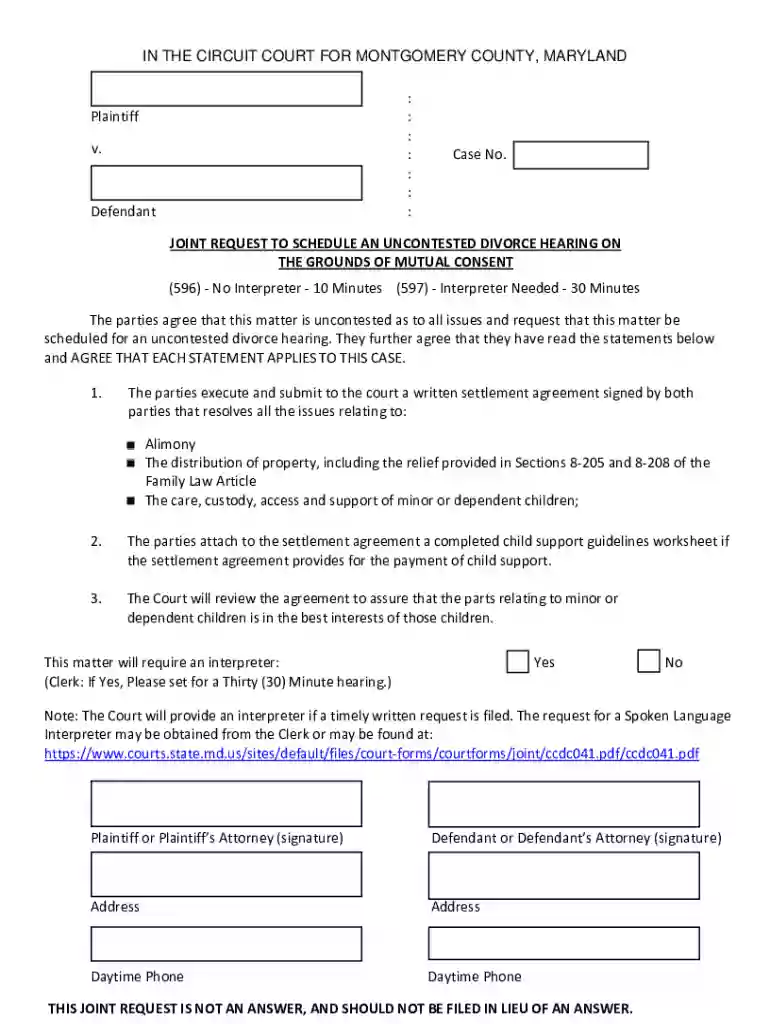
The "Joint Request to Schedule an Uncontested Divorce Hearing" is a legal document used by divorcing couples who have mutually agreed on the terms of their separation, including alimony, property distribution, and child custody/support. This form is critical for proceeding with an uncontested divorce, wherein both parties have resolved their disputes amicably outside of court. Submitting this request to the relevant court schedules a hearing that finalizes the divorce, ensuring all agreements meet legal standards and the best interests of any involved minor children. The form highlights the couple's shared decision and serves as a formal acknowledgment of their settlement.
To use the Joint Request form effectively, both parties must first reach a comprehensive mutual settlement agreement. This includes discussions and resolutions on all relevant issues such as alimony payments, property division, and child-related concerns. Once the agreement is documented, both parties sign the form, confirming their understanding and consent to the terms. It is essential to file this request with the appropriate court, typically within the jurisdiction where one of the spouses resides. After submission, the court reviews the request and schedules a hearing, where the judge verifies that the agreement is fair and legally sound.
Completing the Joint Request form involves a series of specific actions:
Gather Required Information: Both parties should prepare personal and financial information, ensuring all details align with the agreed terms.
Draft and Finalize Agreement: Collaboratively draft the settlement agreement addressing all key issues, obtaining mutual consent.
Fill Out the Form: Accurately complete each section of the form, detailing necessary information about the agreement.
Sign and Date: Both parties must sign and date the form, confirming their agreement and mutual decision.
Submit to the Court: File the request with the circuit court in the relevant jurisdiction, along with any supporting documents.
Schedule the Hearing: Await communication from the court regarding the scheduled hearing date and prepare accordingly.
The form includes several critical elements that ensure its completeness and validity:
These elements collectively ensure the form's acceptance by the court and help establish the framework for an uncontested hearing.
Legally, this form serves to signal both parties' intent to dissolve their marriage under agreed-upon conditions. By filing this request, couples demonstrate their commitment to a peaceful resolution and compliance with court prerequisites. The court uses the details within the form to schedule a hearing and verify that all agreements are fair, equitable, and adhere to the law. Additionally, the form assists the court in safeguarding the interests of any minor children involved by reviewing relevant arrangements.
Each state in the U.S. may impose different requirements regarding uncontested divorce proceedings. For example, some states require a mandatory waiting period after filing before a divorce can be finalized. Additionally, residency requirements often stipulate that at least one party must have lived in the state for a minimum duration. It's essential to consult local legal guidelines or seek advice from a legal professional to ensure compliance with state-specific rules, which can significantly influence the divorce process's timeline and procedural aspects.
When submitting the Joint Request, additional documentation may be required to confirm the details of the agreement and personal circumstances:
Providing these supplemental documents aids the court in reviewing and processing the uncontested divorce more efficiently.
The primary users of this form are couples looking to divorce amicably through the most straightforward and cost-effective legal route. It is particularly suitable for individuals who:
By completing this form, the divorcing parties demonstrate a shared resolve to dissolve the marriage amicably, ensuring that all legal criteria for an uncontested divorce are met.


We've got more versions of the Joint Request to Schedule an Uncontested Divorce Hearing form. Select the right Joint Request to Schedule an Uncontested Divorce Hearing version from the list and start editing it straight away!
At DocHub, your data security is our priority. We follow HIPAA, SOC2, GDPR, and other standards, so you can work on your documents with confidence.


